Welcome back to Hancock’s VMware Half Hour and to Part 6 of the DIY UNRAID NAS build series.
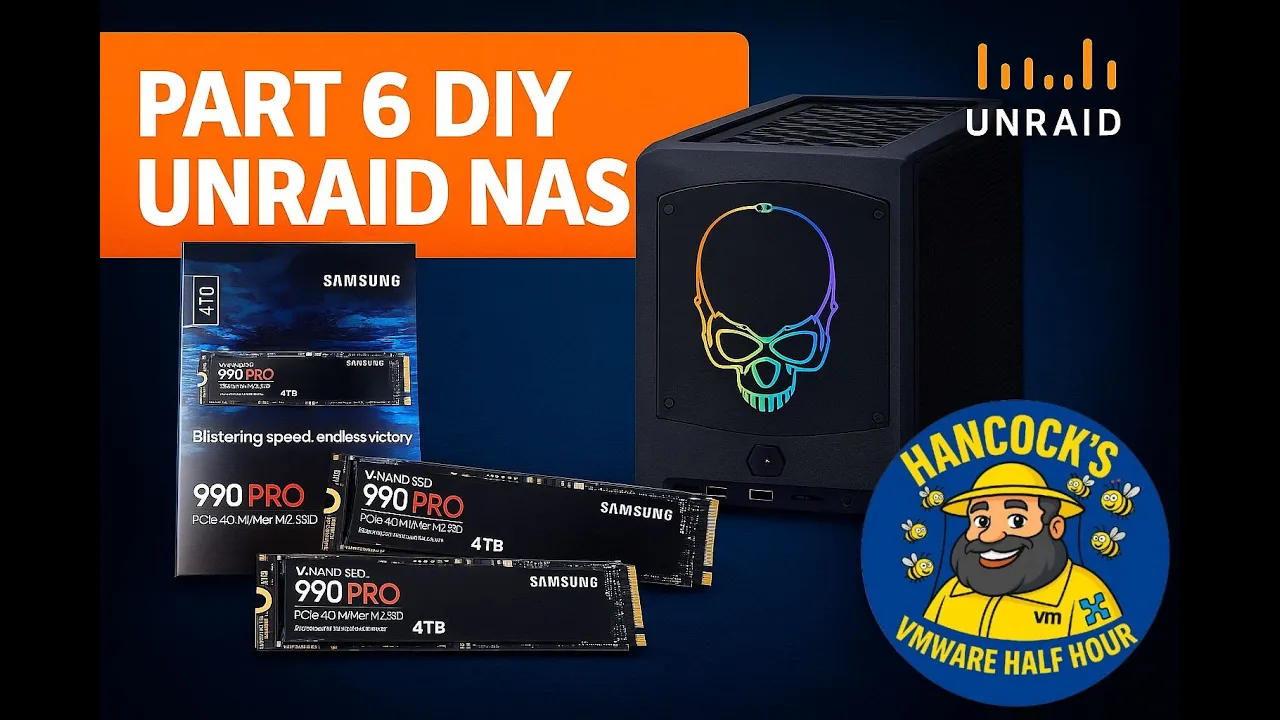
In this episode I install two Samsung 990 PRO Gen 4 NVMe M.2 SSDs into the Intel NUC 11 Extreme.
The NUC 11 Extreme has a surprisingly capable NVMe layout, providing:
2 × PCIe Gen 4 NVMe slots
2 × PCIe Gen 3 NVMe slots
The video walks through verifying the drives, opening the NUC, accessing both NVMe bays, and installing each SSD step-by-step, including the compute board NVMe slot that is a little more awkward to reach.
The episode finishes in Windows 11 where the drives are validated using Disk Manager and Samsung Magician to confirm that both NVMe SSDs are genuine.
What Is Covered in Part 6
Checking the authenticity of Samsung 990 PRO NVMe SSDs
Accessing both the bottom and compute-board NVMe slots in the Intel NUC 11 Extreme
Installing and securing each NVMe stick
Reassembling the NUC 11 Extreme, including panels, shrouds, NIC and PCIe bracket
Confirming both NVMe drives in Windows 11
Using Samsung Magician to verify that the drives are genuine
Preparing the NVMe storage for use in later parts of the UNRAID NAS series
Chapters
00:00 - Intro
00:07 - Welcome to Hancock's VMware Half Hour
00:29 - In Part 6 we are going to fit Samsung 990 PRO NVMe
01:24 - Intel NUC 11 Extreme has 2 x Gen3, 2 x Gen4 slots
01:45 - Check the NVMe are genuine
04:20 - Intel NUC 11 Extreme - open NVMe bottom panel
05:23 - Install first NVMe stick
06:33 - Remove NVMe screw
07:06 - Insert and secure NVMe stick
07:30 - Secure bottom NVMe panel cover
08:40 - Remove PCIe securing bracket
08:54 - Remove side panel
09:11 - Remove NIC
09:44 - Remove fan shroud
09:59 - Open compute board
12:23 - Installing the second NVMe stick
14:36 - Secure NVMe in slot
16:26 - Compute board secured
19:04 - Secure side panels
20:59 - Start Windows 11 and login
21:31 - Check in Disk Manager for NVMe devices
22:40 - This Windows 11 machine is the machine used in Part 100/101
22:44 - Start Disk Management to format the NVMe disks
23:43 - Start Samsung Magician to confirm genuine
25:25 - Both NVMe sticks are confirmed as genuine
25:54 - Thanks for watching
About This Build
This DIY NAS series focuses on turning the Intel NUC 11 Extreme into a compact but powerful UNRAID NAS with NVMe performance at its core.
The Samsung 990 PRO NVMe drives installed in this part will provide a significant uplift in storage performance and will feature heavily in later episodes when the NAS is tuned and benchmarked.
Support the Series
If you are enjoying the series so far, please consider supporting the channel and the content:
Like the video on YouTube
Subscribe to the channel so you do not miss future parts
Leave a comment or question with your own experiences or suggestions
Follow along for Parts 7, 8, 9 and beyond
Thank you for watching and for following the build.
Enjoy the build and stay tuned for upcoming parts where we continue configuring UNRAID and optimising the NAS.
Do not forget to like, comment and subscribe for more technical walkthroughs and builds.
Welcome back to Andysworld!*™ and to Part 5 of my DIY UNRAID NAS series.
In this instalment, I explore a small but very useful upgrade: using the free internal USB headers inside the Intel NUC Extreme 11th Gen to hide the UnRAID boot USB neatly inside the chassis. This keeps the build clean, reduces the risk of accidental removal, and makes the system feel much more like a dedicated appliance.
Why Move the UnRAID USB Inside the NUC?
UNRAID must boot from a USB flash drive. Most people leave it plugged into an external port on the back of the system, but the NUC Extreme includes internal USB 2.0 header pins.
By using those internal headers, we can:
Keep the USB drive inside the case
Free up an external USB port
Reduce the chance of accidental removal or damage
Improve the overall look and tidiness of the build
Make the system feel more like a self-contained NAS appliance
Credit and Hardware Used
This idea came from a very useful Reddit thread:
Reddit source:https://tinyurl.com/yd95mu37 Credit: Thanks to “JoshTheMoss” for highlighting the approach and the required cable.
Adapter Cable
The adapter used in this build was purchased from DeLock:
This adapter converts the internal USB header on the motherboard to a standard USB-A female connector, which is ideal for plugging in the UnRAID boot drive.
What Happens in Part 5
In this episode I:
Open up the Intel NUC Extreme 11th Gen chassis
Locate the unused internal USB header on the motherboard
Prepare the UnRAID USB stick, wrapping it in Kapton tape for additional insulation and protection
Install the DeLock internal USB adapter
Route and position the cable neatly inside the chassis
Connect the USB stick to the internal adapter (with the usual struggle of fitting fingers into a very small case)
Confirm that the system still boots correctly from the now-internal USB device
Give a short preview of what is coming next in Part 6
Video Chapters
00:00 – Intro
00:07 – Welcome to Hancock's VMware Half Hour
00:47 – Using the free internal USB headers
01:05 – Reddit Source – https://tinyurl.com/yd95mu37
01:17 – Kudos to "JoshTheMoss"
02:32 – The Reddit Post
02:44 – Purchased from – https://www.delock.com/produkt/84834/merkmale.html
02:59 – Intel NUC Extreme 11th Gen close-up
03:58 – Internal USB header left disconnected
04:36 – USB flash drive is used for UnRAID
04:49 – Wrapped USB flash drive in Kapton Tape
05:31 – Fit the cable with fat fingers
07:09 – Part 6 – NVMe Time
07:51 – 4 × 4 TB Samsung 990 PRO NVMe Gen 4
08:25 – Thanks for watching
Watch the Episode
Embedded video:
Follow the DIY UNRAID NAS Series on Andysworld!*™
This project is progressing nicely, and each part builds on the last. In Part 6, I move on to storage performance and install 4 × 4 TB Samsung 990 PRO Gen 4 NVMe SSDs for serious throughput.
If you are interested in homelab builds, UNRAID, VMware, or just general tinkering, keep an eye on the rest of the series here on Andysworld!*™.
If you’ve ever attempted a P2V migration using VMware vCenter Converter Standalone 9.0, you’ll know that the product can be as unpredictable as a British summer. One minute everything looks fine, the next minute you’re stuck at 91%, the Helper VM has thrown a wobbly, and the Estimated Time Remaining has declared itself fictional.
And yet… when it works, it really works.
This post is the follow-up to Part 100: HOW TO: P2V a Linux Ubuntu PC, where I walked through the seed conversion. In Part 101, I push things further and demonstrate how to synchronize changes — a feature newly introduced for Linux sources in Converter 9.0.
I won’t sugar-coat it: recording this episode took over 60 hours, spread across five days, with 22 hours of raw footage just to create a 32-minute usable video. Multiple conversion attempts failed, sequences broke, the change tracker stalled, and several recordings had to be completely redone. But I was determined to prove that the feature does work — and with enough perseverance, patience, and the power of video editing, the final demonstration shows a successful, validated P2V Sync Changes workflow.
Why Sync Changes Matters
Traditionally, a P2V conversion requires a maintenance window or downtime. After the initial seed conversion, any new data written to the source must be copied over manually, or the source must be frozen until cutover.
Converter 9.0 introduces a long-requested feature for Linux environments:
Synchronize Changes
This allows you to:
Perform an initial seed P2V conversion
Keep the source machine running
Replicate only the delta changes
Validate the final migration before cutover
It’s not quite Continuous Replication, but it’s closer than we’ve ever had from VMware’s free tooling.
Behind the Scenes: The Reality of Converter 9.0
Converter 9.0 is still fairly new, and “quirky” is an understatement.
Some observations from extensive hands-on testing:
The Helper VM can misbehave, especially around networking
At 91%, the Linux change tracker often stalls
The job status can report errors even though the sync completes
Estimated Time Remaining is not to be trusted
Each sync job creates a snapshot on the destination VM
Converter uses rsync under the hood for Linux sync
Despite all this, syncing does work — it’s just not a single-click process.
Step-by-Step Overview
Here’s the condensed version of the procedure shown in the video:
Start a seed conversion (see Part 100).
Once complete, use SSH on the source to prepare a 10GB test file for replication testing.
Run an MD5 checksum on the source file.
Select Synchronize Changes in Converter.
Let the sync job run — and don’t panic at the 91% pause.
Review any warnings or errors.
Perform a final synchronization before cutover.
Power off the source, power on the destination VM.
Verify the replicated file using MD5 checksum on the destination.
Celebrate when the checksums match — Q.E.D!
Proof of Success
In the final verification during filming:
A 10GB file was replicated
Both source and destination MD5 checksums matched
The Linux VM booted cleanly
Snapshot consolidation completed properly
Despite five days of interruptions, failed jobs, and recording challenges, the outcome was a successful, consistent P2V migration using Sync Changes.
Watch the Full Video (Part 101)
If you want to see the whole process — the setup, the problems, the explanations, the rsync behaviour, and the final success — the full video is now live on my YouTube channel:
This video was one of the most challenging pieces of content I’ve created. But the end result is something I’m genuinely proud of — a real-world demonstration of a feature that many administrators will rely on during migrations, especially in environments where downtime is limited.
Converter 9.0 may still have rough edges, but with patience, persistence, and a bit of luck, it delivers.
Thanks for reading — and as always, thank you for supporting Andysworld! Don’t forget to like, share, or comment if you found this useful.
DIY UnRAID NAS Build – Part 4: Installing a 10GBe Intel X710-DA NIC (Plus an Outtake!)
Welcome back to another instalment of my DIY UnRAID NAS Build series.
If you have been following along, you will know this project is built around an Intel NUC chassis that I have been carefully (and repeatedly!) taking apart to transform into a compact but powerful UnRAID server.
In Part 4, we move on to a major upgrade: installing a 10GBe Intel X710-DA network interface card. And yes, the eagle-eyed among you will notice something unusual at the beginning of the video, because this episode starts with a blooper. I left it in for your entertainment.
A Fun Outtake to Start With
Right from the intro, things get a little chaotic. There is also a mysterious soundtrack playing, and I still do not know where it came from.
If you can identify it, feel free to drop a comment on the video.
Tearing Down the Intel NUC Again
To install the X710-DA NIC, the NUC requires almost complete disassembly:
Remove the back plate
Remove the backplane retainer
Take off the side panels
Open the case
Remove the blanking plate
Prepare the internal slot area
This NUC has become surprisingly modular after taking it apart so many times, but it still puts up a fight occasionally.
Installing the Intel X710-DA 10GBe NIC
Once the case is stripped down, the NIC finally slides into place. It is a tight fit, but the X710-DA is a superb card for a NAS build:
Dual SFP+ ports
Excellent driver support
Great performance in VMware, Linux, and Windows
Ideal for high-speed file transfers and VM workloads
If you are building a NAS that needs to move data quickly between systems, this NIC is a great option.
Reassembly
Next, everything goes back together:
Side panels reinstalled
Back plate fitted
Case secured
System ready for testing
You would think after doing this several times I would be quicker at it, but the NUC still has a few surprises waiting.
Booting into Windows 11 and Driver Issues
Once everything is reassembled, the NUC boots into Windows 11, and immediately there is a warning:
Intel X710-DA: Not Present
Device Manager confirms it. Windows detects that something is installed, but it does not know what it is.
Time to visit the Intel website, download the correct driver bundle, extract it, and install the drivers manually.
After a reboot, success. The NIC appears correctly and is fully functional.
Why 10GBe
For UnRAID, 10GBe significantly improves:
VM migrations
iSCSI and NFS performance
File transfers
Backup times
SMB throughput for Windows and macOS clients
It also future-proofs the NAS for any future network upgrades.
The Mystery Soundtrack
Towards the end of the video I ask again: what is the music playing in the background?
I genuinely have no idea, so if you recognise it, please leave a comment on the video.
Watch the Episode
You can watch the full episode, including all teardown steps, NIC installation, Windows troubleshooting, and the blooper, here:
Thank You for Watching and Reading
Thank you for following along with this NAS build.
Part 5 will continue the series, so stay tuned.
If you have built your own UnRAID NAS or have a favourite NIC for homelab projects, feel free to comment and share your experience.
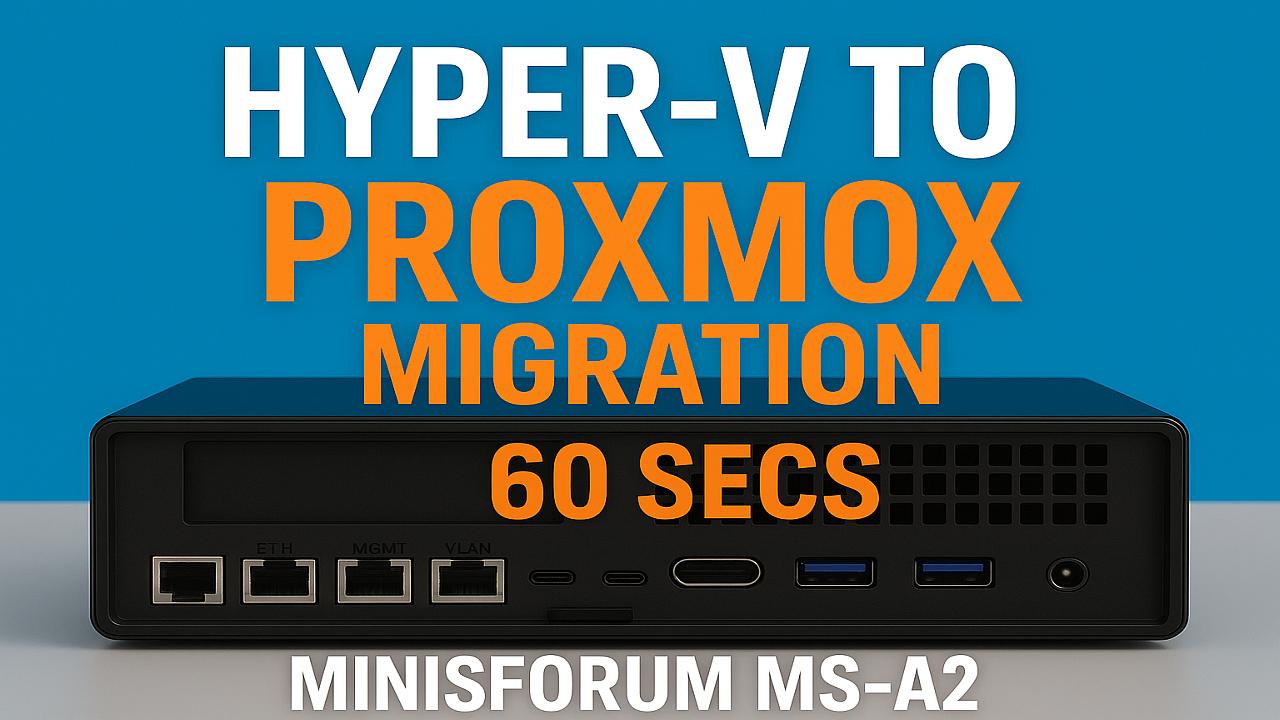
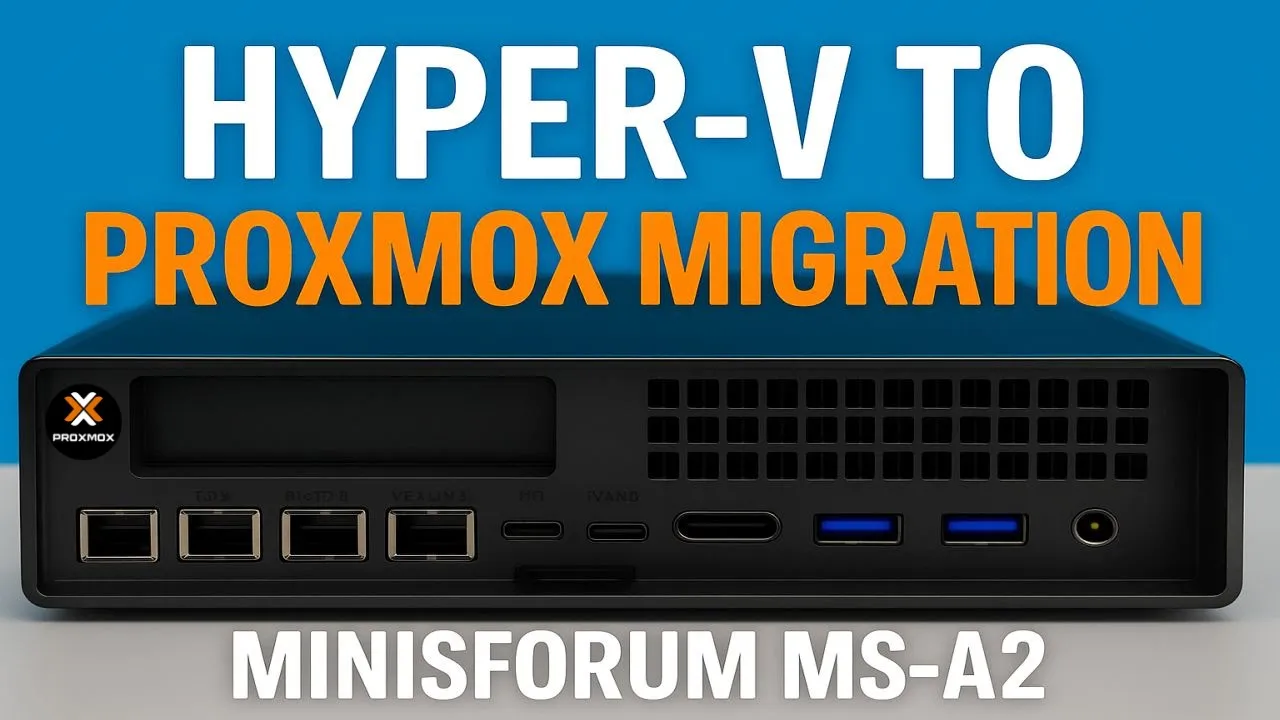
Minisforum MS-A2 Hyper-V to Proxmox 9.0 Migration Minisforum MS-A2 Series Part 15 Ultimate #homelab
In this episode of Hancock’s VMware Half Hour, I walk you through migrating Hyper-V virtual machines to Proxmox 9.0 on the Minisforum MS-A2.
We’ll cover connecting to the Proxmox server via SSH, exploring datastores, working with VHDX files, and running migration demos—including moving a full VM in under 60 seconds! This step-by-step guide shows how easy it is to transition workloads from Hyper-V into Proxmox for your #homelab or production environment.
Whether you’re testing, learning, or planning a migration, this video gives you the tools and knowledge to make it happen smoothly.
Scripts are here on GitHub – https://github.com/einsteinagogo/Hyper-VtoProxmoxMigration.git
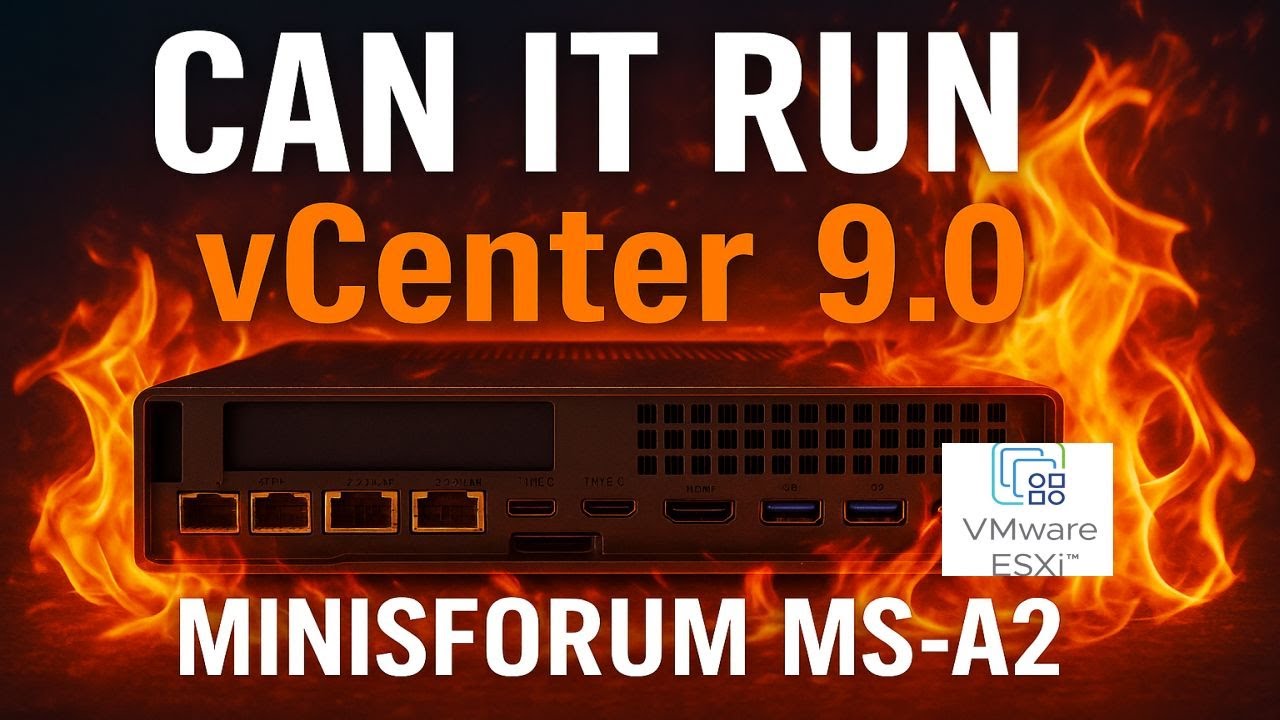
Welcome to Hancock’s VMware Half Hour! In this episode of the Minisforum MS-A2 Series – Part 12 Ultimate #homelab, we take the compact but powerful MS-A2 and push it to the limits by installing VMware vCenter Server 9.0 on ESXi 9.
From installation to configuration and performance benchmarks, I’ll walk you through every step — including DNS setup, deployment options, datastore selection, and SSO configuration. We’ll also run boot speed benchmarks to see just how fast vCenter Server 9.0 can run on the MS-A2. Spoiler: it’s blazing fast! ? It’s on FIRE !
If you’re thinking of building a small, efficient, and powerful #homelab capable of enterprise-level virtualization, this is the video for you.
Minisforum MS-A2 Can it Run ESXi 9.0.0? Minisforum MS-A2 Series Part 11 Ultimate #homelab
Can the Minisforum MS-A2 handle VMware’s latest ESXi 9.0.0?
In Part 11 of the Ultimate #homelab series, we put the MS-A2 to the test with the brand-new VMware vSphere Hypervisor ESXi 9.0. From BIOS boot to creating a demo virtual machine, you’ll see the entire installation process and whether this mini PC can run the latest VMware tech.
Can the powerful Minisforum MS-A2 run VMware vSphere 8.0?
In Part 10 of the Ultimate #homelab series, we put this compact beast to the test by installing VMware vSphere Hypervisor ESXi 8.0.3g and seeing how it performs. From BIOS setup to creating a demo virtual machine, this episode covers the full journey.
What’s Inside This Video:
Installing ESXi 8.0.3g on the Minisforum MS-A2
BIOS configuration & USB boot with Ventoy
Full ESXi setup walkthrough
Creating & running a test VM
Enabling NVMe Memory Tiering with NVMe namespaces
Checking performance and confirming a successful install
If you’ve been wondering whether the MS-A2 can handle serious VMware workloads in a home lab, this is the episode to watch!
In Part 6 of the Minisforum MS-A2 Series, we show you how to migrate VMware ESXi Virtual Machines (VMs) to Microsoft Hyper-V on Windows Server 2025 — using the powerful and compact Minisforum MS-A2 as the ultimate homelab platform.
This video features Veeam Backup & Replication v12.3 to safely back up your ESXi VMs and restore them directly to Hyper-V. It’s a clean and efficient migration method for anyone exploring life after VMware.
Whether you’re planning a full platform switch or testing a hybrid setup, you’ll find practical, step-by-step guidance from backup to restore — with key gotchas and tips throughout.
In this episode, you’ll learn:
Preparing VMware ESXi VMs for migration
Creating backups using Veeam v12.3
Restoring backups to Microsoft Hyper-V
Configuring networking, storage, and integration services
Post-migration testing and optimization
Real-world advice for homelabbers and IT professionals
Perfect for #homelab enthusiasts, sysadmins, and IT pros evaluating alternatives to VMware.
Got questions or want to share your experience? Drop a comment below!
Like this video if it helped you
Subscribe and hit the bell to follow the full MS-A2 homelab journey
Welcome back to another episode of Hancock’s VMware Half Hour! In this video, we take you step-by-step through updating the UEFI BIOS on the Minisforum MS-A2, upgrading from version 1.0.1 to 1.0.2 – all from a very hot #homelab (35°C!).
We walk through downloading the BIOS update, prepping the system (disabling Secure Boot), launching the UEFI shell, and flashing the firmware using EfiFlash.nsh. There’s even a little pop culture nod to Toto and The Wizard of Oz ??, plus a shout-out to VMware vExperts like Daniel Kreiger, William Lam, and Stephen Wagner!
Chapters Included:
Setting up the MS-A2 for flashing
Booting into the UEFI Shell
Running the flash process
Successfully installing BIOS 1.0.2
VMware vExpert tips and how to apply
Post-update validation
Whether you’re a fellow VMware homelabber or just updating your own MS-A2 device, this guide will walk you through it with humour, precision, and heat-induced delirium.
Don’t forget to Like, Subscribe and Share if this helped you out!




![[Valid RSS]](http://andysworld.org.uk/images/valid-rss.png "Validate my RSS feed")