Archive for the ‘vinyl’ Category

Dire Straits – Brothers in Arms: Forensic Analysis of the 2013 Mobile Fidelity CD Layer

Friday, September 25th, 2026

Introduction

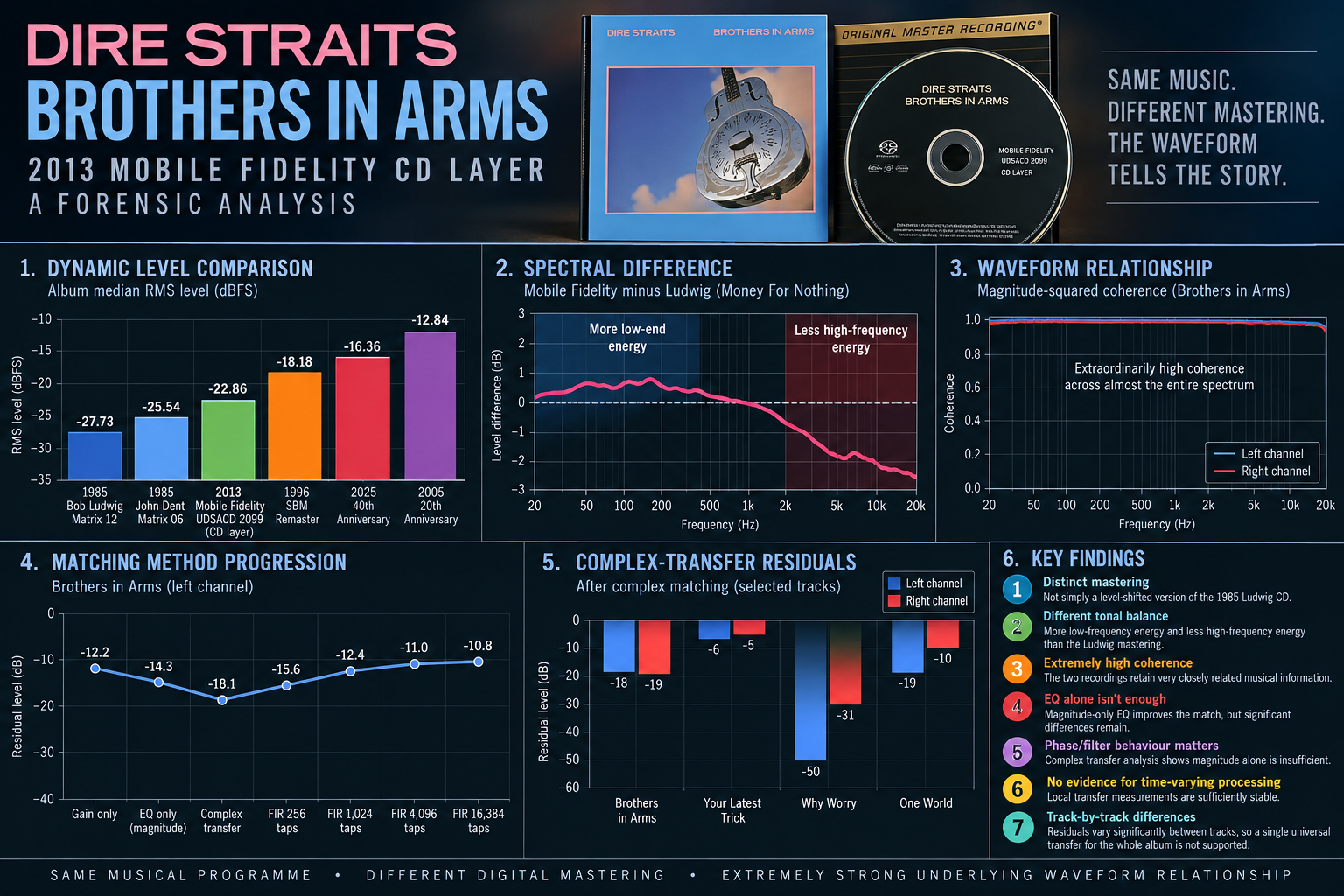
The 2013 Mobile Fidelity release of Brothers in Arms is often discussed alongside the original 1985 CD masterings, but listening alone cannot tell us exactly how the mastering relates to those earlier versions.

I therefore treated the CD layers as digital data and compared the actual PCM samples. The aim was not simply to measure loudness, but to determine how closely the Mobile Fidelity mastering is related to the 1985 programme and what processing separates the two.

The editions compared

  • 1985 John Dent — Matrix 06
  • 1985 Bob Ludwig — Matrix 12/17
  • 1996 SBM
  • 2005 20th Anniversary
  • 2013 Mobile Fidelity UDSACD 2099 — CD layer
  • 2025 40th Anniversary
Important: Matrix 12 and Matrix 17 of the 1985 Bob Ludwig mastering were found to be digitally identical after accounting for a 255-sample offset, so they represent one unique mastering for this analysis.

The Mobile Fidelity CD layer

The Mobile Fidelity UDSACD 2099 CD layer is a standard 44.1 kHz / 16-bit stereo programme. The nine tracks were extracted and verified with AccurateRip and CTDB. All nine tracks returned high-confidence AccurateRip results with no extraction errors.

The measured EAC peak levels range from 53.7% to 99.3%. More importantly, the average level is substantially higher than the 1985 masterings, while the crest factor remains much closer to the original CDs than to the later, more heavily levelled editions.

Dynamic level comparison
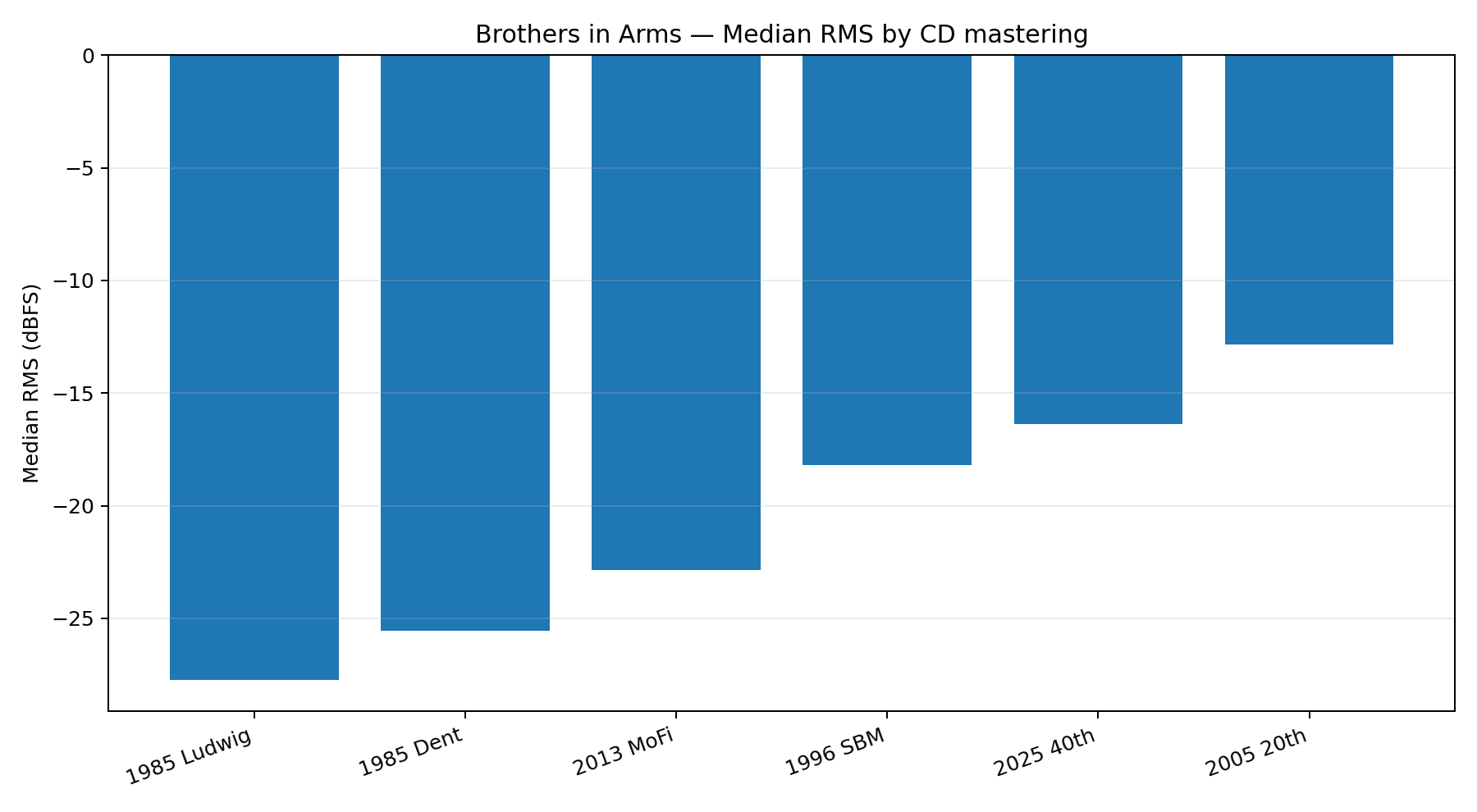
Median RMS level across the album. The 2013 Mobile Fidelity CD layer is considerably louder than the 1985 masterings, but remains substantially more dynamic than the 1996, 2005 and 2025 editions.

The album-wide median RMS figures are approximately:

Mastering Median RMS Median crest
1985 Bob Ludwig -27.73 dBFS 22.52 dB
1985 John Dent -25.54 dBFS 22.33 dB
2013 Mobile Fidelity -22.86 dBFS 21.51 dB
1996 SBM -18.18 dBFS 18.18 dB
2025 40th Anniversary -16.36 dBFS 15.36 dB
2005 20th Anniversary -12.84 dBFS 12.74 dB

Test 1 – Is the Mobile Fidelity version simply a level-shifted 1985 mastering?

No. A simple gain adjustment does not reproduce the Mobile Fidelity waveform.

For example, on Brothers in Arms, Your Latest Trick and Why Worry, aligning corresponding events and optimising the gain produces very high waveform correlations, but leaves substantial residual energy. The residuals are far above the level expected from simple 16-bit quantisation differences.

Test 2 – Spectral differences

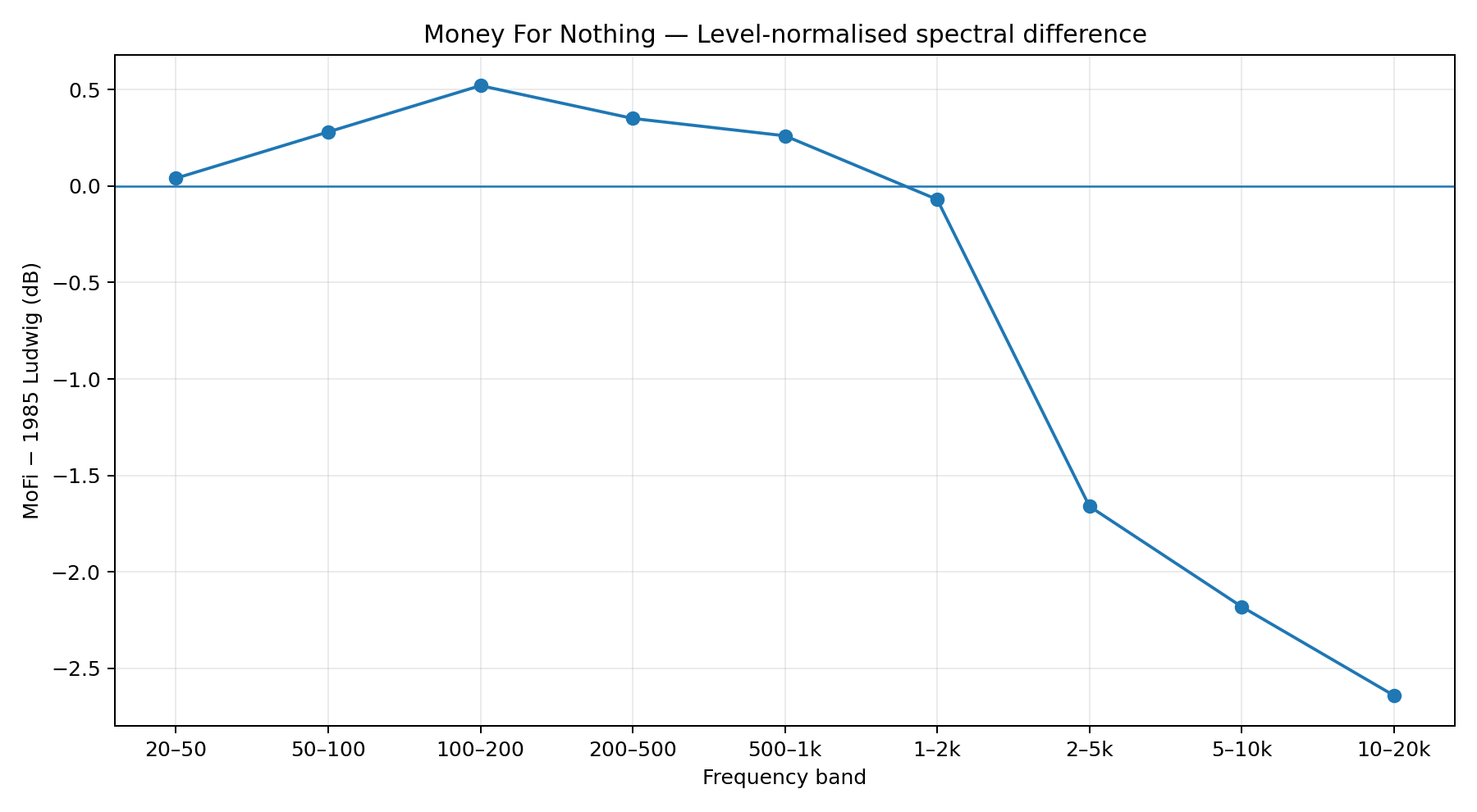
The tonal balance is also different. Money For Nothing provides a useful example. After normalising total 20 Hz–20 kHz power, the approximate Mobile Fidelity-minus-Ludwig spectral difference is:

Band Difference
20–50 Hz +0.04 dB
50–100 Hz +0.28 dB
100–200 Hz +0.52 dB
200–500 Hz +0.35 dB
500 Hz–1 kHz +0.26 dB
1–2 kHz -0.07 dB
2–5 kHz -1.66 dB
5–10 kHz -2.18 dB
10–20 kHz -2.64 dB

Approximate spectral difference after overall power normalisation: Mobile Fidelity minus 1985 Bob Ludwig, Money For Nothing.

This is not the signature of a simple digital gain change. The Mobile Fidelity version has a different frequency balance, with relatively more low-frequency energy and less upper-mid/high-frequency energy than the Ludwig reference.

Test 3 – Can magnitude-only EQ explain the difference?

Magnitude-only EQ improves the match significantly, but it does not completely explain the waveform relationship.

For example, on Brothers in Arms, the gain-only residuals were approximately -12 dB, while a magnitude-EQ correction reduced them to roughly -14 dB. The waveform correlation also increased.

That tells us that tonal balance is part of the difference, but not all of it.

Test 4 – Coherence

The most striking result is the magnitude-squared coherence between the two masterings.

  • Brothers in Arms: approximately 0.999–1.000 across essentially the entire audio band.
  • Your Latest Trick: approximately 1.000 through most of 100 Hz–20 kHz.
  • Why Worry: approximately 1.000 through most of 100 Hz–10 kHz.
  • One World: still extremely high, with the largest reduction occurring at the very top end.

This does not prove that the two CDs came from the same physical analogue tape or mastering chain. It does, however, demonstrate an exceptionally strong deterministic relationship between their waveforms.

Test 5 – Complex transfer behaviour

The next step was to allow both magnitude and phase/filter behaviour to vary rather than attempting to describe the difference with EQ alone.

After aligning the programmes, a complex transfer analysis produced very high correlations and substantially lower residuals on several tracks. The results vary by track and channel, which is important: there is no evidence here for one universal album-wide transfer function.
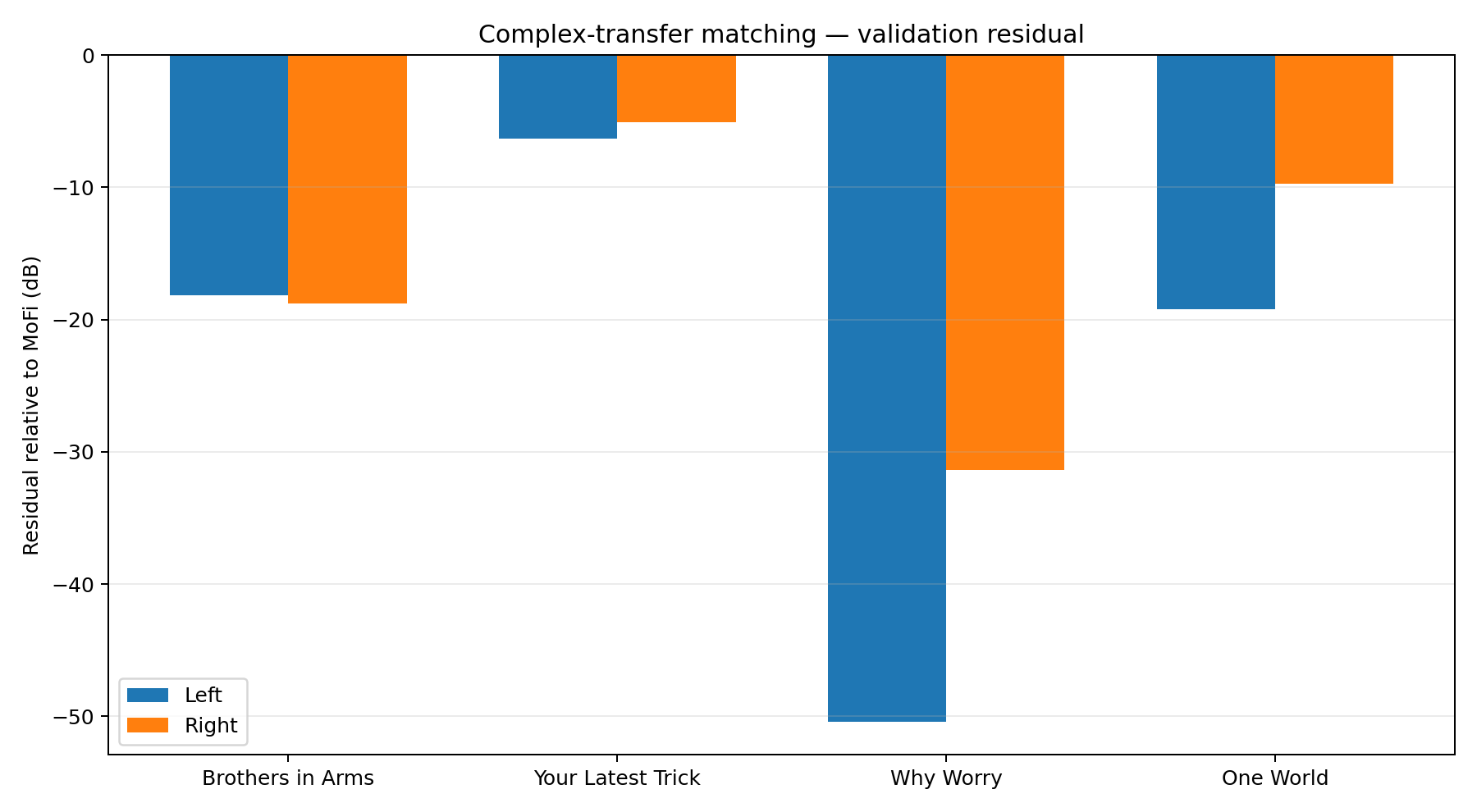
Residual levels after complex-transfer modelling for selected tracks and channels.

Test 6 – FIR filtering

Finite impulse response filtering was also tested. Increasing filter length improved the match in some cases, but the improvement eventually plateaued. This is consistent with a relationship that contains more than a simple static EQ curve, while not by itself proving a particular analogue or digital processing chain.
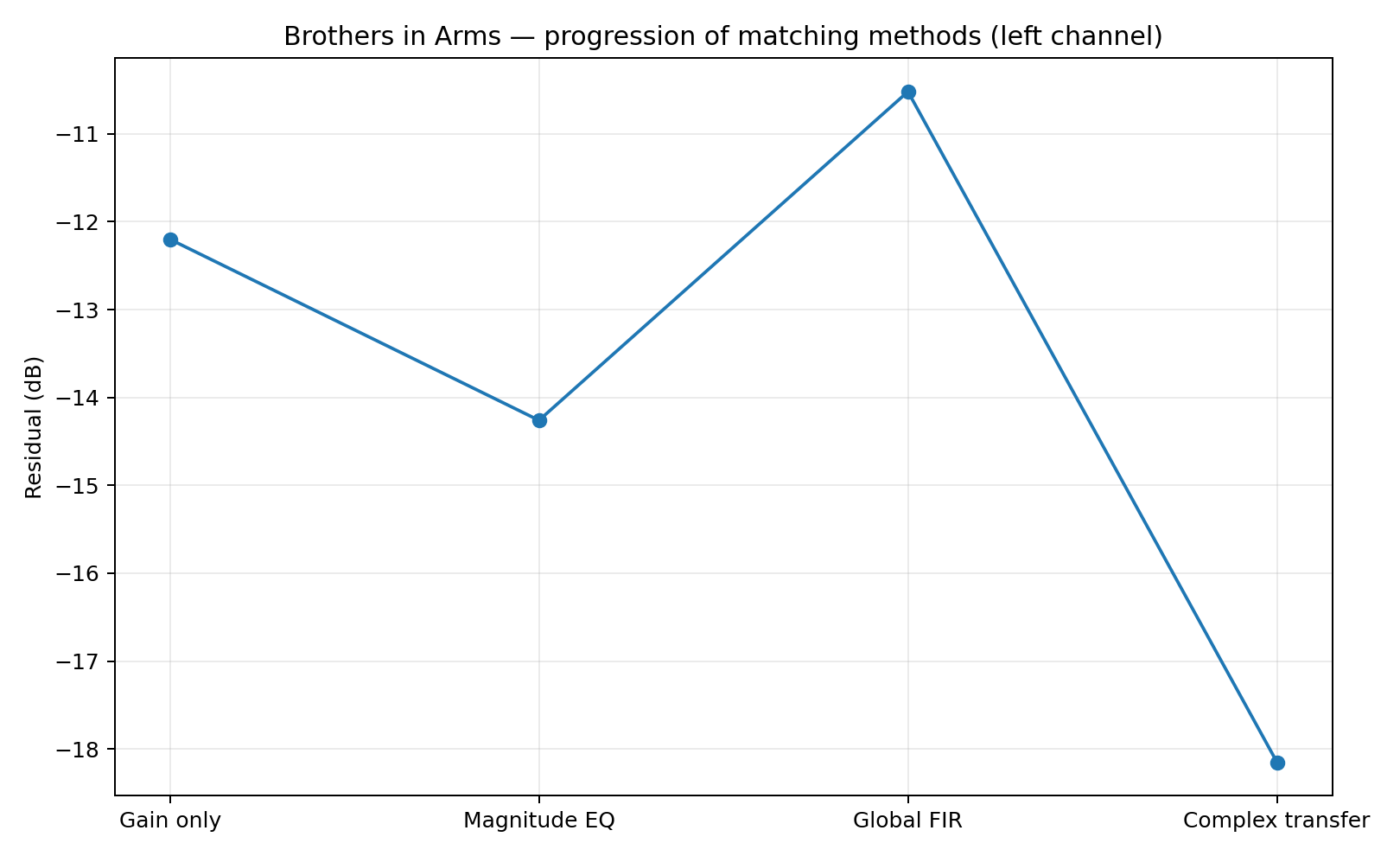
Illustrative progression of the matching methods used during the investigation. The chart is a summary of the analysis rather than a raw measurement plot.

Test 7 – Is the mastering changing over time?

An important possibility was that the Mobile Fidelity transfer might contain time-varying processing. Local transfer measurements were therefore compared at different points in the programme.

The transfer behaviour proved sufficiently stable that a claim of genuine time-varying mastering processing could not be justified from these tests. Some variation appeared in local FIR fits, but that variation was at least partly dependent on the musical content and limitations of the model.

Final complex-transfer results

The final reproducible complex-transfer validation gave the following approximate residuals:

Track Left Right
Brothers in Arms -18.15 dB -18.76 dB
Your Latest Trick -6.29 dB -5.10 dB
Why Worry -50.40 dB -31.38 dB
One World -19.19 dB -9.70 dB

The very low residual on the left channel of Why Worry is particularly interesting, with
the residual approaching the regime where quantisation and numerical effects become relevant.
However, the same cannot be said of every track, so the Mobile Fidelity mastering cannot simply
be described as a quantised copy of the Ludwig master.

Quantisation noise and the 1985 comparison

The relationship between the two 1985 masterings provides a useful control experiment. After channel reversal, gain correction and track-specific sample alignment, the John Dent and Bob Ludwig files match within approximately ±1 least-significant bit on most tracks. Their residuals are typically around -61 to -69 dB.

The Mobile Fidelity residuals are materially higher on several tracks. That is strong evidence against describing the 2013 CD layer as merely a digital level-shift or quantised copy of the 1985 Ludwig mastering.

What the analysis actually proves

  • The 2013 Mobile Fidelity CD layer is a distinct mastering.
  • It is not simply a global gain change of the 1985 Bob Ludwig mastering.
  • Its tonal balance is measurably different.
  • Magnitude-only EQ cannot fully explain the relationship.
  • The two programmes retain an exceptionally strong waveform relationship.
  • Complex transfer behaviour accounts for substantially more of the relationship than simple EQ.
  • A single universal album-wide transfer function has not been demonstrated.
  • Time-varying processing has not been demonstrated.
  • The waveform data alone cannot identify the physical analogue source tape.

What it does not prove

Digital waveform analysis cannot tell us with certainty which physical tape was used at the Mobile Fidelity mastering stage. A strong waveform relationship is evidence about the digital signals; it is not direct evidence about the provenance of the analogue source.

Likewise, these measurements do not establish the exact analogue mastering chain, converter, equaliser, compressor, limiter or other equipment that may have been used. Those conclusions would require documentation or additional independent evidence.

Conclusion

The 2013 Mobile Fidelity UDSACD 2099 CD layer is best described as a genuinely distinct digital mastering of Brothers in Arms. It is not simply the 1985 Bob Ludwig CD with its level changed.

At the same time, the forensic measurements show an unusually strong underlying relationship between the two programmes. The Mobile Fidelity version appears to preserve the same musical programme extremely closely while applying a different tonal and transfer characteristic.

That makes the 2013 CD layer particularly interesting: the differences are not adequately described by loudness alone, but neither does the evidence support treating it as an unrelated digital source.

Next stage

The next stage of the investigation is to run the same full analysis across all nine tracks and compare the transfer behaviour track by track. That should show whether the differences follow a consistent mastering pattern or whether individual tracks received materially different treatment.

Analysis by Andy Hancock. Measurements are based on the actual extracted CD-layer PCM data. Figures
labelled as summary or illustrative should not be treated as raw measurement plots.

A Journey Through Time: Marillion, Friendship, and a Chemistry Test

Thursday, October 30th, 2025

Thinking about this story, it all starts over 45 years ago. It was the early 1980s when I first noticed a poster hanging on the Sixth Form common room wall. It read:

“Marillion – Market Square Heroes – Catch Them on Tour Now!”

That poster intrigued me. At the time, I was already deep into music, but something about Marillion’s energy and storytelling grabbed me. Later, I found out that Mark Wilkinson, the brilliant illustrator and artist, designed the album covers, 12″ record covers, and picture discs for Marillion. His artwork was as mesmerizing as the music, bringing their songs to life with incredible detail.


The NUS Photo Card and University Gigs

In the 1980s, by pure chance, Progressive Rock bands often played at University College of North Wales (UCNW), now known as Bangor University.

I’m not entirely sure how it happened, but I ended up meeting a bunch of Bangor students who worked in the Student Union Office. Handing them a photograph, they were able to create me a fake NUS photo card—my golden ticket to seeing some incredible bands.

Thanks to that little stroke of luck, I got to see Pallas, IQ, Pendragon, Solstice, and Skyline Drifter, all doing the university circuit at the time.


The First Time I Heard Marillion

The next time I saw Skyline Drifter, they had changed their name to Marillion. That night was unforgettable—I heard Market Square Heroes, Three Boats Down from the Candy, The Web, and Grendel for the very first time.

Their sound was like nothing else I had experienced before, and from that moment on, I was hooked.

From then on, I could not wait for their first album, Script for a Jester’s Tear, to be released on EMI.


1983 – Script for a Jester’s Tear Hits the World

In 1983, Script for a Jester’s Tear was finally released. It was everything I had hoped for—raw emotion, intricate storytelling, and an atmosphere that was utterly unique.

Then came the single Garden Party, and to my surprise (and slight horror), Marillion appeared on Top of the Pops.

I couldn’t believe it. They had made it.

But at the time, I remember thinking, they’ve sold out! They’re not mine anymore! That underground, cult-like exclusivity I felt had suddenly evaporated.

Of course, looking back now, I realize how incredible it was that a progressive rock band managed to break into mainstream TV at all!


1984 – Fugazi and More Gigs in Liverpool

Then in 1984, Marillion released another album—Fugazi.

This meant only one thing: more gigs in Liverpool at the Royal Court! Their sound had evolved, and the atmosphere at those shows was electric.

By this point, Marillion was more than just a band I liked—they were the soundtrack to my life.


The Chemistry Test Dilemma

Fast forward to 1984, and I found myself organizing a minibus of school friends to attend a Marillion gig at the Liverpool Royal Court.

Excitement was high, but there was just one problem—we had an important Chemistry test the very next morning.

The gig was going to be incredible, but revising for the test? That would be impossible. My friend Gordan and I decided to take a chance and ask our Head of Chemistry, Dr. Emlyn Roberts, if the test date could be changed.

His response?

“Going to a concert? Education comes before seeing bands.”

He then asked which band we were planning to see.

“Marillion,” we answered.

Dr. Roberts didn’t say another word.


The Concert and the Unexpected Surprise

We went to the concert anyway, and it was absolutely worth it. However, since we lived on Anglesey, North Wales, the journey back was long, and we didn’t get home until late morning.

Sleep-deprived but still buzzing from the gig, we dragged ourselves to school and sat at our desks at 9:00 AM, waiting for the test to begin.

As the papers lay face down, Dr. Roberts walked over to me, leaned in, and simply said:

“He Knows You Know.”

Then he smiled.

I turned to my friends—we all knew exactly what he meant.

And the test? A breeze!


1985 – Misplaced Childhood and Marillion’s Biggest Hit

Then came 1985, and whispers of a new Marillion release started circulating. Not just any release—a concept album!

By this time, a new record shop had opened in Menai Bridge, and I had pre-ordered the album in advance. The excitement was unbearable.

For two weeks straight, I cycled four miles every day to the shop just to check if my pre-order had arrived.

Eventually, in 1985, Misplaced Childhood was released—a bold, immersive concept album that marked a turning point for Marillion.

Then came Kayleigh—a song that took the band to a whole new level. The single charted in the Top 40, climbing all the way to No. 2.

The only thing keeping it from reaching No. 1?

“You’ll Never Walk Alone” by the charity supergroup The Crowd.

And even today, I still meet people named Kayleigh after that massive chart hit!


1987 – Clutching at Straws & The End of an Era

By 1987, Marillion released Clutching at Straws.

It was another masterpiece, but it had a different feel. Maybe it was the themes of disillusionment, burnout, and excess, or maybe deep down, we all knew this was the end of something special.

And sure enough, it was.

This would be the last album Fish would write with Marillion. By 1988, he had left the band.


1988 – The Fork in the Road

By 1988, Fish had left Marillion, marking the end of an era. For those of us who had followed the band since the early days, it felt like a seismic shift—one that took a long time to come to terms with.

But for me, the choice was clear—I never followed Marillion again.

Instead, I chose to follow Fish’s solo career.

In 1990, Fish released his first solo album under EMI, Vigil in the Wilderness of Mirrors. It was an album that showcased his unique voice and storytelling, and I was hooked all over again.

Then, in 1991, Fish followed it up with Internal Exile, an album filled with personal reflections and Scottish identity. It was raw, powerful, and deeply personal—everything I had loved about his music from the start.


2020 – The End of a Chapter

Fast forward to 2020, and Fish had decided it was time to retire.

He had planned a farewell tour, giving fans one last chance to see him live before he stepped away from the stage for good. But then… COVID-19 happened. The tour was shut down, and the world went into lockdown.

While the tour never happened, Fish still had one final gift for his fans—his last studio album, Weltschmerz.

Released in 2020, Weltschmerz was, in my opinion, his best work. The album was a culmination of everything Fish had ever done—his storytelling, his passion, and his ability to create deep emotional connections through music. It was a fitting end to an incredible career.


A Reunion, 40 Years in the Making

Fast forward to 2020/2021, and Marillion’s music brought my old friendships back together.

I reconnected with Charlie and Ranald—friends I hadn’t seen in nearly 40 years!

Charles and I attended Marillion’s gigs in Liverpool and Leamington Spa, and Ranald joined us in Liverpool. And now, in 2025, we’ll do it all over again!


The Power of Music & a Personal Invitation

Over the last few years, thanks to Simone, I’ve been fortunate to receive Marillion’s albums.

As a token of appreciation, I’m sending a little something in return—something that might help Fish’s voice on tour. It’s great for coughs and sore throats!

And here’s an open invitation:

I live just a few miles from Fish’s sister in Pocklington, out in the Yorkshire countryside.

If Fish and Simone ever fancy a day of beekeeping, they’re more than welcome!

I’m sure I’ve got a large bee suit that’ll fit Big Lad himself! ?


And Now, 2025: At Haddington for the Final Time

Here I am, in 2025, at Haddington, watching Fish for the final time. He’s entering retirement, and it’s an emotional experience.

It feels surreal—the music, the memories, the friendships we’ve all shared over the years.

At Journey’s End, as the final notes ring out, I realize that this chapter of my life, filled with Marillion, Fish, and all the moments in between, is coming to a close.

It’s not just the end of a tour—it’s the end of an era. And it will stay with me forever.

Meltonby Honey As Seen On Fish on Friday (FoF)

Monday, September 2nd, 2024

So you probably already know, I have a following for early Marillion (81-91), and after Fish split, I’ve followed Fish Solo career, and the latest and last albums arrived last week.

So last week on Friday 30th August 2024, Meltonby Honey appeared on the show!

The video is the right way wound now, and for those wondering “He Knows You Know” is a Marillion song, one of my favorites, and it still remains a mystery how Dr Emlyin Roberts knew!

I unwrapped the long-awaited Fish album “Vigil in A Wilderness of Mirrors” “2024 REMIXED” Vinyl and CD/BLU-RAY

Friday, August 16th, 2024

fish logo

Today, my joy knew no bounds as I unwrapped the long-awaited Fish album “2024 REMIXED”, a masterpiece meticulously crafted by the exceptionally gifted Calum Malcolm. This latest offering from Fish is a true gem available in both vinyl and CD/DVD formats. The exclusive release of “Vigil in A Wilderness of Mirrors” brilliantly showcases Fish’s musical genius and Calum Malcolm’s unique artistic vision. This special edition allows fans to fully immerse themselves in the captivating world of the album through a variety of mediums, offering a diverse and enriching listening experience like no other. Whether you prefer the nostalgic crackle of vinyl or the pristine clarity of a CD/DVD, this album is sure to enthrall and fascinate listeners with its profound complexities. Don’t miss out on the opportunity to explore the intricate layers of sound and emotion expertly woven together by Fish and Calum Malcolm in this exceptional musical journey. Dive deep into their creativity and let yourself be transported to a realm of unparalleled musical beauty, where every note and rhythm tells a story that resonates deeply with the soul.

Available to exclusively order from https://fishmusic.scot/