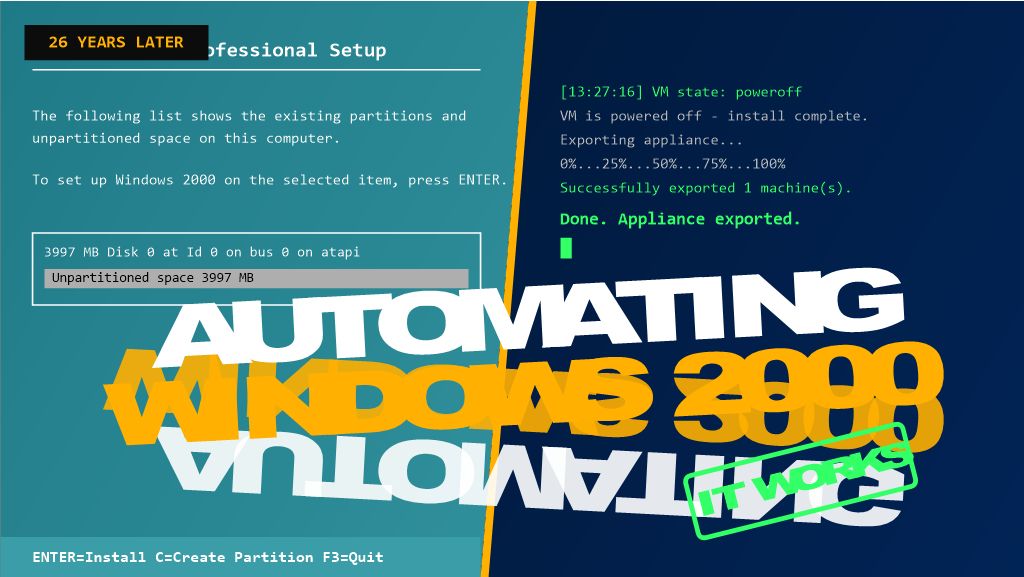
26 years after its release, Windows 2000 Professional still has a place in testing, legacy support, and retro-computing labs — but building a VM for it by hand, every single time, gets old fast. In my latest video, “HOWTO VirtualBox: How to Automate the Creation of an Appliance File,” I walk through a PowerShell script that does the whole job unattended: create the VM, install Windows 2000 Pro with zero clicking through Setup, power it off automatically, and export the finished appliance as a portable .ova file.
Here’s the write-up, including a couple of the gotchas that tripped the script up along the way.
Why Automate This?
A VirtualBox appliance file (.ova) packages a fully configured VM — OS, disk, settings, all of it — into a single portable file you can import anywhere. Building one by hand through the GUI is fine once. Needing a fresh Windows 2000 Pro VM repeatedly for a lab or test environment is a different story, and that’s where scripting the whole pipeline with VBoxManage.exe through PowerShell pays off.
The Twist With Windows 2000
Windows 2000 predates the autounattend.xml mechanism that later Windows versions use, so the assumption going in was that VBoxManage unattended install — the built-in facility that auto-generates a Windows answer file — wouldn’t support it, and that a hand-built winnt.sif + floppy would be needed instead.
Turns out that’s not the case. VBoxManage unattended install does support Windows 2000 — it builds its own answer file, auxiliary ISO, and floppy internally, no manual winnt.sif or floppy-writing tool required. That’s the route this script uses.
What the Script Does
At a high level, Deploy-Win2kProVM.ps1 handles the whole pipeline in one run:
Prompts for a VM name and cleans up any existing VM with that name.
Creates a new VirtualBox VM (Windows2000 guest type, PIIX4 IDE controller, 1 CPU — matches what this OS actually needs).
Creates and attaches a virtual hard disk.
Kicks off VBoxManage unattended install pointed at a standard Windows 2000 Pro install ISO — VBoxManage handles the answer file, auxiliary ISO, and floppy itself, and installs Guest Additions in the same pass.
Polls the VM’s state until it powers itself off.
Exports the finished VM to a .ova appliance file.
The full script is available on GitHub: [link to your GitHub repo]
Gotchas Worth Knowing About Before You Run This
A few things that came up while getting this working, in case they save you the same troubleshooting:
Flag names for unattended install are strict and easy to get wrong. It’s --key, not --product-key. It’s --user-password (or --admin-password, depending on the account type), not --password. VBoxManage errors out immediately with an “Unknown option” message if you get these wrong — worth double-checking against VBoxManage unattended install --help for your installed version.
Windows 2000 needs 1 CPU and --ioapic off. This matches a manually-built VM confirmed to install and boot reliably — modern virtual chipset defaults can trip up an OS this old.
Setup won’t shut down on its own. Without a shutdown command, the VM finishes install and just sits at the desktop, so the polling loop in the script would wait forever. The fix is VBoxManage’s own --post-install-command="shutdown -s -t 0" flag, which runs inside the guest automatically once Setup completes (via the Guest Additions execution channel — hence --install-additions needs to run first).
Downloaded scripts get blocked by Windows. If you see “not digitally signed” when running the .ps1 file, it’s the Mark of the Web from a browser download. Fix it with:
powershell
Unblock-File -Path '.\Deploy-Win2kProVM.ps1'
A genuine product key is required. There’s no way around supplying a real one in the unattended install parameters.
What You End Up With
Run the script, type a VM name, and walk away — no manual clicking through Setup, no hand-built floppy images. A few minutes later, you’ve got a fully installed, Guest-Additions-equipped Windows 2000 Professional VM exported as a ready-to-share .ova.
That exported file also becomes a reusable template — importing it for a fresh copy is far faster than rerunning the whole install.
Watch the Full Video
This post covers the highlights, but the video walks through the whole process live — including the actual errors we hit and fixed along the way. Check it out here: https://youtu.be/Nz2vhgU01qM
If you’ve automated your own VirtualBox workflows, I’d love to hear how — drop a comment on the video or below!
Lets start this by saying….As a “HiFi snob”! With lots of audio equipment!Apart from the obvious difference — one has a black spine and the other has a clear spine — what’s the difference between these two compact discs?That was the question that started this little investigation.At first glance, both CDs contain the same Fleetwood Mac album. One is an early West German Target CD and the other is the 2004 remastered and expanded edition.But are the original album tracks actually the same?Does the 2004 version simply contain the same digital master at a higher volume?Or did the mastering change?I decided to find out.
The Two CDs
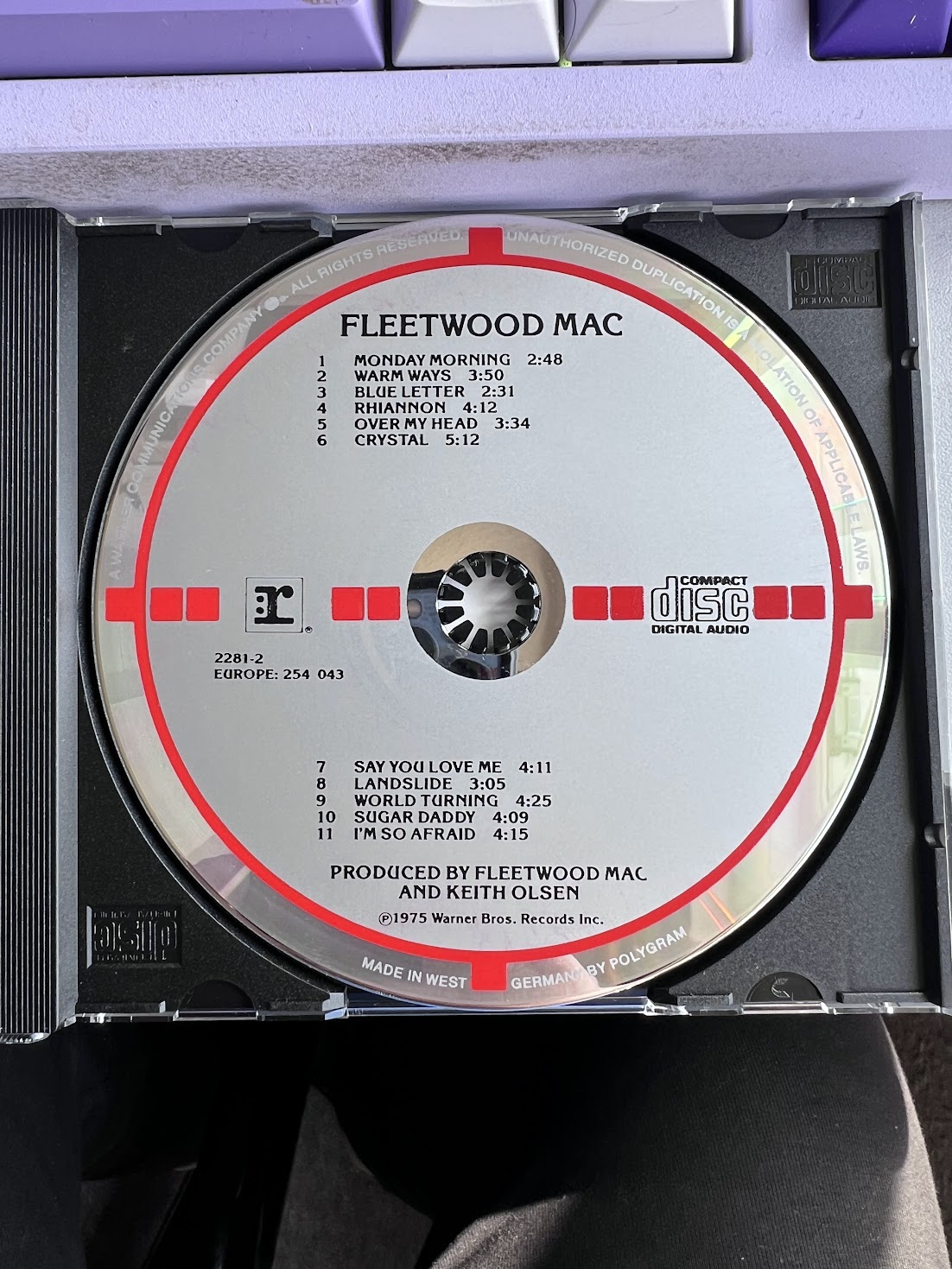
The 1994 West German Target CD
The first CD is the West German Target pressing.
The most immediately noticeable feature is the black spine, along with the distinctive Target-style disc design associated with these early CD releases.
The disc contains the original 11-track album:
Monday Morning
Warm Ways
Blue Letter
Rhiannon
Over My Head
Crystal
Say You Love Me
Landslide
World Turning
Sugar Daddy
I’m So Afraid
The disc was manufactured in West Germany and is one of the early Target-style compact discs associated with the original CD era.
There is something rather special about these early Target CDs. They belong to the first generation of commercially produced CDs and have become collectible in their own right.
But I wasn’t interested in the Target CD simply because it looks good.
I wanted to know how it sounds.
The 2004 Edition
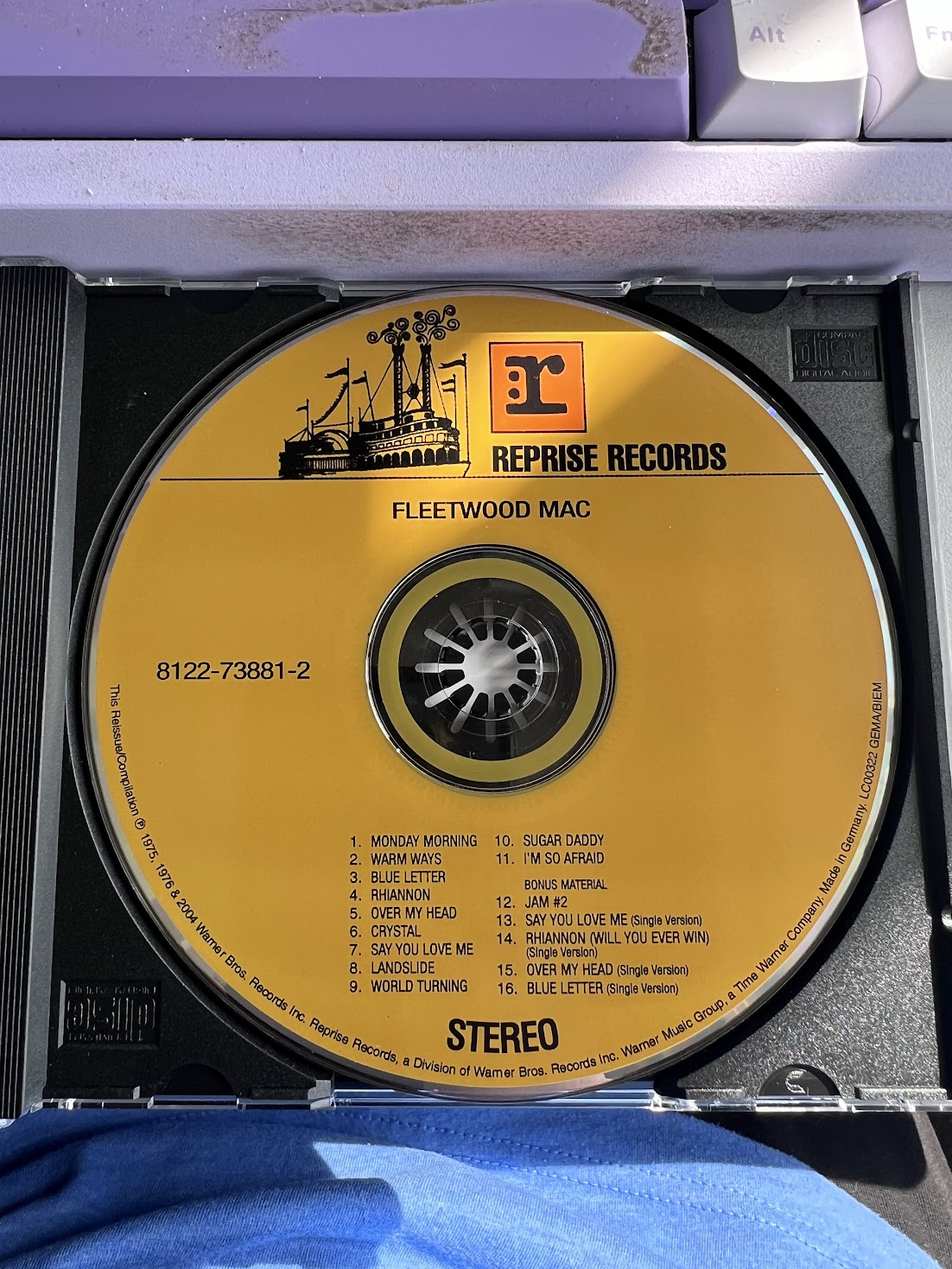
The second disc is the 2004 remastered and expanded edition.
And immediately there is another obvious physical difference.
The spine is clear rather than black.
But the differences go much further than that.
The 2004 edition contains 16 tracks, rather than the original 11.
The five additional recordings are:
Jam, No. 2
Say You Love Me
Rhiannon (Will You Ever Win)
Over My Head
Blue Letter
So before we even listen to the two CDs, we already know that the 2004 edition is more than a simple reissue.
It is an expanded and remastered edition.
But what happened to the original 11 tracks?
Let’s Rip the CDs
Rather than relying on my ears alone, I wanted to make this as objective as possible.
Both CDs were ripped using Exact Audio Copy (EAC), using secure extraction, and saved as lossless FLAC files.
The EAC results were then checked against AccurateRip and the CUETools Database.
The results were excellent.
1994 West German Target
All 11 tracks were reported as accurately ripped.
No errors occurred.
2004 Edition
All 16 tracks were also reported as accurately ripped.
No errors occurred.
The 2004 tracks had an AccurateRip confidence of 200, providing extremely strong confirmation of the extraction.
This means we weren’t comparing two recordings made from a CD player.
We were comparing the actual digital audio data extracted from the CDs.
The First Track: Monday Morning
I started with the opening track, Monday Morning.
And this is where things immediately became interesting.
The 1994 CD has a peak level of approximately:
-2.47 dBFS
The 2004 version reaches:
-0.10 dBFS
So the 2004 version is getting extremely close to digital full scale.
But peak level alone doesn’t tell the whole story.
The average level is even more revealing.
The 1994 version measures approximately –20.6 dBFS RMS.
The 2004 version measures approximately –13.2 dBFS RMS.
That’s roughly a 7.3 dB increase in average level.
In simple terms, the 2004 version is substantially louder.
But I wanted to know whether that was the whole story.
Is the 2004 Version Simply Louder?
This was the obvious question.
If the 2004 CD was simply the 1994 mastering with the volume turned up, reducing the 2004 version by the appropriate amount should make the two recordings essentially identical.
It doesn’t.
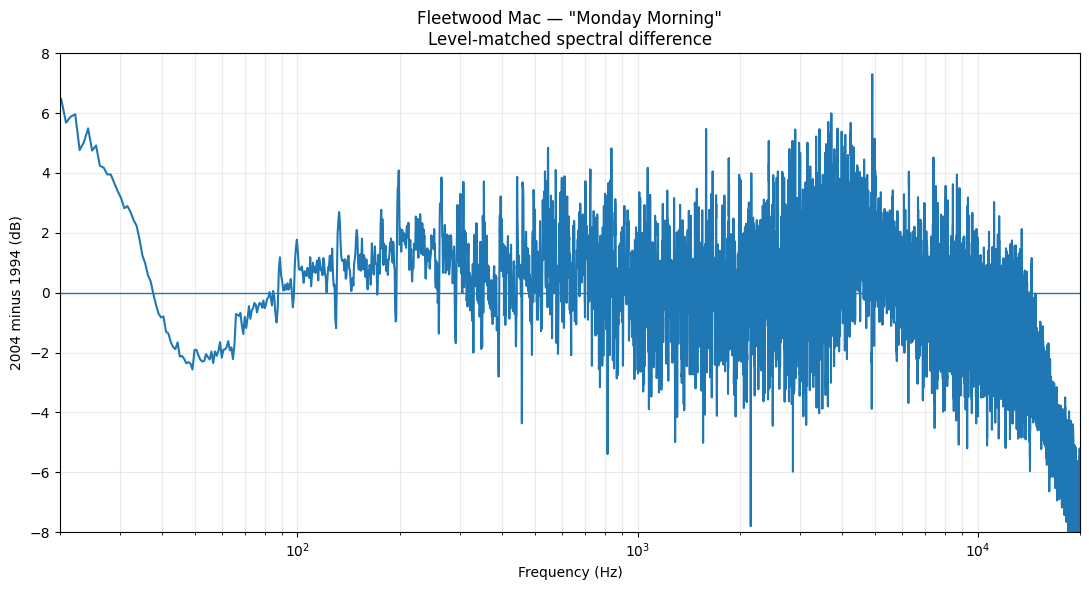
I level-matched the two versions, removing the large difference in overall volume, and then compared them again.
There were still measurable differences.
That means the 2004 version isn’t simply the 1994 master with the volume increased.
The mastering has changed.
The Dynamic Range Difference
One of the measurements we can use to examine this is crest factor — the difference between the average level of a recording and its peaks.
A higher crest factor generally means greater separation between the average level and the peaks.
For Monday Morning:
1994: approximately 17.6 dB
2004: approximately 13.1 dB
That’s a difference of approximately 4.5 dB.
And this wasn’t unique to Monday Morning.
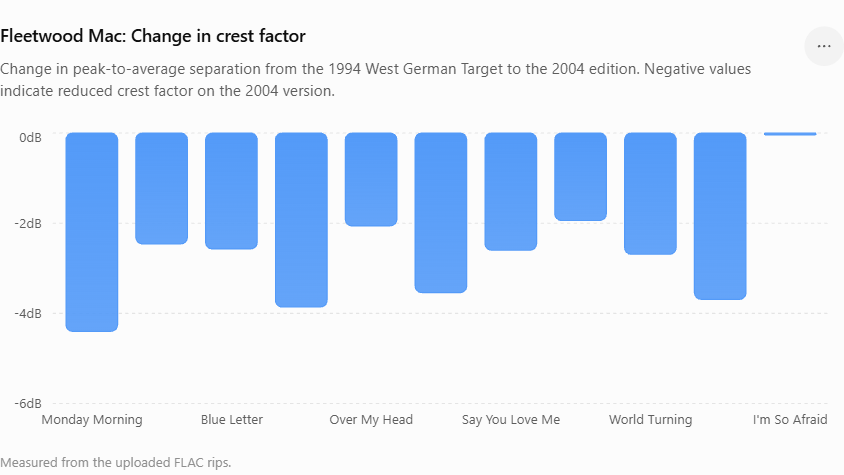
When all 11 tracks appearing on both CDs were analysed, 10 of the 11 tracks showed a reduction in crest factor on the 2004 version.
That is a significant pattern.
It tells us that the 2004 mastering has generally been made louder and denser.
It does not, by itself, mean that the CD is clipped. High peak levels and clipping are two different things.
Change in crest factor between the 1994 West German Target and 2004 editions. Negative values indicate reduced peak-to-average separation on the 2004 version.
The Whole Album Tells the Story
This is where the comparison becomes much more convincing.
Rather than looking at one song, I analysed all 11 tracks that appear on both CDs.
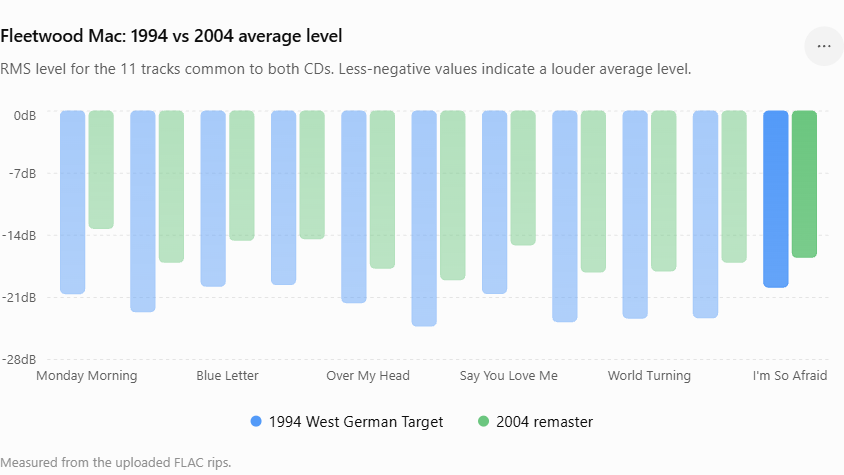
The average RMS difference across the album is approximately:
5.3 dB louder on the 2004 edition
Every single one of the 11 common tracks is louder on the 2004 CD.
The graph makes the pattern very easy to see.
The 2004 version is consistently louder across the original album.
But What About the EQ?
This was the next question.
Perhaps the 2004 mastering was simply compressed and made louder.
To test that, I removed the volume difference by level-matching the two versions.
Then I compared their frequency spectra.
And again, the results showed that the two CDs aren’t identical.
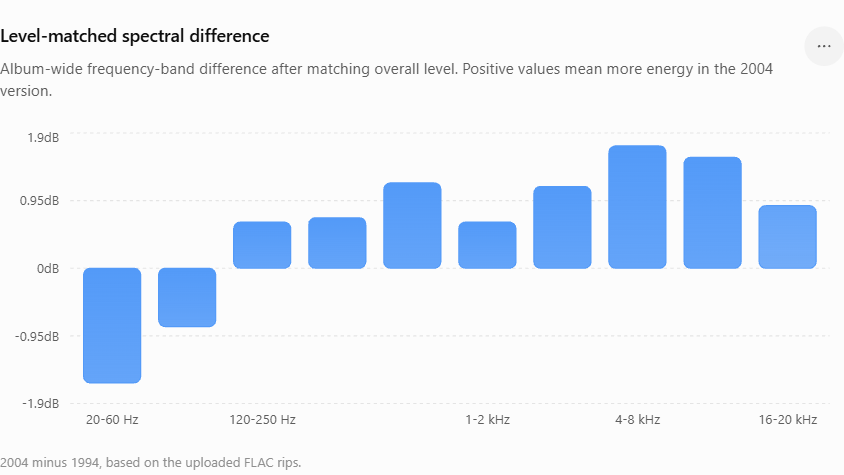
The broad album-wide differences were approximately:
Frequency range
2004 compared with 1994
20–60 Hz
-1.6 dB
60–120 Hz
-0.8 dB
120–250 Hz
+0.7 dB
250–500 Hz
+0.7 dB
500 Hz–1 kHz
+1.2 dB
1–2 kHz
+0.7 dB
2–4 kHz
+1.2 dB
4–8 kHz
+1.7 dB
8–16 kHz
+1.6 dB
16–20 kHz
+0.9 dB
The important point isn’t each individual number.
It’s the overall shape.
After the overall volume difference was removed, the 2004 mastering still showed less energy in the very lowest frequencies and more energy through much of the midrange and upper frequencies.
So the tonal balance has changed too.
A Picture Tells a Thousand Words
Put the two discs next to each other and the physical differences are immediately obvious.
The black spine and clear spine are only the beginning.
The artwork, disc design, catalogue information, packaging and track content all provide clues that these aren’t simply two identical CDs from different production runs.
But the really interesting difference is something you can’t see by looking at the discs.
It’s in the audio data.
Eleven Tracks, Same Conclusion
The strongest evidence comes from looking at all 11 tracks common to both editions.
Every track is louder on the 2004 CD.
Ten out of eleven have a lower crest factor.
The frequency analysis also shows a different tonal balance after level matching.
This means we can confidently say that the 2004 edition is not simply the 1994 mastering with the volume turned up.
There has been a change in the mastering.
And Then There Are the Five Bonus Tracks
The 2004 edition adds five additional recordings.
These aren’t relevant when comparing the mastering of the original 11 tracks, because there is no corresponding recording on the 1994 disc.
But they are still an important part of the comparison.
The 2004 CD therefore offers something the 1994 Target doesn’t:
additional material.
So Which One Is Better?
Now we get to the difficult question.
Which CD sounds better?
The measurements can tell us what changed.
They can’t tell us what you will personally prefer.
The 1994 West German Target
Lower overall mastering levels
Greater peak-to-average separation
More headroom
A different tonal balance
The original 11-track album
The 2004 Edition
A substantially higher average level
Peaks much closer to digital full scale
Reduced peak-to-average dynamics on most tracks
A different tonal balance
Five additional recordings
If you prefer a mastering with greater dynamic headroom and less aggressive level management, the 1994 Target is likely to be the more interesting choice.
If you prefer a louder, more forward presentation and want the bonus material, the 2004 edition has obvious advantages.
The Conclusion
So, what’s the difference between these two compact discs?
Quite a lot.
It started with something as simple as noticing that one had a black spine and the other had a clear spine.
But once the discs were ripped and analysed, the differences became much more substantial.
The 2004 edition isn’t simply the 1994 CD with the volume turned up.
Across all 11 tracks common to both editions, the 2004 version is approximately 5.3 dB louder on average.
Ten of the 11 tracks show reduced crest factor.
And after level-matching the recordings, there are still measurable differences in frequency balance.
In other words, these are different masterings.
The 1994 West German Target represents a much more conservatively mastered presentation, with greater peak-to-average separation.
The 2004 edition offers a louder, more forward mastering, a different tonal balance and five additional recordings.
So the answer to the question I started with is:
The difference isn’t just the spine.
The two CDs may contain the same Fleetwood Mac album, but they don’t contain exactly the same sound.
And now that we’ve got the measurements, the question becomes a much more interesting one:
Minisforum MS-A2 NVMe namespaces U.2 Samsung PM9A3 Minisforum MS-A2 Series Part 9 Ultimate #homelab
In this episode of Hancock’s VMware Half Hour, we walk through configuring NVMe namespaces on a Samsung U.2 PMA9A3 enterprise SSD using the MINISFORUM MS-A2.
You’ll learn what U.2 NVMe SSDs are, their benefits in enterprise and homelab environments, and how to create, format, and attach namespaces for specific use cases like ESXi OS installs, NVMe memory tiering, and vSAN.
We also cover hands-on NVMe CLI commands in Ubuntu, capacity checks, alignment considerations, and how to avoid fake or counterfeit SSDs.
All the commands used in this video are here on GitHub
I’ve recently been reminded after installing my new “balls” or Cambridge Audio “Puds” on my DAC – see here – S700 Isomagic DAC “puds” – rubber balls!, that these outboard DACs (digital to audio converters) have the HDCD chip manufactured by Pacific Microsonics Inc, which Microsoft purchased all those years ago. This chip decodes the HDCD information. My Arcam Alpha 5 DAC does not have this technology but roll forward 10 years, and some vintage DACs do have this ability to decode HDCD. But it is unlikely that we will ever see this technology incorporated in modern-day DACs, because rumours are that Microsoft requires a payment of $400,000 for the license!!!
It has also been removed from Windows media player in Windows 10, so it looks like the only way to play HDCD content, is on a vintage DAC!
Why Microsoft purchased the technology, not to use it, and to price it out of the market, when digital audio content is now on the rise Hi-Res Walkmans, e.g. Sony NW-A50 Hi-Res Walkman® Portable Audio Player, USB DACS, FLAC and lossless audio are on the rise again.
When we ripped to MP3, we were trying to make the rip as small as possible, to conserver storage space on our hard drives, my first MP3 player had only 128MB storage cards, today storage is cheap, and we are now ripping to lossless formats, e.g. FLAC, DSD, DSF.
In this modern-day when recording studios record to digital media and not analogue tapes, not sure why HDCD encoding is not used more, other than the lack of equipment to play it!
You need to have a CD Player that can decode HDCD or an HDCD encoded digital file. The CD I’m playing is “Brothers In Arms [2005 – 20th Anniversary Edition]”
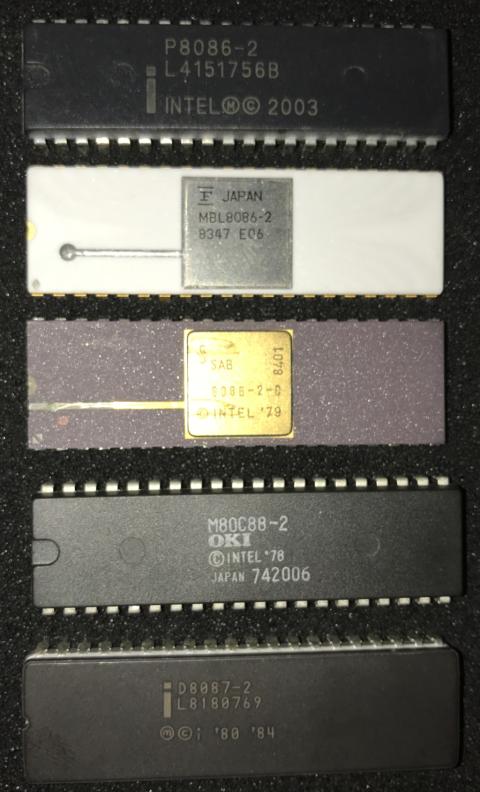
Sorting through my computing related stuff, I’ve acquired over the last 30 years…. I found my collection of Intel 8086, 8088 CPUs and Intel 8087 maths co-processor.
Released 40 years ago, the birth of a standard which has kept me in a job for my working career!
I’m not quite sure if this qualifies as vintage computing, and it really breaks my heart to dispose and scrap this computer equipment, which costs many tens of thousands of pounds to purchase twenty years ago!
But it’s not been used in twelve years, and is now out of date and old, and I cannot keep it forever. You may be thinking what a waste – surely – somebody wants it, well – I tried using eBay for all my old vintage computing – but eBay is now trying to catch-up with Amazon, and it’s not the place anymore to sell, vintage, old computing, it’s full of tyre kickers, they place bids, purchase items, and then place dispute with eBay, making up an excuse, because there is not the subject matter selection, so they just select not as described, eBay then refunds them, and expects you to pay for the returned item, and let them keep it!
So I’ve abandoned ebay, I then turned to Freecycle, Gumtree and Sphock – but again this is just for people on stupid street, and the fact is the Younger Generation of Computing people today (“GUI Munchers!), do not understand all this stuff to be able to use it!
e.g. I did ask 960 students on a Computer Science Degree course, if they wanted any of this, and most of the responses were goes it have a GTX1080Ti, or can I use it to mine Bitcoins! and there was really only 1 student, which new what it was! 1 out of 960!!!!
Umm, not sure what they are being taught….
So, it goes to the local tip or recycling centre!
Very little plastic used, and all heavy metal – and after nearly 12 years of not being used, when I powered it on all 1TB of Clustered High Performance Available storage sparked into life….backed up now to 3 x SSDs, and all the 36 disks, security erased and taken to the local tip in carrier shopping bags!
3 x Compaq RA4100 with FC-AL Fabric
Dismantled and stripped
1TB - 36 Ultra SCSI 10k rpm disks in shopping bagsAt the tip!
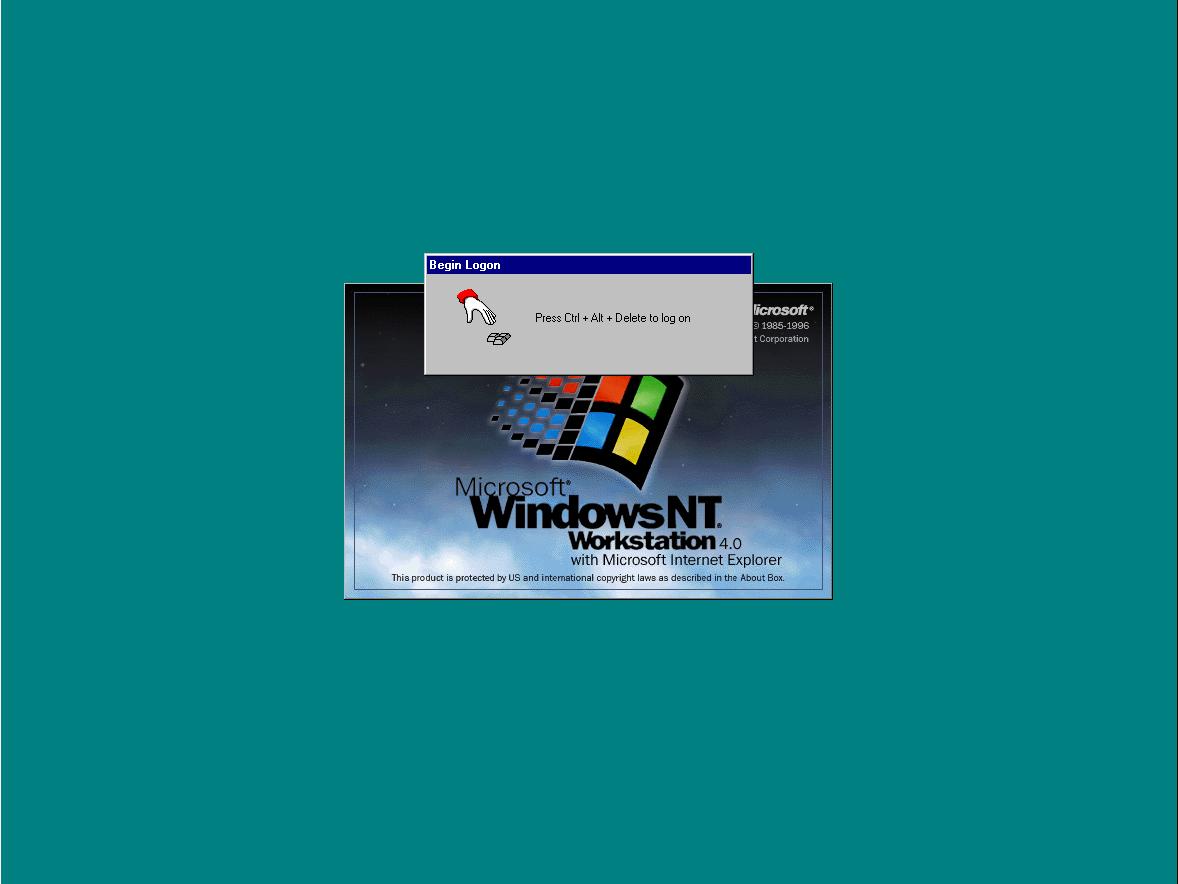
I’ve categorised this blog post as Vintage, well I think Microsoft Windows NT Workstation 4.0 and Microsoft Windows NT Server 4.0, deserve Vintage status, it’s over 15 years since it’s release, and I still remember the day, when I was the only Senior Analyst in a new job, that had installed Windows New Technology, so the first task of the day (week) was to sit with a pile of floppy disks, because they had not purchased the CDROM version, and install on 10 computers, I was still waiting for my “Top Secret Security Clearance” to be approved, so I was locked in the Datacentre! On reflection now, it would seems a very odd place to lock someone on a Ministry Of Defence site, that did not have clearance! If I needed to take a comfort break, I had to be escorted around the site!
Windows NT 4.0 License Agreement
If you’ve never read the Windows NT 4.0 License Agreement, it states 8. “…. Java Technology is not fault tolerant and is not designed, manufactured, or intended for use or resale as on-line control equipment in hazardous environments or nuclear facilities, aircraft navigation or communication systems…..”.
So Windows NT Workstation 4.0 is not supposed to be used for a messaging system? (best not say anymore about that!).
Windows NT Workstation 4.0 and Microsoft Windows NT Server 4.0 install so fast in a virtual environment, after many many many, manual installations and deployments on physcal servers and workstations, installation is over in 60 seconds. (it’s just rather anyonying that SP6 is require to install VMware Tools!, all of 32MB!).
Microsoft Windows NT Workstation 4.0
Microsoft Windows NT Server Version : 4.0
You are probably wondering at this point, why am I installing and testing Microsoft Windows NT Workstation 4.0 and Microsoft Windows NT Server 4.0 on VMware ESXi 5.0!
Ah, well good reason, Boot Ferrule Man, who works in the Semiconductor Industry, one of their semiconductor robots, lets call him “Cheese”, which is controlled by an NT 4.0 PC with SSD installed in 1995, has gone wrong! So I’m just testing the media! (well okay, ISOs, the media is archived!).
Told you it had a reason!!!
and final shout-out, All the very Best Steve. I wish you and your family well.
A friend of mine is moving house in a few months, and has decided not to take vintage computers he’s collected over many years, and he was going to scrap them and take them down the skip, unless homes were found. So I collect a car load of vintage stuff
BBC Micros, BBC Masters, Telextet, Prestel and 6502 2nd Processors
I collected the following:-
10 BBC Micros ‘Beebs’
4 BBC Masters
3 Cumuna dual 5.25 floppy disk drives (horizontal)
2 Cub Monitors
2 Spectrum+3 128k
2 Cherry Teletext keyboards
Teletext Adaptor
Prestel Adaptor
6502 Second Processor
Teletext, Prestel and Second Processor for BBC Micro









![[Valid RSS]](http://andysworld.org.uk/images/valid-rss.png "Validate my RSS feed")