
Same music. Different masterings. Real differences.
Why this album matters to me
Brothers in Arms is one of my favourite albums, and it was also one of the first albums I owned on Compact Disc when it was released in 1985.
I was also lucky enough to see Dire Straits when they toured Brothers in Arms in 1985. I went with some school friends, along with my father and one of his friends. One of those school friends still blames that concert for his hearing problems now, at 58 — we were right down the front, very close to the speaker stack, and it was loud!
I still have the ticket stub from that concert, along with the stickers that were given away at the time. I even stuck the stickers to my school calculator, which somehow survived all these years.

So Brothers in Arms isn’t simply another album in my collection; it’s tied to some very specific memories from 1985.
My father was also a big fan of Brothers in Arms. After he died, I remember walking through Bridgend High Street in South Wales, when a busker suddenly started playing “Brothers in Arms”. Hearing that song unexpectedly, at that particular moment, was one of those experiences that stays with you.
My father always told me that he wanted “Brothers in Arms” played at his funeral, and in September 2023, at his funeral, it was played as the last song as we left the service at the crematorium.
Even now, hearing Track 9 can bring a tear to my eye.
After all these years, the album has become connected not only with memories of being young and buying one of my first CDs, but also with the memory of my father.
Fast-forward nearly forty years and I found myself looking at the album from a rather different perspective:
How different are all those CD versions actually from one another?
There are numerous editions of Brothers in Arms, and audiophile discussions often describe them in terms such as “warm”, “bright”, “dynamic”, “compressed” or “better sounding”.
Rather than relying on descriptions, I wanted to find out what the digital audio actually shows.
So I collected six different stereo CD editions, ripped them accurately, and started comparing the actual samples.
The results turned out to be considerably more interesting than I expected.
The six editions

For this investigation I examined six physical editions:
| Year |
Edition |
Mastering / identification |
| 1985 |
Original CD, Matrix 06 |
John Dent |
| 1985 |
Original CD, Matrix 12 |
Bob Ludwig |
| 1996 |
SBM Remaster |
Bob Ludwig |
| 2000 |
XRCD2 |
Hiromichi Takiguchi |
| 2005 |
20th Anniversary Hybrid SACD |
Bob Ludwig |
| 2025 |
40th Anniversary Edition |
Miles Showell |
The chronological order is important because these aren’t simply six different pressings of the same mastering.
The two 1985 discs require particularly careful investigation, while the later editions clearly represent different mastering generations.
And this wasn’t an investigation based solely on files found online.
I photographed and scanned the actual physical discs and packaging used in the investigation, including catalogue numbers, matrix information and mastering credits where visible.
That physical evidence became particularly important when comparing the original 1985 discs.
How I approached the investigation
I wanted to avoid the usual problem with CD comparisons where somebody simply loads six files into an audio editor, adjusts the volume until they sound similar, and then declares one “better”.

Instead, I treated the discs as forensic evidence.
Each disc was:
- ripped using Exact Audio Copy
- checked against AccurateRip
- checked using the CueTools Database where available
- retained as lossless FLAC
- analysed at the sample level
- compared for peak levels
- compared for RMS level
- compared for crest factor
- examined spectrally
- checked for channel orientation
- checked for sample offsets
- compared directly at the waveform/sample level
This allowed me to distinguish between differences caused simply by level, differences caused by timing or offsets, and genuine changes to the audio samples.
1985 – John Dent – Matrix 06

The first disc is the original 1985 pressing identified by its matrix.
Catalogue: 824 499-2
Matrix: 824 499-2 06 #
The booklet credits:
Mastered by John Dent at The Sound Clinic, London
The rip was verified successfully with AccurateRip and CTDB.
All nine tracks were accurately ripped with no errors.
Peak levels
| Track |
Peak |
| So Far Away |
100.0% |
| Money for Nothing |
100.0% |
| Walk of Life |
56.3% |
| Your Latest Trick |
41.6% |
| Why Worry |
22.7% |
| Ride Across the River |
72.6% |
| The Man’s Too Strong |
69.1% |
| One World |
89.6% |
| Brothers in Arms |
56.5% |
The median RMS level was approximately –25.54 dBFS, with a median crest factor of approximately 22.33 dB.
This is a remarkably dynamic presentation by modern CD standards.
The disc contains only a handful of exact full-scale samples. Tracks 1 and 2 contain full-scale samples; the remaining tracks do not.
1985 – Bob Ludwig – Matrix 12
The second original CD is also catalogue number 824 499-2, but it has a different matrix:
Matrix: 824 499-2 12 #
The disc is identified as Made in West Germany by PDO Hanover.
The important point here is that this is a different physical pressing from the Matrix 06 disc.
The rip was again fully verified.
All nine tracks were accurately ripped.
Peak levels
| Track |
Peak |
| So Far Away |
79.4% |
| Money for Nothing |
79.4% |
| Walk of Life |
44.7% |
| Your Latest Trick |
33.0% |
| Why Worry |
18.0% |
| Ride Across the River |
57.6% |
| The Man’s Too Strong |
54.9% |
| One World |
71.1% |
| Brothers in Arms |
44.9% |
The median RMS level is approximately –27.73 dBFS, with a median crest factor of approximately 22.52 dB.
At first glance, therefore, Matrix 12 simply looks like a quieter version of Matrix 06.
But that turns out to be only part of the story.
The first surprise: Matrix 06 and Matrix 12
This was where the investigation became much more interesting.
If the two 1985 discs were genuinely completely independent digital masterings, we would expect substantially more differences than simply a change in level.
Instead, the digital data shows an extraordinarily close relationship.
After:
- reversing the left and right channels
- applying approximately –2 dB of gain
- allowing for track-specific sample offsets
- accounting for 16-bit requantisation
the majority of the tracks essentially reproduce one another.
For Tracks 1, 2 and 4–9, the correlation is extraordinarily high and the residual difference is generally down around the –60 to -70 dB region.
In practical terms, after the transformation, the samples reproduce to within approximately ±1 LSB.
That is an extremely strong relationship.
It means that the two discs cannot sensibly be described as completely unrelated digital masterings.
But there is an important qualification.
They aren’t completely identical either.
The “Walk of Life” exception

Track 3, “Walk of Life”, contains two localised areas where the relationship breaks down.
The differences occur approximately around:
- 3:06.55–3:06.75
- 3:09.83–3:10.10
Both channels are affected.
Importantly, the differences cannot simply be explained by another small timing offset.
The difference energy is concentrated around roughly the 330–400 Hz region.
Outside these areas, the two versions return to their extraordinarily close relationship.
This is why I think the safest conclusion is:
Matrix 06 and Matrix 12 are two separately identified 1985 mastering/pressing variants, but their digital programs are extraordinarily closely related.
They should not be described as completely bit-identical.
At the same time, it would also be misleading to describe them as completely unrelated masterings.
The sample-level evidence is much more interesting than either of those simple explanations.
A particularly interesting detail: sample offsets
The comparison also revealed that the tracks aren’t necessarily aligned at exactly the same sample position.
For example, several tracks exhibit an offset of approximately 367 samples, while others have different offsets.
The measured offsets included:
| Track |
Offset |
| 1 |
367 |
| 2 |
367 |
| 3 |
367 |
| 4 |
367 |
| 5 |
367 |
| 6 |
3307 |
| 7 |
1543 |
| 8 |
2131 |
| 9 |
3307 |
Once those offsets are taken into account, the underlying relationship becomes remarkably clear.
This is a good example of why simply comparing waveforms visually isn’t enough.
Two identical audio programmes can look completely different in an editor if one has been shifted by even a single sample.
1996 – SBM Remaster
The next major version is the 1996 SBM remaster.
This is a different mastering generation from the original 1985 discs.
It was mastered by Bob Ludwig at Gateway and uses Sony’s Super Bit Mapping process.
The digital measurements show a substantial increase in level compared with both original 1985 versions.
Peak levels
| Track |
Peak |
| So Far Away |
97.7% |
| Money for Nothing |
97.7% |
| Walk of Life |
97.7% |
| Your Latest Trick |
100.0% |
| Why Worry |
70.7% |
| Ride Across the River |
100.0% |
| The Man’s Too Strong |
97.7% |
| One World |
97.7% |
| Brothers in Arms |
97.7% |
The median RMS level is approximately –18.18 dBFS, while the median crest factor is approximately 18.18 dB.
This is substantially less dynamic than either of the original 1985 versions.
There are also exact full-scale samples on Tracks 4 and 6.
2000 – XRCD2
Then we reach the particularly interesting 2000 XRCD2.
This is the Japanese-made XRCD2 edition released for the Hong Kong market.
Catalogue: 5483572
Barcode: 731454835725
Format: XRCD2 / 20-bit K2
Mastering engineer: Hiromichi Takiguchi
Disc matrix: 5483572 2T
The disc itself identifies Universal Music Ltd., Hong Kong and Made in Japan, and carries the XRCD2/K2 information.
The physical disc therefore provides useful evidence that this is a distinct release rather than simply another European pressing.
The rip was again accurately verified.
All nine tracks were successfully ripped with no errors.
Peak levels
| Track |
Peak |
| So Far Away |
100.0% |
| Money for Nothing |
100.0% |
| Walk of Life |
100.0% |
| Your Latest Trick |
100.0% |
| Why Worry |
79.2% |
| Ride Across the River |
100.0% |
| The Man’s Too Strong |
100.0% |
| One World |
100.0% |
| Brothers in Arms |
100.0% |
The median RMS level is approximately –15.45 dBFS.
The median crest factor is also approximately 15.45 dB.
This represents a very substantial increase in average level compared with the original 1985 CDs.
The XRCD’s full-scale samples
One of the things I specifically investigated on the XRCD was exactly what those 100% peak readings meant at the sample level.

The results are interesting.
There are exact full-scale samples at both ends of the 16-bit range on most tracks.
For example:
| Track |
-32768 samples |
+32767 samples |
| So Far Away |
769 |
131 |
| Money for Nothing |
1,402 |
573 |
| Walk of Life |
382 |
278 |
| Your Latest Trick |
27 |
38 |
| Why Worry |
0 |
0 |
| Ride Across the River |
297 |
171 |
| The Man’s Too Strong |
523 |
465 |
| One World |
674 |
666 |
| Brothers in Arms |
150 |
204 |
The longest consecutive runs reach several samples on some tracks.
For example, Money for Nothing contains a run of five consecutive samples at full scale.
This establishes something more precise than simply saying “the XRCD is loud”.
There are actual samples sitting exactly at the limits of the 16-bit PCM representation.
I don’t want to overstate what that means, however.
The sample data demonstrates exact full-scale sample behaviour and peak limiting/clipping-like behaviour. It does not, by itself, prove a particular clipping algorithm or analogue/digital processing chain.
The actual samples are the evidence; the explanation needs to remain appropriately cautious.
2005 – 20th Anniversary Hybrid SACD
The 2005 20th Anniversary Edition is another significant change.
This is a hybrid SACD release containing:
- SACD stereo
- SACD surround
- CD Audio
The edition uses the new 5.1 mix prepared by Chuck Ainlay, with mastering by Bob Ludwig at Gateway Mastering & DVD, Maine.
For this investigation I analysed the CD layer, rather than treating the SACD layer as though it were the same digital source.
CD-layer measurements
The peak is approximately 98.8% on every track.
The median RMS level is approximately:
-12.84 dBFS
The median crest factor is approximately:
12.74 dB
This is the most compressed/loudest of the six editions by these particular measurements.
The difference compared with the original 1985 discs is substantial.
The 2005 CD layer is approximately 15 dB higher in median RMS level than the 1985 Bob Ludwig Matrix 12 disc.
That is a huge difference in digital level and dynamics.
2025 – 40th Anniversary Edition
The final edition in the comparison is the 2025 40th Anniversary Edition.
The set contains three discs, including the San Antonio Live in ’85 material, with the first disc containing the Brothers in Arms album.
Catalogue: 7565089
The 2025 edition is interesting because it does not simply continue the trend established by the 2005 edition.
Its measurements are:
Peak levels
Approximately 89.1% on most tracks, with Track 5 at approximately 86.0%.
The median RMS level is approximately:
-16.36 dBFS
The median crest factor is approximately:
15.36 dB
So the 2025 edition is considerably quieter than the 2005 CD layer.
It nevertheless remains significantly louder than the original 1985 discs.
This makes the 2025 mastering an interesting middle ground in the overall history of the CD versions.
The numbers side by side

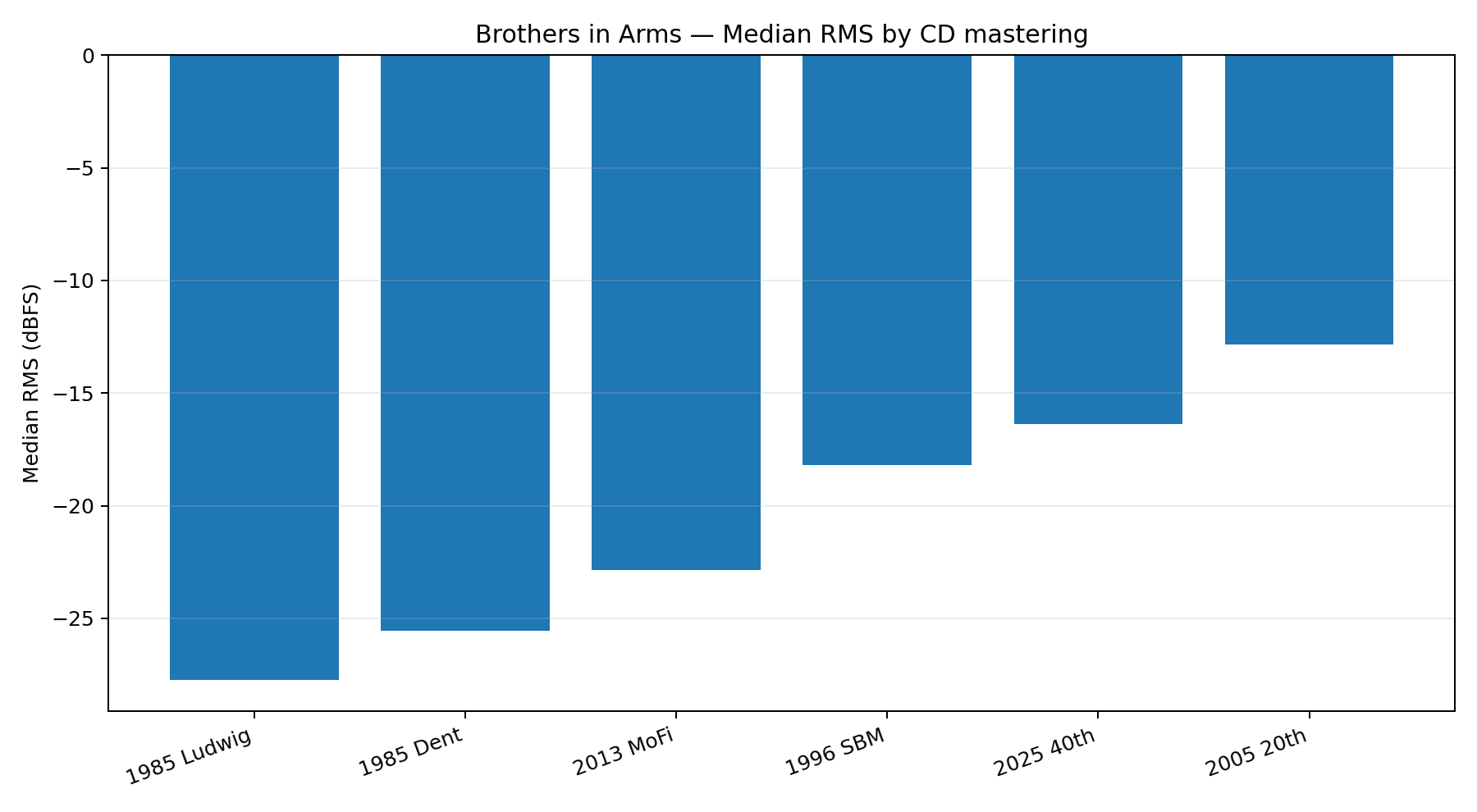
Putting all six editions together makes the progression much easier to see.
| Edition |
Median RMS |
Median Crest |
| 1985 John Dent – Matrix 06 |
-25.54 dBFS |
22.33 dB |
| 1985 Bob Ludwig – Matrix 12 |
-27.73 dBFS |
22.52 dB |
| 1996 SBM |
-18.18 dBFS |
18.18 dB |
| 2000 XRCD2 |
-15.45 dBFS |
15.45 dB |
| 2005 20th Anniversary |
-12.84 dBFS |
12.74 dB |
| 2025 40th Anniversary |
-16.36 dBFS |
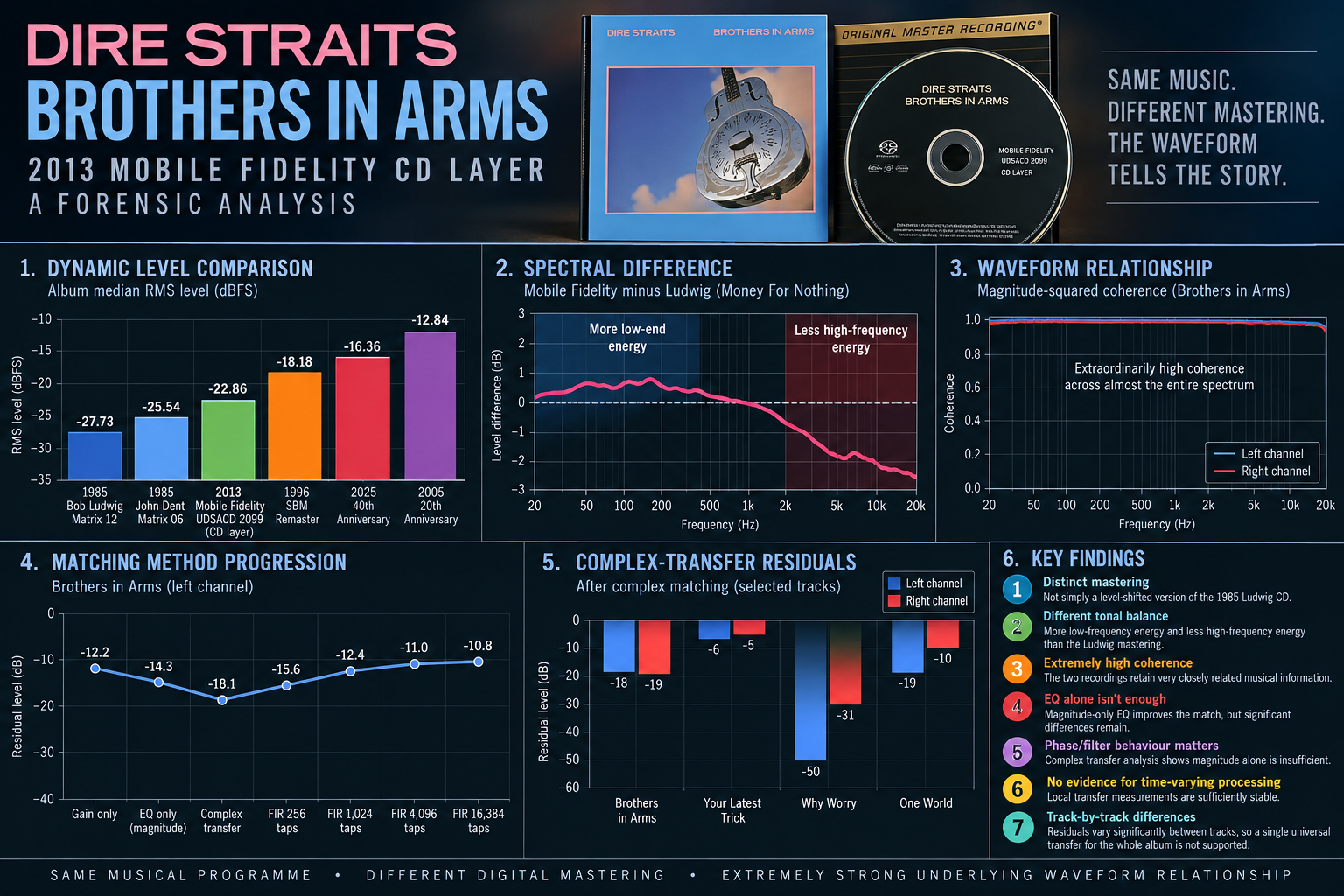
15.36 dB |
This table tells a very clear story.
The original 1985 discs have the highest crest factors and the lowest average digital levels.
The 1996 edition moves substantially towards higher average level.
The 2000 XRCD2 goes further.
The 2005 CD layer goes further still.
The 2025 edition moves back down again, although it remains considerably above the original 1985 level.
What about the peak levels?
Peak percentage alone doesn’t tell the whole story.
A track can have a 100% sample but still have a relatively low RMS level.
Conversely, an aggressively processed recording can have a peak below 100% while still having very little dynamic range.
That is why I have looked at both peak level and RMS/crest measurements.
For example, the 1985 John Dent disc contains 100% peaks on Tracks 1 and 2, but its average level remains extremely low.
The 2005 edition, by contrast, has peaks around 98.8% throughout while having a dramatically higher average level.
So “100% peak” does not automatically mean “compressed”.
The relationship between peak and average level is much more informative.
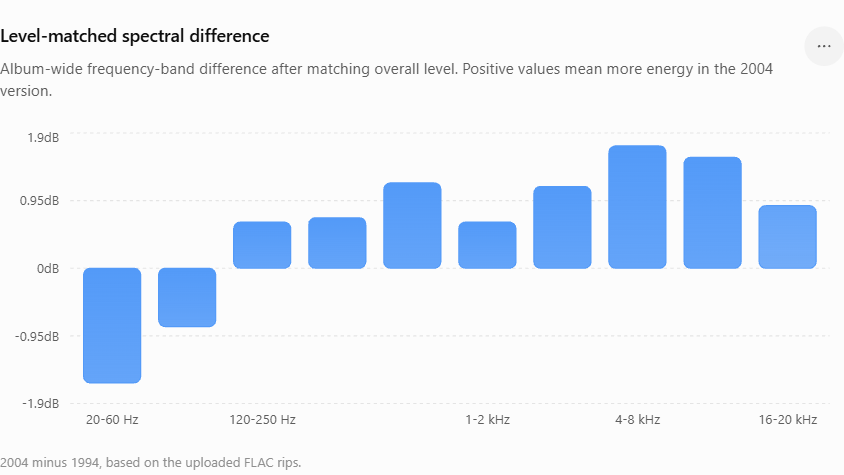
Spectral analysis

The next stage was to look at the frequency content.
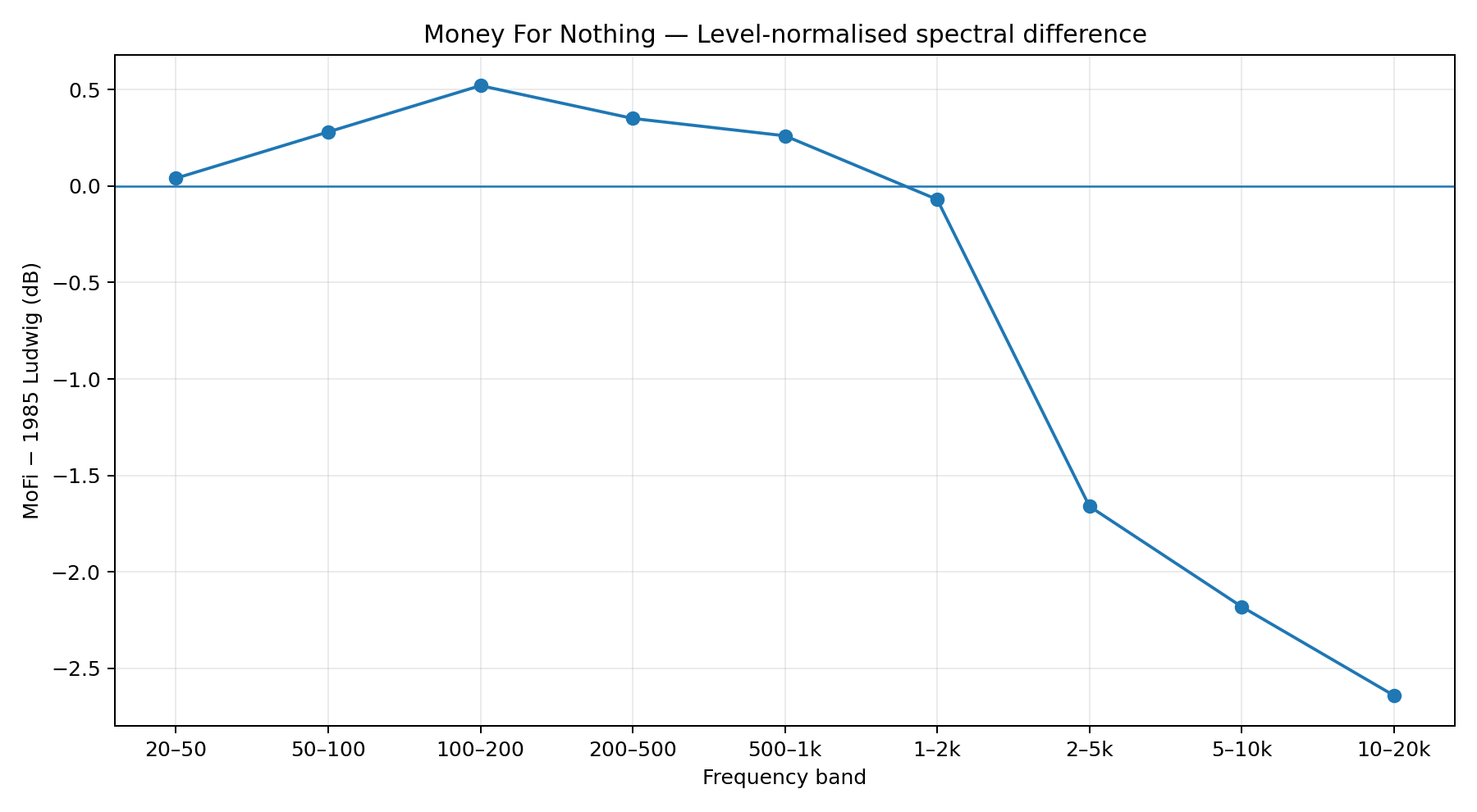
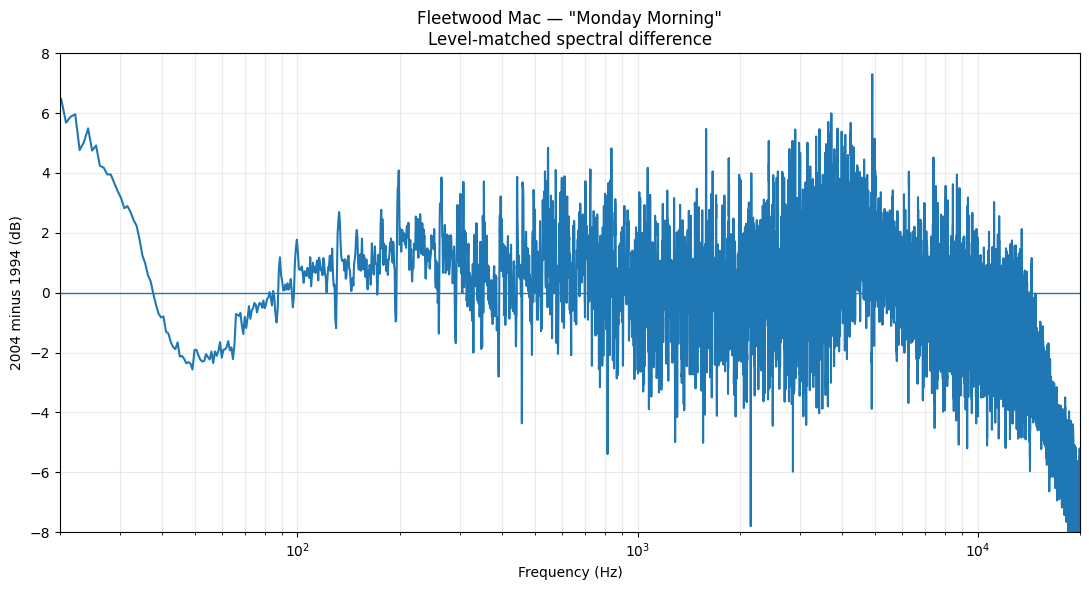
This is where things get particularly useful because a level difference can be removed mathematically.
For the spectral comparison, the tracks were level-matched before examining their frequency distribution.
The aim wasn’t to create a prettier graph.
The aim was to ask:
Once volume is taken out of the equation, are the tonal balances actually different?
The answer is yes — but the size and character of the differences vary substantially between editions.
The original 1985 versions are particularly close to one another.
The later editions show much more substantial differences once level is normalised.
“Walk of Life” – the track that gave me the biggest clue
“Walk of Life” is Track 3, and it became the most interesting track in the entire investigation.
At first, the Matrix 06 and Matrix 12 versions appear to be almost identical after the appropriate channel and level corrections.
The correlation is extraordinarily high.
But when the actual residual is examined rather than simply looking at the correlation coefficient, two small sections stand out.
These occur around:
3:06.55–3:06.75
and
3:09.83–3:10.10
The differences occur in both channels.
There is no simple additional timing offset that makes them disappear.
This is important because it means the discrepancy isn’t simply an alignment problem.
Most of the track behaves as though it has come from essentially the same digital programme.
These small areas do not.
That is exactly the sort of thing that can disappear completely if the analysis is limited to listening tests or a basic “are the files identical?” comparison.
Why the sample-level comparison matters

One of the things I wanted to establish with this project was that mastering comparisons don’t have to remain subjective.
Words such as:
- warm
- bright
- analogue
- harsh
- smooth
- punchy
- compressed
can be useful descriptions of listening impressions.
But they don’t tell us what actually happened to the samples.
With sample-level analysis we can ask much more precise questions:
- Are the channels reversed?
- Is one version simply quieter?
- Is there a fixed sample offset?
- Are the samples mathematically related?
- Is there a change in the waveform?
- Is the difference localised?
- Are there full-scale samples?
- How much does the RMS level change?
- How much does the crest factor change?
- Does the spectrum change after level matching?
That is the approach I wanted to take here.
Physical discs still matter
One of the most enjoyable parts of this project has been going back to the actual discs.
It’s very easy when discussing CD masterings online to end up talking about catalogue numbers and matrix numbers as though they are abstract database entries.
They aren’t.
They are physical objects.
The Matrix 06 disc is an actual 1985 pressing.
The Matrix 12 disc is another physical pressing.
The XRCD has its own catalogue number, physical matrix and Japanese manufacturing information.
The 2005 edition is physically identifiable as the hybrid SACD release.
The 2025 edition is physically identifiable as the new 40th Anniversary set.
Photographing the actual discs gives the analysis a much stronger foundation.
It means the audio files can be tied back to something physically identifiable.
The 1985 discs are the real rabbit hole
The most interesting result of the entire investigation isn’t actually which edition is “best”.
It is the relationship between the two original 1985 discs.
The Matrix 06 and Matrix 12 discs are labelled and documented differently, and yet the digital audio is extraordinarily closely related.
After accounting for:
- channel reversal
- approximately 2 dB of level
- sample offsets
- 16-bit requantisation
most of the album effectively falls back into place.
That is a much more interesting result than simply finding two CDs that sound similar.
And then there is Walk of Life.
Those two localised differences prevent the easy conclusion that the discs are simply identical data with a different level.
There is something genuinely different there.
A note about the 1996 SBM
The 1996 edition represents a very different point in the story.
The average level rises substantially compared with both 1985 discs.
The crest factor falls.
The peak levels approach full scale throughout most of the album.
This doesn’t mean the 1996 edition is necessarily “bad”.
It simply means that the mastering has different technical characteristics from the original 1985 discs.
That distinction is important.
The purpose of this investigation is not to turn measurements into a subjective ranking.
It is to document what actually changed.
A note about the XRCD
The XRCD is particularly interesting because it combines a different mastering identity with a very different production philosophy.
It was mastered by Hiromichi Takiguchi, using JVC’s XRCD/K2 process.
The physical disc identifies it as an XRCD2 release, catalogue 5483572, made in Japan for the Hong Kong market.
Digitally, it sits much closer to the later high-level masterings than to the original 1985 discs in terms of RMS and crest factor.
The exact full-scale sample counts are also notable.
Whether someone likes the resulting sound is a separate question.
What can be stated objectively is that the PCM data contains many exact full-scale samples and has a substantially higher average level than either 1985 disc.
The 2005 edition
The 2005 20th Anniversary edition represents another major step in the mastering history.
It is also important not to confuse the various layers and mixes.
The release contains a new 5.1 mix by Chuck Ainlay.
The CD layer analysed here is not simply interchangeable with the original 1985 stereo CD.
Technically, its measured dynamics are the most restricted of the six editions examined.
With a median RMS of approximately –12.84 dBFS and a median crest factor of approximately 12.74 dB, it is considerably denser than the original CDs.
Again, that is a measurement rather than a judgement.
The 2025 40th Anniversary edition
The 2025 release provides an interesting counterpoint.
Despite being a modern anniversary edition, its measured dynamics are not as restricted as the 2005 CD layer.
Its median RMS is approximately –16.36 dBFS.
Its median crest factor is approximately 15.36 dB.
That places it between the original 1985 discs and the 1996/2000/2005 editions in terms of average level.
It therefore doesn’t fit a simple narrative of “each new edition got progressively louder”.
The history is more complicated than that.
What I think the measurements actually tell us
After working through the six discs, several things are clear.
1. The two 1985 editions are exceptionally dynamic
Both original discs have much lower RMS levels and higher crest factors than the later editions.
2. Matrix 06 and Matrix 12 are extraordinarily closely related
Their digital programmes show an extremely strong mathematical relationship after channel reversal, level correction and sample alignment.
3. They aren’t completely identical
The localised differences in “Walk of Life” mean that the two discs should not simply be described as bit-identical masterings.
4. The 1996 edition is substantially louder
Its RMS level is considerably higher and its crest factor lower than either 1985 edition.
5. The XRCD is louder still
The 2000 XRCD2 has a median RMS of approximately -15.45 dBFS and contains numerous exact full-scale samples.
6. The 2005 CD layer is the densest of the six
It has the highest average level and lowest median crest factor in this comparison.
7. The 2025 edition moves away from the 2005 level
Its average level is lower and its crest factor higher than the 2005 CD layer, although it remains considerably above the original 1985 discs.
So which one is “best”?
That wasn’t actually the question I set out to answer.
And I don’t think a collection of measurements can tell somebody which version they should enjoy.
What the measurements can tell us is what is physically and digitally different.
If someone prefers the original 1985 presentation, the measurements provide a strong technical explanation for why it behaves differently from the later releases.
If someone prefers the XRCD, the data doesn’t invalidate that preference.
If somebody prefers the 2005 version, the measurements don’t tell them that they shouldn’t.
The interesting part is that we can now separate what the disc actually contains from descriptions based purely on reputation.
The mastering timeline

The six discs provide a fascinating snapshot of the changing approach to Brothers in Arms over four decades:
1985
Original CD mastering variants, including the John Dent Matrix 06 and Bob Ludwig Matrix 12 discs.
1996
SBM remaster, again associated with Bob Ludwig.
2000
XRCD2 edition, mastered by Hiromichi Takiguchi using JVC’s K2/XRCD process.
2005
20th Anniversary hybrid SACD, including the new 5.1 mix by Chuck Ainlay and Bob Ludwig mastering.
2025
40th Anniversary edition, representing another modern mastering of the album.
The physical discs tell the release history.
The audio samples tell the mastering history.
And when the two are considered together, the story becomes much more interesting.
Methodology
All analysis was performed from actual lossless CD rips of the physical editions examined.
The basic process was:
- Rip each disc using Exact Audio Copy.
- Verify the rip with AccurateRip.
- Check CTDB where available.
- Retain the audio as lossless FLAC.
- Measure track peak levels.
- Calculate RMS levels.
- Calculate crest factors.
- Check for exact full-scale samples.
- Align tracks before sample-level comparison.
- Test channel orientation.
- Test gain relationships.
- Search for sample offsets.
- Calculate correlation and residual error.
- Examine localised waveform differences.
- Perform spectral comparisons using level-matched audio.
- Compare the results against the physical disc evidence.
The intention throughout was to make the analysis reproducible and to avoid making claims that go beyond what the samples demonstrate.

Final thoughts
When I started this project, I expected to find some differences between different CD editions of Brothers in Arms.
I didn’t expect to end up investigating individual samples separated by a few hundredths of a second.
The most fascinating result for me isn’t simply that later editions became louder.
It’s the discovery that the two original 1985 discs — despite being separately identified as Matrix 06 and Matrix 12 — are astonishingly closely related at the digital level.
And then, right in the middle of Walk of Life, there are those small areas where the relationship breaks down.
That is exactly the sort of thing that makes this kind of investigation worthwhile.
After nearly forty years of listening to this album, I thought I knew it pretty well.
It turns out there was still quite a lot hiding in the samples.
And perhaps that’s the fitting thing about Brothers in Arms.
For me, it started as one of the first CDs I owned in 1985. It was part of a concert I went to with my father and school friends. It became connected with memories of my father, with that busker in Bridgend, and ultimately with his funeral.
Now, nearly forty years later, I’m listening to it again — but this time I’m listening to the numbers as well as the music.
Same album. Different masterings. Real differences.
And sometimes, the differences are only a few samples long.
CDs Still Wanted for Analysis
I think I’ve picked six different Brothers in Arms pressings over the last 40 years that are particularly significant, and they’ve given me a fascinating cross-section of how the album has been mastered and reissued.
But there are still a couple I’d really like to obtain and analyse.
If you have either of the following editions, I’d be very interested in hearing from you:
- 2013 Mobile Fidelity SACD
- 2014 SHM-SACD
I’d particularly like to analyse the actual audio alongside photographs of the physical disc and its matrix information. That way I can establish exactly which mastering is present and compare it with the six editions documented here.
So, if you’ve got one of these sitting on your shelf and would be willing to help, please get in touch. I’d love to add the results to this investigation.
And finally…
If you really want to know which one I think is the best, you’ll have to ask me.
After all, I’ve spent the last 40 years collecting them, ripping them, comparing them and, in some cases, analysing them down to the individual sample.
I definitely have a personal favourite.
But that’s another discussion…
For Dad.

Edit – 20 September 2026
Within 24 hours of this post, two readers are sending me their copies of
- 2013 Mobile Fidelity SACD
- 2014 SHM-SACD
So I’ll update you, with a final post, when I’ve analysed the remaining two!






![[Valid RSS]](http://andysworld.org.uk/images/valid-rss.png "Validate my RSS feed")