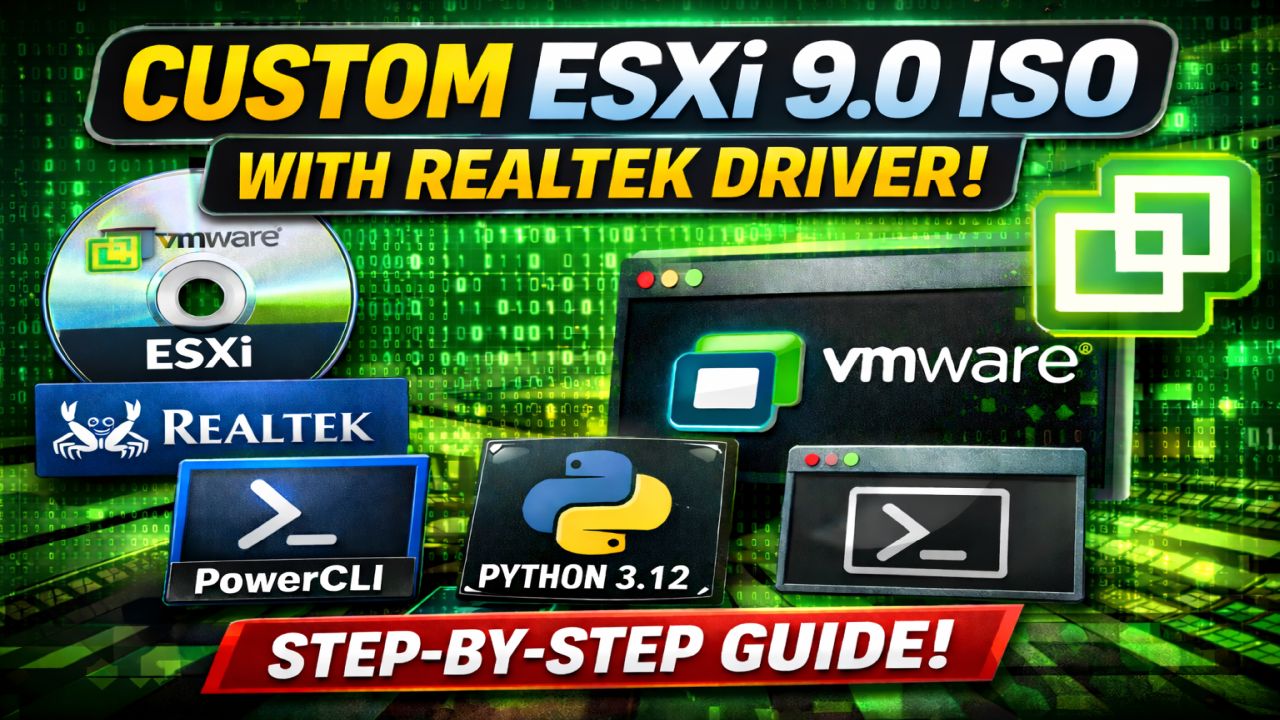
HOW TO: Create a Custom VCF 9.0 VMware ESXi 9.0 ISO with Realtek Driver (PowerCLI)
Author: Andy – Andysworld.org.uk
Good news for homelab enthusiasts! We finally have a working Realtek network driver for ESXi 9.0. In this guide, I’ll show you step-by-step how to create a customised VMware ESXi 9.0 ISO for VCF 9.0 with the Realtek driver injected (slipstreamed) using PowerShell 7 and VMware PowerCLI.
Why This Matters
If you’re running ESXi in a homelab environment using consumer hardware, Mini PCs, or whitebox builds, Realtek NIC support has historically been a challenge. With the latest Realtek driver available, we can now build a custom ESXi 9.0 ISO that works perfectly in lab environments.
This process allows you to:
Inject the Realtek driver into the ESXi 9.0 image profile
Create a bootable ISO installer
Export an offline ZIP bundle
Important Disclaimer
ESXi 9.0 depot files require a valid Broadcom contract. I do not distribute depot files, customised ISOs, or any Broadcom software. Please obtain required files through official channels.
You should now have both a customised ISO and ZIP bundle ready for deployment in your homelab.
Method 2 – Scripted Approach
If you prefer automation, you can use a PowerShell script to perform the entire process in one go. The script automates:
Loading depot files
Cloning image profiles
Injecting the Realtek driver
Exporting ISO and ZIP bundles
This method is ideal for repeat builds or lab rebuilds.
Who Is This For?
Homelab enthusiasts
VMware learners
Mini PC / Whitebox ESXi users
VCF 9.0 lab deployments
This guide is intended for lab and educational use only, not production environments.
Final Thoughts
Creating a custom ESXi image is a valuable skill for anyone running a VMware homelab. With the Realtek driver now available for ESXi 9.0, lab builders can continue using affordable hardware while staying current with VMware releases.
If you found this guide helpful, check out more VMware content here at Andysworld.org.uk.
Minisforum MS-A2: How to Install the New Realtek Driver on VMware ESXi 9.0
Running VMware ESXi 9.0 on the Minisforum MS-A2 is a fantastic option for homelabs and edge deployments, but out of the box you may notice that not all Realtek network interfaces are detected.
In this guide, based on my latest episode of Hancock’s VMware Half Hour, I walk through installing the new Broadcom-compiled Realtek driver (available as an official Broadcom Fling) to unlock additional NIC support.
What This Guide Covers
Why Realtek NICs are limited by default on ESXi 9.0
Where to download the official Broadcom Fling driver
Installing the driver using esxcli
Rebooting safely and verifying NIC availability
Supported Realtek Network Adapters
The driver demonstrated in this guide supports the following Realtek PCIe devices:
RTL8111 – 1GbE
RTL8125 – 2.5GbE
RTL8126 – 5GbE
RTL8127 – 10GbE
Driver Installation Command
Once the driver ZIP has been copied to your ESXi datastore and the host is in maintenance mode, install it using:
After installation, a reboot is required for the new network interfaces to become available.
Video Chapters
00:00 - Start
00:03 - Welcome to Hancock's VMware Half Hour
00:37 - Todays video - HOW TO Install Realtek driver on ESXi 9.0
00:55 - Broadcom Released the Realtek Driver fling in November 2025
01:55 - Minisforum MS-A2 - VCF 9.0 Homelab of the Year 2025 !
02:26 - Available as a Broadcom Fling - Tech Preview - not for production
02:55 - I'm not a fan of Realtek let it be known!
03:11 - Go to Broadcom Fling Portal site to download - https://support.broadcom.com/group/ecx/productdownloads?subfamily=Flings&freeDownloads=true
03:22 - Download the driver don't forget to Accept the Agreement!
03:51 - Enable SSH on Host, and use WinSCP to copy to local datastore
04:31 - Whoops Zoom is broke again!
05:07 - Connect to host using SSH
05:22 - Use lspci to show PCI devices in the host
06:05 - Use grep - lspci | grep Realtek
07:01 - Install the driver using esxcli software component apply -d /VMware-Re-Driver_1.101.00-5vmw.800.1.0.20613240.zip
07:59 - A reboot is required, reboot the server
08:36 - Reboot server
09:20 - The reason for the 10th Outake !
10:01 - Login to ESXi 9.0 using HTML Client
10:51 - Realtek driver is installed and network interfaces are available for use
11:07 - HenryChan1973 this video is for you!
12:23 - Thanks for Watching
Final Thoughts
This Broadcom Fling makes ESXi 8.0 far more usable on modern mini PCs like the Minisforum MS-A2, especially for homelabbers who rely on multi-gig Realtek networking.
Huge thanks to Henrychan1973 for their contribution and support.
If this guide helped you, consider subscribing on YouTube and checking out more VMware content on the blog.
In this episode of Hancock’s VMware Half Hour, we walk through creating an Offline Depot using a Python script to support VMware Cloud Foundation (VCF) 9.0 deployments in air-gapped or isolated environments. We begin with a brief update on the VCF Installer, remove previously downloaded components, and disconnect our offline repository from a Synology NAS. Then we dive into the technical steps—running a Python script on Ubuntu using the http_server_auth.py script from GitHub, mounting an NFS export, verifying FQDN configuration, and checking access to the depot via a web browser. Finally, we show how to configure the VCF Installer to use this offline depot, perform downloads directly to the installer, and verify SSH shell activity to ensure everything is working correctly. This practical guide is ideal for anyone managing VCF in restricted environments or those who need a secure and reusable local depot setup.
HOW TO: Create an Offline Depot with a Synology NAS | VCF 9.0 Component Deployment Guide
In this video, we walk through the step-by-step process of creating an offline depot using a Synology NAS for VMware Cloud Foundation (VCF) 9.0. Whether you’re dealing with limited internet access or building a secure deployment workflow, this guide will help you set up a fully functional offline repository that integrates seamlessly with the VCF installer.
As of July 30th, Broadcom has released updated VCF 9.0 metadata, and we’ll use that to demonstrate how to populate the repo.
What You’ll Learn:
How to install and configure the Web Station and Apache HTTP Server 2.4 on Synology
How to enable Basic Authentication required by VCF
Where to upload and extract the VCF 9.0 metadata bundle
How to verify access via browser and the VCF 9.0 installer
Enjoying the content? Support me with an espresso coffee! Buy Me an Espresso Coffee! – https://buymeacoffee.com/einsteinagogo
Want to support British beekeeping? Get RAW PURE honey here! https://meltonbyhoney.com/ Sorry UK only, unless demand increases to international destinations!
In this hands-on tutorial, I walk you through the process of adding an ESXi 9.0 host to vCenter Server 9.0 — a crucial step in building out your VMware Cloud Foundation 9.0 environment.
This video is part of the VCF 9.0 Component Deployment Guide series and is ideal for system administrators, cloud architects, and home lab enthusiasts looking to expand their infrastructure using the latest VMware technologies.
You’ll learn how to:
Prepare your ESXi 9.0 host for integration
Connect the host to vCenter 9.0
Assign networking and licensing
Verify the host is ready for VCF deployment
Compatible with vSphere 8.x, NSX 4.x, and VCF 9.x
Perfect for lab builds, proof-of-concept, or production rollouts
Have questions or run into issues? Drop a comment and I’ll be glad to help.
Don’t forget to Like, Subscribe, and Click the Bell to stay updated with the latest VMware and vExpert content!
Enjoying the content? Support me with an espresso coffee! Buy Me an Espresso Coffee! – https://buymeacoffee.com/einsteinagogo
Want to support British beekeeping? Get RAW PURE honey here! https://meltonbyhoney.com/ Sorry UK only, unless demand increases to international destinations!
Unlock the full power of VMware Cloud Foundation 9.0 with this in-depth, step-by-step tutorial! In this video, I walk you through the complete process of deploying, installing, and configuring the VCF 9.0 Installer — from downloading the bundle to initial setup and system configuration.
Whether you’re a VMware admin, cloud architect, or just starting with VCF, this guide will help you confidently deploy your management domain using the new VCF 9.0 enhancements.
Fully compatible with vSphere 8 and NSX 4
Covers deployment of the Management Domain using the new SDDC Manager
Designed for enterprise environments
Have questions? Drop them in the comments and I’ll help where I can.
Don’t forget to Like, Subscribe, and Hit the Bell icon for more VMware and vExpert tutorials!
Enjoying the content? Support me with an espresso coffee! Buy Me an Espresso Coffee! – https://buymeacoffee.com/einsteinagogo
Want to support British beekeeping? Get RAW PURE honey here! https://meltonbyhoney.com/ Sorry UK only, unless demand increases to international destinations!
In this detailed tutorial, we guide you through the installation and initial configuration of VMware vCenter Server 9.0, a critical management component in VMware Cloud Foundation (VCF) 9.0 environments. Whether you’re deploying in a home lab, testing environment, or preparing for production, this video walks you through every step.
What’s Covered in This Video:
Overview of vCenter 9.0 and its role in VCF 9.0
System requirements and deployment options
Preparing the vCenter Server 9.0 ISO/OVA
Step-by-step installer walkthrough (Stage 1 & 2)
Configuring SSO domain, time sync, and networking
Accessing the vSphere Web Client (UI)
Best practices for post-install configuration
Why vCenter 9.0?
vCenter Server 9.0 introduces platform enhancements, improved lifecycle management, and tight integration with VCF 9.0, making it the control center of your modern Software-Defined Data Center (SDDC).
Prerequisites:
ESXi 9.0 host deployed and reachable
DNS entries in place (forward/reverse)
vCenter Server 9.0 ISO/OVA from VMware Customer Connect
Like this video? Don’t forget to Like, Subscribe, and turn on notifications for more VMware tutorials and cloud infrastructure content.
Got questions about vCenter 9.0 or VCF 9.0? Drop a comment below — we respond to every one!
Enjoying the content? Support me with an espresso coffee! Buy Me an Espresso Coffee! – https://buymeacoffee.com/einsteinagogo
Want to support British beekeeping? Get RAW PURE honey here! https://meltonbyhoney.com/ Sorry UK only, unless demand increases to international destinations!
How to Install VMware vSphere ESXi 9.0 | VCF 9.0 Component Deployment Guide ?
In this step-by-step tutorial, we walk you through the installation of VMware vSphere ESXi 9.0, a foundational hypervisor within the VMware Cloud Foundation (VCF) 9.0 stack. Whether you’re building a lab, staging a production deployment, or simply exploring the latest VMware offerings, this guide will help you get started quickly and confidently.
Key tips and best practices for stability and performance
Why ESXi 9.0?
VMware vSphere ESXi 9.0 brings increased performance, updated hardware support, and is a critical part of the modern VCF 9.0 infrastructure platform—enabling fully automated SDDC (Software-Defined Data Center) deployment and management.
Requirements:
Compatible server or VM platform
ESXi 9.0 ISO (from VMware Customer Connect)
Basic understanding of virtualization concepts
If you found this helpful, don’t forget to like, subscribe, and hit the for more VMware tutorials and enterprise IT content!
Got questions about the installation? Drop them in the comments—we’re here to help!



![[Valid RSS]](http://andysworld.org.uk/images/valid-rss.png "Validate my RSS feed")