Welcome back to Andysworld!*™ and to Part 5 of my DIY UNRAID NAS series.
In this instalment, I explore a small but very useful upgrade: using the free internal USB headers inside the Intel NUC Extreme 11th Gen to hide the UnRAID boot USB neatly inside the chassis. This keeps the build clean, reduces the risk of accidental removal, and makes the system feel much more like a dedicated appliance.
Why Move the UnRAID USB Inside the NUC?
UNRAID must boot from a USB flash drive. Most people leave it plugged into an external port on the back of the system, but the NUC Extreme includes internal USB 2.0 header pins.
By using those internal headers, we can:
Keep the USB drive inside the case
Free up an external USB port
Reduce the chance of accidental removal or damage
Improve the overall look and tidiness of the build
Make the system feel more like a self-contained NAS appliance
Credit and Hardware Used
This idea came from a very useful Reddit thread:
Reddit source:https://tinyurl.com/yd95mu37 Credit: Thanks to “JoshTheMoss” for highlighting the approach and the required cable.
Adapter Cable
The adapter used in this build was purchased from DeLock:
This adapter converts the internal USB header on the motherboard to a standard USB-A female connector, which is ideal for plugging in the UnRAID boot drive.
What Happens in Part 5
In this episode I:
Open up the Intel NUC Extreme 11th Gen chassis
Locate the unused internal USB header on the motherboard
Prepare the UnRAID USB stick, wrapping it in Kapton tape for additional insulation and protection
Install the DeLock internal USB adapter
Route and position the cable neatly inside the chassis
Connect the USB stick to the internal adapter (with the usual struggle of fitting fingers into a very small case)
Confirm that the system still boots correctly from the now-internal USB device
Give a short preview of what is coming next in Part 6
Video Chapters
00:00 – Intro
00:07 – Welcome to Hancock's VMware Half Hour
00:47 – Using the free internal USB headers
01:05 – Reddit Source – https://tinyurl.com/yd95mu37
01:17 – Kudos to "JoshTheMoss"
02:32 – The Reddit Post
02:44 – Purchased from – https://www.delock.com/produkt/84834/merkmale.html
02:59 – Intel NUC Extreme 11th Gen close-up
03:58 – Internal USB header left disconnected
04:36 – USB flash drive is used for UnRAID
04:49 – Wrapped USB flash drive in Kapton Tape
05:31 – Fit the cable with fat fingers
07:09 – Part 6 – NVMe Time
07:51 – 4 × 4 TB Samsung 990 PRO NVMe Gen 4
08:25 – Thanks for watching
Watch the Episode
Embedded video:
Follow the DIY UNRAID NAS Series on Andysworld!*™
This project is progressing nicely, and each part builds on the last. In Part 6, I move on to storage performance and install 4 × 4 TB Samsung 990 PRO Gen 4 NVMe SSDs for serious throughput.
If you are interested in homelab builds, UNRAID, VMware, or just general tinkering, keep an eye on the rest of the series here on Andysworld!*™.
If you’ve ever attempted a P2V migration using VMware vCenter Converter Standalone 9.0, you’ll know that the product can be as unpredictable as a British summer. One minute everything looks fine, the next minute you’re stuck at 91%, the Helper VM has thrown a wobbly, and the Estimated Time Remaining has declared itself fictional.
And yet… when it works, it really works.
This post is the follow-up to Part 100: HOW TO: P2V a Linux Ubuntu PC, where I walked through the seed conversion. In Part 101, I push things further and demonstrate how to synchronize changes — a feature newly introduced for Linux sources in Converter 9.0.
I won’t sugar-coat it: recording this episode took over 60 hours, spread across five days, with 22 hours of raw footage just to create a 32-minute usable video. Multiple conversion attempts failed, sequences broke, the change tracker stalled, and several recordings had to be completely redone. But I was determined to prove that the feature does work — and with enough perseverance, patience, and the power of video editing, the final demonstration shows a successful, validated P2V Sync Changes workflow.
Why Sync Changes Matters
Traditionally, a P2V conversion requires a maintenance window or downtime. After the initial seed conversion, any new data written to the source must be copied over manually, or the source must be frozen until cutover.
Converter 9.0 introduces a long-requested feature for Linux environments:
Synchronize Changes
This allows you to:
Perform an initial seed P2V conversion
Keep the source machine running
Replicate only the delta changes
Validate the final migration before cutover
It’s not quite Continuous Replication, but it’s closer than we’ve ever had from VMware’s free tooling.
Behind the Scenes: The Reality of Converter 9.0
Converter 9.0 is still fairly new, and “quirky” is an understatement.
Some observations from extensive hands-on testing:
The Helper VM can misbehave, especially around networking
At 91%, the Linux change tracker often stalls
The job status can report errors even though the sync completes
Estimated Time Remaining is not to be trusted
Each sync job creates a snapshot on the destination VM
Converter uses rsync under the hood for Linux sync
Despite all this, syncing does work — it’s just not a single-click process.
Step-by-Step Overview
Here’s the condensed version of the procedure shown in the video:
Start a seed conversion (see Part 100).
Once complete, use SSH on the source to prepare a 10GB test file for replication testing.
Run an MD5 checksum on the source file.
Select Synchronize Changes in Converter.
Let the sync job run — and don’t panic at the 91% pause.
Review any warnings or errors.
Perform a final synchronization before cutover.
Power off the source, power on the destination VM.
Verify the replicated file using MD5 checksum on the destination.
Celebrate when the checksums match — Q.E.D!
Proof of Success
In the final verification during filming:
A 10GB file was replicated
Both source and destination MD5 checksums matched
The Linux VM booted cleanly
Snapshot consolidation completed properly
Despite five days of interruptions, failed jobs, and recording challenges, the outcome was a successful, consistent P2V migration using Sync Changes.
Watch the Full Video (Part 101)
If you want to see the whole process — the setup, the problems, the explanations, the rsync behaviour, and the final success — the full video is now live on my YouTube channel:
This video was one of the most challenging pieces of content I’ve created. But the end result is something I’m genuinely proud of — a real-world demonstration of a feature that many administrators will rely on during migrations, especially in environments where downtime is limited.
Converter 9.0 may still have rough edges, but with patience, persistence, and a bit of luck, it delivers.
Thanks for reading — and as always, thank you for supporting Andysworld! Don’t forget to like, share, or comment if you found this useful.
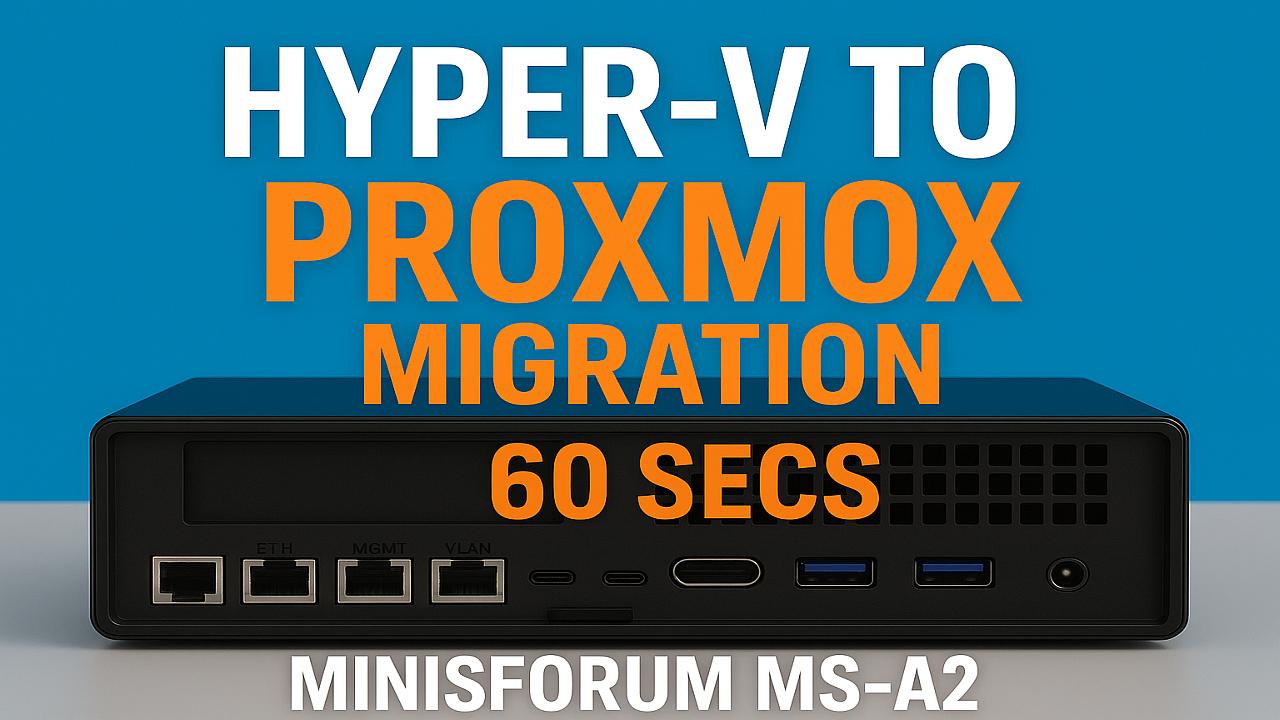
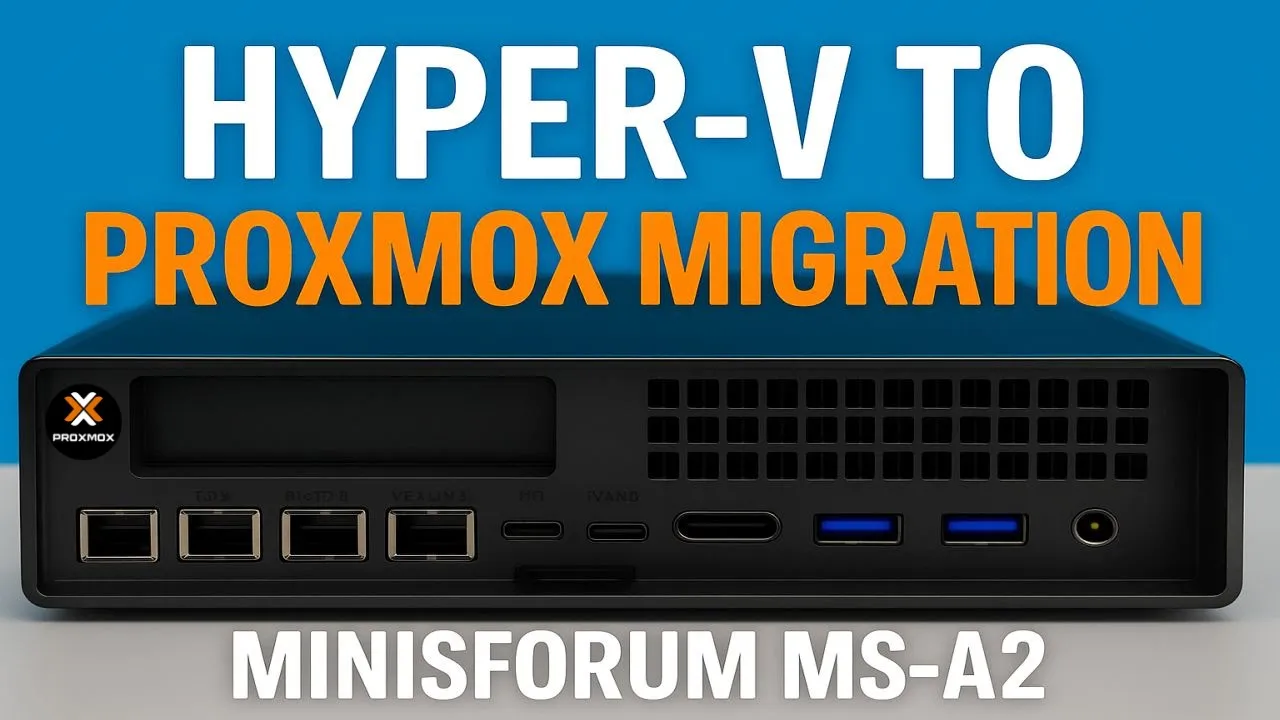
Minisforum MS-A2 Hyper-V to Proxmox 9.0 Migration Minisforum MS-A2 Series Part 15 Ultimate #homelab
In this episode of Hancock’s VMware Half Hour, I walk you through migrating Hyper-V virtual machines to Proxmox 9.0 on the Minisforum MS-A2.
We’ll cover connecting to the Proxmox server via SSH, exploring datastores, working with VHDX files, and running migration demos—including moving a full VM in under 60 seconds! This step-by-step guide shows how easy it is to transition workloads from Hyper-V into Proxmox for your #homelab or production environment.
Whether you’re testing, learning, or planning a migration, this video gives you the tools and knowledge to make it happen smoothly.
Scripts are here on GitHub – https://github.com/einsteinagogo/Hyper-VtoProxmoxMigration.git
In Part 6 of the Minisforum MS-A2 Series, we show you how to migrate VMware ESXi Virtual Machines (VMs) to Microsoft Hyper-V on Windows Server 2025 — using the powerful and compact Minisforum MS-A2 as the ultimate homelab platform.
This video features Veeam Backup & Replication v12.3 to safely back up your ESXi VMs and restore them directly to Hyper-V. It’s a clean and efficient migration method for anyone exploring life after VMware.
Whether you’re planning a full platform switch or testing a hybrid setup, you’ll find practical, step-by-step guidance from backup to restore — with key gotchas and tips throughout.
In this episode, you’ll learn:
Preparing VMware ESXi VMs for migration
Creating backups using Veeam v12.3
Restoring backups to Microsoft Hyper-V
Configuring networking, storage, and integration services
Post-migration testing and optimization
Real-world advice for homelabbers and IT professionals
Perfect for #homelab enthusiasts, sysadmins, and IT pros evaluating alternatives to VMware.
Got questions or want to share your experience? Drop a comment below!
Like this video if it helped you
Subscribe and hit the bell to follow the full MS-A2 homelab journey
Hey everyone — welcome back to Andysworld!, where there’s always something bubbling in the pot (usually tech-flavoured, sometimes coffee, sometimes bees).
500 Hacks a Day — Mission Accomplished!
After a consistent streak of daily pwnage, I’ve finally hit 500 hacks a day on TryHackMe! It’s been an epic ride, sharpening my skills and staying sharp in the ever-evolving world of cybersecurity. But… that’s it for now. As much as I’ve loved the challenge, life’s too hectic to keep up the daily grind — and honestly, it’s time to re-balance.
If you’ve not tuned into Hancock’s VMware Half Hour yet, what are you doing? ? The YouTube channel is keeping me plenty busy — but it’s worth every minute. From real-world scenarios to community spotlights and the latest from the VMwareverse, it’s been great to share stories, learn, and laugh with fellow techies around the world.
Catch the next episode if you haven’t already — things are just heating up.
vExpert PRO – 5 Years Strong!
Big news landed this month — I’m proud (and humbled) to announce that I’ve been recognised as a VMware vExpert PRO for the fifth year running. Not only that, but I’ve also picked up the vExpert VCF badge, too!
This recognition means a lot — it’s not just about titles; it’s about community, contribution, and passion. The vExpert family has been a huge part of my journey, and it’s an honour to continue helping others grow and succeed in the ecosystem.
and that’s not forget the Bees !
Beekeeping at Meltonby Honey
Bees are a mixed bag this is to say, some are doing really well, and some are not doing so well, so this month of June, in the June Gap – need to start sorting out and selecting hives to work this Summer, and dare I say it starting Winter preparations, and a week today attend a Bee Health Day, sponsored by DEFRA !
That’s it for now — life’s buzzing, tech is flying, and the blog never sleeps (even if I do). Thanks to everyone who’s been along for the ride so far.
Until next time — stay curious, stay hacking, and don’t forget to say “What’s Occurin’?” ?
If you’ve been following me for a while — either here on Andysworld! or on social — you’ll probably have noticed I’ve got a bit of a thing for TryHackMe. That’s right: the gamified, hands-on cybersecurity platform that lets you “learn hacking the fun way.”
While I’ve worn many hats over the years — from building corporate desktops in the 90s to deploying Thin Clients, backing VMware before it was cool, and even keeping bees in my spare time — I’ve always had a quiet curiosity for cybersecurity.
But in recent years, that curiosity has turned into something more structured. I’ve been diving head-first into daily challenges, CTFs, and red team/blue team rooms on TryHackMe. Every day I log in and test my “hacking” and “penetration” skills. (Legally, of course. Let’s not get too excited.)
Why TryHackMe?
Simple: it’s accessible, addictive, and just plain fun. The platform breaks down complicated security concepts into digestible learning paths and real-world scenarios. Whether you’re into Linux fundamentals, web app hacking, or breaking into Windows environments, there’s something for everyone — and something new to learn every day.
I started with a few easy rooms — some were fun, some had me questioning my life choices — but before long I found myself chasing streaks, solving buffer overflows, exploiting SQL injections, and pivoting through internal networks like it was second nature. It’s part puzzle, part education, and part thrill.
That Daily Streak… and the Climb
I’ll admit it: I got hooked on the daily streak. There’s something about seeing that little flame icon next to your
name that sparks a sense of achievement. Each day I carve out time to complete at least one room, even if it’s a short task or a simple walkthrough. And in doing so, I’ve kept my streak alive and sharpened my skills without ever feeling like it’s a chore.
And here’s the kicker — recently, after being ranked #1,060 out of over 3 million TryHackMe users, I finally cracked the four-digit barrier and rose to #998! Top 1,000 in the world. Not bad for a “beekeeper with a hacking habit,” eh?
Oh — and right now, I’m sitting on a 461-day hacking streak. That’s right. 461 consecutive days of training, solving, cracking, and learning. I’m not far off the 500-day HackStreak badge, and believe me — I will get there. It’s part stubbornness, part obsession, but mostly just a whole lot of fun.
What’s Next?
Honestly, I’d love to get into some deeper reverse engineering, exploit development, and maybe even take on some of the harder red team labs. And who knows — maybe I’ll finally take a proper cert (OffSec, I’m looking at you) just to prove to myself I can.
TryHackMe has rekindled my passion for hands-on learning, just like Experts Exchange did in the early days. It’s reminded me that whether you’re troubleshooting snapshots, spinning up ESXi hosts, or brute-forcing a login page, there’s always more to learn.
Whether you’re an old-school sysadmin like me, a student just starting out, or someone who’s just curious about hacking without getting arrested — I highly recommend giving TryHackMe a spin.
And if you’re already in the game — drop me a message. I’ll see you on the leaderboard ?
Want me to whip up a graphic showing your current rank and streak progress? I can give it that polished blog badge feel.
In this video, I will show you HOW TO: Install Open Virtual Machine Tools for Linux on a VMware Linux virtual machine on a VMware vSphere Hypervisor 7.0 (ESXi 7.0) Host Server, using the VMware Host Client. The virtual machine has Ubuntu 20.04 LTS Desktop edition installed.
In this video, I will show you HOW TO: Install VMware Tools for Linux on a VMware Linux virtual machine on a VMware vSphere Hypervisor 7.0 (ESXi 7.0) Host Server, using the VMware Host Client. The virtual machine has Ubuntu 20.04 LTS Desktop edition installed.
In this video, I will show you HOW TO: Create your second Linux Virtual Machine on a VMware vSphere Hypervisor 7.0 (ESXi 7.0) Host Server. The Linux Distribution we will install is Ubuntu 20.04 LTS Desktop Edition.
In this video, I will show you HOW TO: Create your first Linux Virtual Machine on a VMware vSphere Hypervisor 7.0 (ESXi 7.0) Host Server. The Linux Distribution we will install is Ubuntu 20.04 LTS Server Edition.




![[Valid RSS]](http://andysworld.org.uk/images/valid-rss.png "Validate my RSS feed")