Welcome to the FishHouse Blog!

Water Chemistry Lesson Part 1

Sunday, October 9th, 2005

The secret of breeding and keeping fish is all about managing water, and to successfully manage water you need to understand a little water chemistry.

pH
pH is the measure of acidity or alkalinity of water. A pH reading of 7.0 is neutral. A pH higher than 7.0 is alkaline, and a pH lower than 7.0 is acidic.

pH is defined as follows: the lower-case letter “p” in pH stands for the negative common (base ten) logarithm, while the upper-case letter “H” stands for the element hydrogen. Thus, pH is a logarithmic measurement of the number of moles of hydrogen ions (H+) per liter of solution. Incidentally, the “p” prefix is also used with other types of chemical measurements where a logarithmic scale is desired, pCO2 (Carbon Dioxide) and pO2 (Oxygen) being two such examples.

In layman’s terms this means, that a 0.2 change in pH is a big change to fish, never try to change the pH of aquarium water by more than 0.2 a day.

I use an Aquarium test kit, manufacturered by Aquarium Pharmaceuticals Inc to test for pH. This is a wet kit, but there are many different test kits around, and some dry kits which are quicker to use, but more expensive. I also use digital pH testers for quickness, but the pH probe has a life, and must be regularly calibrated before use.

ph Meters

pH should be tested weekly, since natural materials in the aquarium can cause a pH change.

KH
K(c)arbonate hardness is the measure of carbonate and bicarbonate ion concentrations dissolved in water. These minerals are present in our tap, well and bottled spring water. The level of carbonate hardness in tap and bottled water depends on the source of the water and the treatment process it has undergone. Carbonate hardness helps stabilize pH in the aquarium. An aquarium with a very low KH < 50ppm will tend to be acidic. Aquariums with a very low KH level are subject to rapid pH shifts, if not monitored carefully, sometimes referred to a pH crash. Water with a high KH level > 200pm usually have a high pH. KH is usually measured in dKH.

KH Test Kit

GH
General Hardness is the measure of calcium and magnesium ion concentrations dissolved in water. These minerals are also present in in our tap, well and bottled spring water. It also depends on the source of the water and the treatment process it has undergone. Hard water > 200ppm is high in calcium and magnesium, while soft water 50 – 100ppm is low in these minerals. GH is usually measured in dGH.

To convert both GH and KH to parts per million (ppm) multiply by 17.9.

I use a test kit manufactuered by Aquarium Pharmaceuticals Inc to test for KH & GH.

Why am I telling you all this? Over the forthcoming weeks, I’ll be installing a Dennerle CO2 system into my display tank to aid plant growth, and I’ll be using terms such as pH, KH and GH, so you’ll understand what I referring to!

Replacment Air Filter for Hailea Air Compressor

Saturday, October 8th, 2005

As promised I received the replacement air filter for my Hailea Air Compressor from those nice people at Pond Suppliers UK. It’s been fitted to the air compressor, and appears to be working correctly. The original air filter had split and air was being sucked in through the crack and not the air inlet.

Hot or Cold?

Friday, October 7th, 2005

After some careful consideration, considering the advantages and disadvantages, I have decided to re-locate the air-inlet to my compressor back into the fish house in the garage, at ceiling height. I’ve drilled a small hole in my jablite partition and inserted the eheim tubing which connects to the air-inlet of my Hailea Air Compressor.

Air Compressor

Advantages of Internal Air

  • Internal air tends to be of a constant
    temperature.
  • Internal air tends to be of a constant
    humidity.
  • Internal air will be free of pollutants.

Disadvantages of External Air

  • Cold external air will cool the body of the compressor,
    possibly causing some condensation and water damage to the surrounding area.
  • It will cool the aquariums.
  • Air could be contaminated.

What’s for supper?

Thursday, October 6th, 2005


An aquarist in Germany recommended that I try
Sera
Catfish Chips for Ancistrus and Pleco Catfish if I’m finding it difficult in obtaining Hikari
Algae Wafers, he has had great success with this product in Germany. Many high
quality aquarium products come from Germany, Eheim,
Tetra and
Dennerle
are just a few manufacturers,
so I’ll definitely experiment with this product.

Sera retailers in the UK are not common, but I know a place on my doorstep that
stocks Sera products. Petland, York is a
Sera retailer.

I purchased some Sera Catfish Chips for Ancistrus and Pleco Catfish, the
ingredients are very interesting because the usual marine algae and spirulina
are present, but willow wood and bark and alder wood are also ingredients. This
product will certainly help if you have no bogwood present in your aquariums for
the catfish to graze on. Many years ago, when I first saw a "pleco" in aquaria,
it was given willow wood and bark to graze on, this was before the days of any
"Algae Wafers", it was said, that chemicals in the willow made the catfish
sleepy, like an anaesthetic if they ate too much, so it was only fed in small
quantities. This is the first fish food product I’ve seen using "wood" as an
ingredient.

I offer my fish a varied diet to stop them getting hooked on one type of
food, I vary the food each day, here’s a list of the products I use:-

  • Tetra Prima.
  • Tetra Tips Freeze Dried Tablets.
  • Tetra Fresh Delica Daphinia, Bloodworm, Brine Shrimp.
  • Tetra Holiday and Weekend Food Sticks.
  • Tetra Min Flake Food.
  • JMC Catfish Pellets.
  • Barlow’s Aquatics Sinking, Stinking Catfish Pellets.
  • Nutrafin Max Complete Flake Food.
  • Aquarian Tropical Flake Food.
  • Phoenix Tropical Flake.
  • Today’s Freeze Dried Tubifex Worms.
  • ZM 000, 100, 200, 300, 400, Small, Medium and Large Granular Advanced Fish
    Diets.
  • Ruto Frozen foods, Spinach, Tubifex and Bloodworm.
  • Frozen prawns.
  • Courgettes, Cucumber, peas and lettuce.
  • Live Food when available.
  • and Sera Catfish Chips for Ancistrus and Pleco
    Catfish.

When I first started "fishkeeping", many years ago, when my Dad won a
goldfish at the Fun Fair, we came home with a glass goldfish bowl, and a
cardboard tube of ant eggs to feed the goldfish.

Tropical Fish Food Technology has greatly improved! If it had not improved, I
don’t think I would have been as successful in breeding and caring for the
tropical fish in the many years I’ve kept them. For many years I was hooked on
Aquarian Tropical Flake, not personally, but variety is the spice of life!

Go on, change your food today!

Time flys by when your the driver of a train…..

Wednesday, October 5th, 2005

Another emergency again this evening, and it would happen when I’m pulling the late shifts in the office.

Arrived home at 7.15pm to find one of my display tanks in the house very cloudy, checked the Eheim 2015 External Canister filter, and again it had stopped working, I’ve previously reported this failure a few weeks ago.

I checked the water quality, and the ammonia was higher than usual, this could be the filter has stopped working, or the addition of the vallis which has been slowly rotting.

I completed a 50% partial water change, with water at the correct temperarture and pH.

I’ve also brought in a “daddy” of a filter an Eheim 2317 external canister filter, this is a mature filter, that is used in the fish house, as a standby filter for emergency use.

I must now investigate why the 2015 is failing.

Collection of Eheim Filters

This picture shows an Eheim Classic 2015, 2313 and 2317, along with Hy-Flo Model C, UV Filter and Dennerle Profi 2000 System.

Fish House

Wednesday, October 5th, 2005

This is a picture of the fish house, I took some months ago, I’ve had to mangle many photos together because I couldn’t fit it in the frame, but you’ll get the general idea, of what it looks like, and what keeps me busy.

Fish House

I’ve just added some new blog code, and wanted to test it here! I’ve hopefully fixed the bugs now. Where do I get the time!

Bubble, bubble, toil, and trouble!

Tuesday, October 4th, 2005

….The Witches Cauldron Brew, the
bogwood is still soaking nicely.

I’ve seen the
L190
this evening, it’s still in the tank and feeding. I visited
Petland in my lunchtime today in York, they have an excellent collection of Ls
in stock, I almost parted with an

L177
but needed to catch the bus! Maybe next time! I don’t think they
have a website, but here’s a
review
by the Ryedale Aquarist Society.
 

I’ve just noticed that I use the
terms Ls and Lxxx numbers a lot, and some readers may be confused with what I am
referring to. The group of catfish I keep are in the scientific name
Loricariidae, this is pronouced
Lori KARI Iday or more commonly referred to Suckermouth Armoured Catfishes (yes
they do stick to the glass!), they have rows of armour plating covering body,
underslung suckermouth. They all come from South America. Originally when a
suckermouth armoured catfish was discovered, it was given a scientific name (latin),
and a common name, as more were discovered in recent years it became impossible
to readily identify them, and give them common names, so the L numbering system
was invented to uniquely identify each catfish, and hence the L series was born,
there is also an LDA series, the same has also been done for Corydoras
catfishes, Cichlids and Rays.

Endlers’ are doing well, and have another four fry.

Purple Spotted Gudgeon in the fish house are massive compared to the fish in the
display tank. Sexual difference possibly.

Many projects still to complete, fish house needs a tidy for the forthcoming
cold weather, and I’ve got a new temperature project finished, but need to
relocate the computer system in the fish house.

Again, I’m pulling the late shift all week, at the office, so not much time to
organise the fish house.

Had an excellent response from

Pond Supplies UK
, and a replacement end-cap for my Hailea air compressor
has been posted. That’s Excellent Customer Service, I’m still awaiting to hear
from Java-Plants (I think all
the Vallis is now dead!).

Search Archives Button

Monday, October 3rd, 2005

I’ve added a Search Archives Button, so you can now search the archives easier, the Search Tool is in the Right Hand Margin. It looks like this:-

The format is a bit off, but I’m not a graphic designer.

Young Koi Angelfish

Monday, October 3rd, 2005

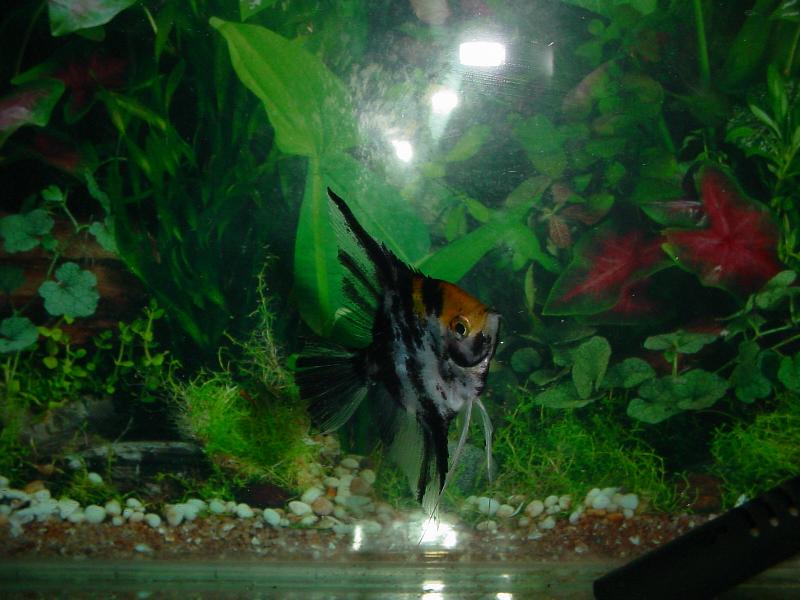
This is one of my special Koi Angelfish I’ve breed.

Young Koi Angelfish

Sorry for RSS users, I’m modifying the blog code, to add new features. So you may get this entry a few times, depending on how often you download the RSS feed.

Cheap Alternative to Aquatic Planting Kit Pots

Monday, October 3rd, 2005

This was emailed to me by a fellow aquarist after having difficulties with the gibbiceps digging up the plants in my display tank. Reproduced here in its entirety with permission of the author – Amerce.

“Actually I managed to rig something a little bit cheaper up for myself with items I had left over or had squirreled away.

I had some peat left over from my killifish breeding pots (sterilized in the microwave), I had some aquarium sand (£2+ for a 3 kg bag), some fine gravel left over from another aquarium and some plastic containers left over from various things (Ferrero rocher container, strawberry punnet container etc. I’d punched some holes in the container bottom beforehand), the most expensive part was buying the plants and the plant rooter granules.

I lined the bottom of the containers with some peat, sprinkled some of the root granules and then tied up the plants (using the lead that java sent me), once I had decided where all the plants were going I then used the wet sand to firmly place the plants in the container (I’d washed the sand earlier and it was still a bit moist) the sand acted like putty and was easy to shape and mould around the plant roots, then I sprinkled the gravel over everything to make sure the sand and plants didn’t float up once it was placed in the tank, and because the containers had been punched before the water soaked in to the base of the container and gradually filled it and it sank nicely without loosing the plant, soil, or sand.

This way the undergravel isn’t bunged up with roots from the plants and you can take out the containers at any time to do plant maintenance and also move the container where ever you want without upsetting the plants too much.”

So this Christmas, save those Ferrero rocher containers, and recycle them, and save them from landfill!

Ruto Logo
Ruto Frozen Fishfood

http://www.monsterfishkeepers.com

www.planetcatfish.com

http://www.plymouthdiscus.com/

http://www.magclip.co.uk/

Dyed Fish Campaign