Posts Tagged ‘watts’
Demonstration of Wattson
Monday, October 29th, 2007Planting Seeds
Sunday, October 28th, 2007Planting more seeds today later in the greenhouse, postponed moving the last three fish tanks into the fish house because the weather is terrible.
So here’s some more pictures of my new friend “Wattson”
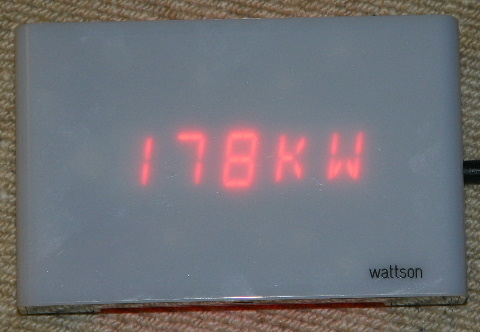
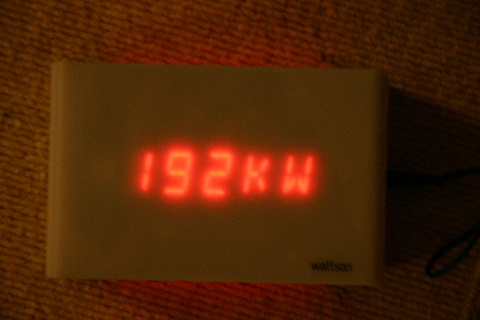
Polar Bear Killer!
Saturday, October 27th, 2007
20.7kW (realtime reading of electricity being consumed at 1.30am 27/10/07)
Maybe I need to change the subject title, doesn’t seem very nice, and what’s this go to do with the FishHouse Blog. You’ll probably hear this term more and more, as we all strive for a greener planet and reduce our carbon foot prints! Has the penny dropped yet! But we all need electricity to run our fish houses, every year I see more and more people leave the hobby, and close fish houses, and it’s not surprising with rising energy costs. But don’t all hobbies cost money!!!?
To celebrate my big birthday coming up in November, I’ve purchased myself a present from Better Generation, it’s a Smart Electricity Meter called a Wattson by DIY Kyoto. I’ve already got a few power meters, that I purchased in October 2005, see my review here these record the power being used by an individual appliance, or if you use a four/six-way adaptor, you can measure combined power, I’ve been using these in my fish house for years. But want I wanted was a device that could measure total power consumed after the electricity meter before the consumer unit (fusebox), transmit it remotely to a display in the house, and finally output and record the information to a PC, so I can compare electricity consumption versus temperature in the fish house and outside during the winter and summer months. Also looking at the electricity used by our Economy 7 Storage and Immersion Heaters.
I pre-ordered this unit, at the beginning of October ’07, and it arrived yesterday it’s FANTASTIC!. I’m not going to write a review, because there our lots of fab reviews out there about the product, check Better Generation for one.
It’s a designer gadget with mood lighting that measures electicity consumed and outputs it to a PC.

The Wattson smart electricity meter showing 21,000 Watts (21kW) being used at 1.30am last night, when the storage heaters came on! Average consumption is about 3kW in the house. This is mainly the fish house and computers in the house, most other electrical appliances are negligible by comparison, but if high wattage appliance is turned-on, e.g. kettle, Wattson spots it! and flashes changes from purple flashing to red!
Polar Bear Killer!
Saturday, October 27th, 2007
20.7kW (realtime reading of electricity being consumed at 1.30am 27/10/07)
Maybe I need to change the subject title, doesn’t seem very nice, and what’s this go to do with the House Blog. You’ll probably hear this term more and more, as we all strive for a greener planet and reduce our carbon foot prints! Has the penny dropped yet!
To celebrate my big birthday coming up in November, I’ve purchased myself a present from Better Generation, it’s a Smart Electricity Meter called a Wattson by DIY Kyoto. I’ve already got a few power meters, that I purchased in October 2005, see my review here these record the power being used by an individual appliance, or if you use a four/six-way adaptor, you can measure combined power, I’ve been using these in my fish house for years. But want I wanted was a device that could measure total power consumed after the electricity meter before the consumer unit (fusebox), transmit it remotely to a display in the house, and finally output and record the information to a PC, so I can compare electricity consumption versus temperature in the fish house and outside during the winter and summer months. Also looking at the electricity used by our Economy 7 Storage and Immersion Heaters.
I pre-ordered this unit, at the beginning of October ’07, and it arrived yesterday it’s FANTASTIC!. I’m not going to write a review, because there our lots of fab reviews out there about the product, check Better Generation for one.
It’s a designer gadget with mood lighting that measures electicity consumed and outputs it to a PC.
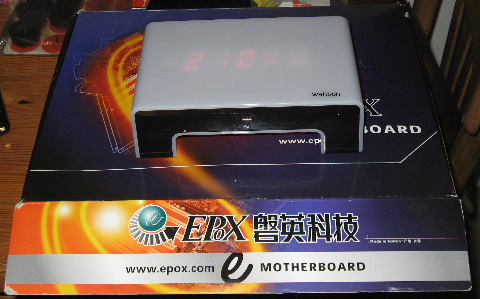
The Wattson smart electricity meter showing 21,000 Watts (21kW) being used at 1.30am last night, when the storage heaters came on! Average consumption is about 3kW in the house.
Andy’s HandyPro 3500L
Sunday, October 15th, 2006Due to a local power outage in July when I was moving the Fish House, I lost a pair of Angel fish and a Magnum Pleco. Unfortunately, the power outage lasted in excess of 12 hours. Power outages in this area always occur, usually in the Summer months of July and August after the thunder and lightening storms. We very rarely have power outages in the Winter months. I decided in July to purchase a 1kVA (1000 watt) petrol generator from B&Q for 99 GBP UK pounds. Very little money to protect the fish house, if there should be a power outage. It’s only 1kVA (1000 watts), which is about 700 watts of power, using a 8 litre tank of petrol, it will not run the entire fish house, but will keep filters and air pumps running, and a few heaters until power is restored.
Lately, I’ve had a few problems with this unit, leaking petrol tank, after speaking with Performance Power Customer Support, I was not happy with the quality of this unit, and I’ve since noticed that B&Q have reduced these units to 79 GBP UK pounds, so I decided to return to B&Q for a refund.
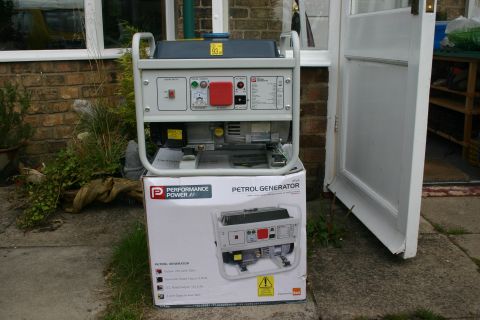
B&Q 1kVA Performance Power Petrol Generator
This was the replacement I’ve purchased, a Briggs & Stratton HandyPro 3500L, this unit is based on the Classic Pro 3500, 16 litre petrol tank, a run-time of 11 hours @ half load. 2.7kVA (2700 watts), 10Amps. It weighs approx 66kg when filled with petrol!

Briggs & Stratton HandyPro 3500L
I’ve been testing it today, by boiling water in a kettle connected to it, it’s also quieter than the cheaper B&Q model.
Do you suffer from high electricity bills?
Tuesday, November 1st, 2005If the answer is yes, then please read on, I’ve found an electronic wattage
and current meter which I’ve been using in my fish house for about a week, to
analyse running costs and efficiency of heaters, filters, air pumps and
compressors in order to reduce my electricity bill or possibly complete the
calculations and switch to Economy 7. I’m so impressed with this device, I want
to share my experiences with you, so you too can reduce your electricity bills.
The Wattage and current meter in use:-

1. Plugged into a standard UK Socket. The unit has seven modes of
operation that can be selected using the Function Button.. When first connecting
the units to AC it shows the date, day and time. This can be set using the Set
and Change buttons.

2. An electrical appliance is
connected to the socket, Voltage Display
Maximum current is 13A, 220-250v AC that can be drawn by an electrical
appliance, so this should be ample for most electrical appliances fitted with a
standard 13A plug. Mode 1 shows the present voltage (V) and frequency (Hz) being
supplied to the appliance. I’ve connected an Eheim 1260 External pond pump to
the meter for these tests. . The display shows 241v and 50Hz in the photograph.

3. Amps display
The present current strength (A) and the power factor received by the
appliance are displayed. The display shows 0.45A and 0.80 power factor in the
photograph.
 4. Wattage display
In this mode, the power is displayed in Watts. The photograph shows 87.12 W,
this is an interesting measurement, because the manufacturer states this has a
power rating of 65 watts. I have found this mode very helpful, in checking
appliances for efficiency. You cannot always believe, what is typed on the
sticker, and certainly with air compressors and blowers, wattage increases under
heavy load and clogged air stones.

The wattage display has another display which is very useful, especially for
measuring Maximum wattage drawn by an appliance(s). When pressing the 2-Price
button in wattage display, it shows the maximum wattage recorded and pressing
the 2-button display again displays the date and time at which it was recorded.
The photograph shows a maximum recorded wattage of 1222W (1.2kW). This was
previously recorded when the unit was connected to a multi-channel thermostat
controlling the temperatures in six aquariums in the fish house.
 This display shows the date and time the maximum wattage was recorded. The
photograph shows 15:56 Sunday, this coincides with me opening and closing the
fish house doors, when completing partial water changes. I’ve also now been able
to graph, temperature drops in the fish house, with external temperature outside
temperature, and add extra insulation, I’ll also be using a fan heater in the
colder evenings with a electronic plug-in thermostat, to come on to keep the
ambient fish house temperature at approx 25 degreesC.

5. Operation Duration
The total time displayed during which the connected appliance has been
switched on. If the electrical appliance draws no current, no time is recorded.
The photograph shows the multi-channel thermostat has been connected for a total
of 62 hours and 11 minutes.

6. kWh display
A very important mode, in this mode, the cumulative total electricity
consumption by the connected appliances in kWh is displayed. This is important
because it is this unit, that we are charged for by our electricity suppliers,
and is often referred to as the Unit charge. I currently pay 8.1p per kWh to
Npower. If the 2-Price button is selected, you can toggle between Peak and
Off-Peak settings, if you have Economy 7.In this photograph 20.38kWh have been
consumed. Most watt meters end here, but there’s more…

7. Electricity price per kWh
This is mode 7, but I’ve jumped to this mode for a reason. This unit, allows
you to program the cost of Electricity price per kWh, at day and night rates if
you have Economy 7. I’ve set the meter at 8.1p per kWh in the photograph. Other
current and watt meters do not allow you to set a cost, and you need to complete
the maths, not difficult, but if you have a device that can automatically
calculate the cost, and display it, you can easily see at a glance, how much an
item is costing you, and how hard it’s hitting your pocket.

8. Cost
This is what we all want to know and calculate, we can gather the the
manufacturers wattage for an appliance, calculate the kWh and complete the maths
to finally calculate the cost, BUT manufacturers specifications are incorrect,
it is very difficult to account for thermostatically controlled appliances,
aquarium thermostats and heaters, that are not connected 24 hours a day, fridge
freezers etc
Actual measurement of the appliance under test is the only true method, of
costing an appliance.
In this photograph it shows a value of 1.65 GBP, this is how much it costs me
to heat six fish tanks in my fish house for a period of 63 hours and 11 minutes,
maximum wattage recorded was 1.2kW at 15:56 Sunday 30th October 2005, when I
opened and closed the fish house door! I hope this information has been useful.
Some technical details on the current and wattage meter are as follows:-
- Modern electronic monitoring system permits readout of electricity
consumption and running costs of connected appliances. - Clear display, including actual time and day of the week.
- Voltage and frequency display in AC volts (V) and Hertz (Hz).
- Display of present current consumption and true power in amps (A) and cos
phi. - Power consumption display in Watts (W).
- Display of metered period in hours and minutes.
- Display of total current consumption during metered period in kWh.
- Display of total costs of metered current consumed.
- Display of local electricity tariff per kWh. (user programmable).
- Maximum power recorded against date and time.
- Helps to save costs and electricity.
- Maximum current 13 Amps.
- Made in Germany.
- Battery backup, so you don’t have to re-input date and time, price per
kWh. - Available mail order from
JLB
Electronics via the Internet.
This wattage and current meter is unique, do not be fooled by cheaper units
made in China, this is the only unit that can be programmed with your
Electricity Unit charge (price per kWh, available from you electricity bill),
that will give you a real cost displayed in pounds and pence, it’s also the only
unit that records maximum power drawn, which is time stamped. I believe this is
available exclusively from
JLB
Electronics, but don’t quote me on that. I’ve already purchased two units.
I’m not easily impressed with electronic gadgets but this wattage and current
meter rocks big time, and "it does what it says on the tin", don’t take my word
for it, purchase one and test it for yourself. An excellent Christmas Present.
Spot the difference!
Tuesday, October 18th, 2005
And then there were two. These are two slightly different filters. The Eheim filter on the left is an Eheim 2034, and the filter on the right is an Eheim 2030 External Canister Filter. Both have filter volume capacities of 18l, both rated at approximately 60 watts, same as a standard light bulb. The main difference are the external oil-cooled pumps, the 2034 uses the 1034 pump, rated at 2160l/h, the 2030 is rated at 1200l/h. Suitable for fish tanks up to 1500l and 1000l respectively.
These oil-cooled external pumps which can be used in extremely humid spaces and outdoors are superior to there air-cooled cousins. Unfortunately, Eheim no longer manufacture these units, and haven’t done so for a long time.
After soak testing the 2030, I’ve noticed a small leak again, I may decide to purchase a replacement Threaded inlet connector for 2250/2260 (Part No. 7276900), part from the later 2250/2260 are compatible.
Concerned with all this electricity I’m burning and escalting electricity costs, I’ve just purchased some digital units, that will calculate my electricity running costs of the fish house, and individual items. I’ll review it here when they arrive shortly.
It could be cost effective to install a central filtration system with all this filter power!
New Air Compressor Arrives
Thursday, September 15th, 2005
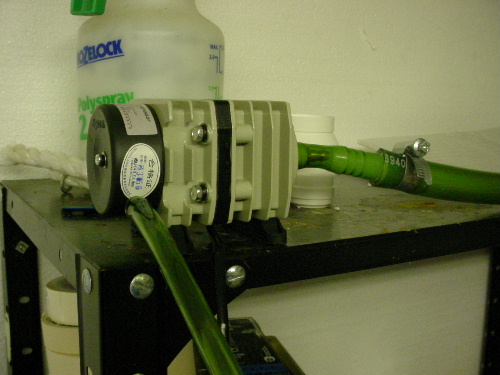 The
The
Hailea ACO-208 arrived today by ANC Courier to my Office address. I purchased
this from
POND-SUPPLIES-UK,
Hebden Bridge, Yorkshire. Excellent customer service. This compressor is
much smaller than I had imagined, although I had the technical specification, I
never thought to look at the measurements, I thought it maybe a similar size to
my Clearseal LP40, 40 litre per minute air pump. It’s certainly in a very small
package at 25 watts delivering 45 litre per minute.
Installation was trickier than expected because the air output nozzle is
suited for 8-10mm pipe, I need to connect this to, 19mm bore pipe, so I’ve used
different widths of Eheim tubing glued so I could connect it directly to the
pump, two jubilee clips should finally secure in place. Another feature of this
pump is the air inlet, which I’ve connected small Eheim tubing to, which I’ll
route to the outside of the garage to bring in cooler air, I may have to check
this, because this may decrease tank temperature, by bleeding cold air into the
fish tank. I need to spend some time, locating to air compressor in it’s
permanent position, and migrating the airline to the tanks.
![[Valid RSS]](http://andysworld.org.uk/images/valid-rss.png "Validate my RSS feed")