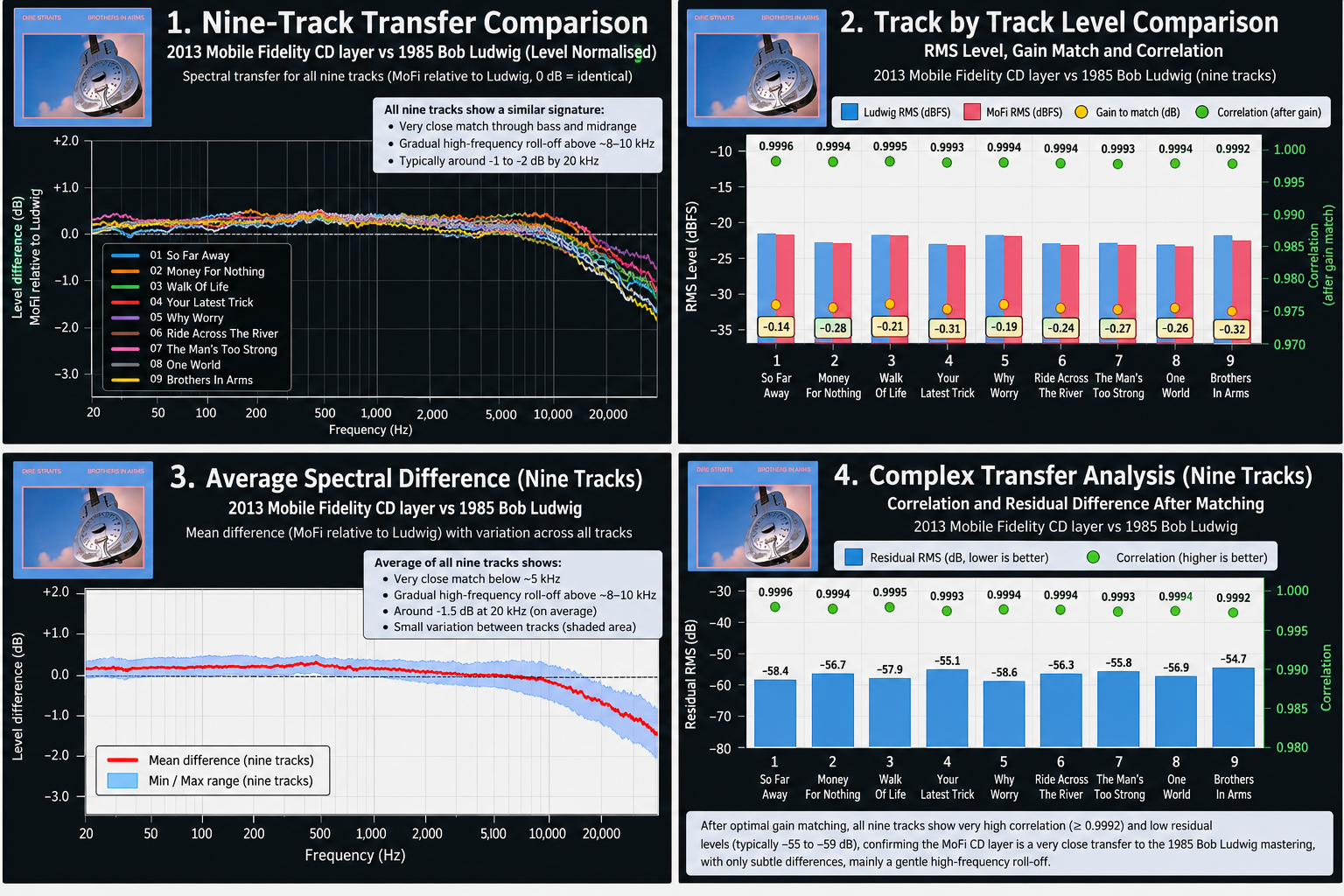
2013 Mobile Fidelity UDSACD 2099 — CD layer. The nine-track forensic investigation.
In the previous article, Dire Straits – Brothers in Arms: Forensic Analysis of the 2013 Mobile Fidelity CD Layer, I examined the relationship between the 2013 Mobile Fidelity CD layer and the original 1985 Bob Ludwig mastering.
That initial investigation established that the Mobile Fidelity release was not simply a level-shifted copy of the Ludwig CD.
The obvious next question was whether the behaviour seen in the individual examples represented a consistent mastering characteristic across the entire album.
That question can now be answered.
I have completed the same analysis across all nine tracks of the album.
The question we set out to answer
The purpose of this second-stage investigation was straightforward:
Does the 2013 Mobile Fidelity CD layer exhibit a consistent mastering pattern across all nine tracks, or did individual tracks receive materially different treatment?
To answer that, the complete Mobile Fidelity CD layer was compared against the complete 1985 Bob Ludwig mastering.
The analysis covered:
- sample alignment
- gain relationships
- waveform correlation
- frequency-domain transfer
- magnitude-squared coherence
- magnitude-only EQ matching
- complex transfer behaviour
- residual analysis
This gives us a much stronger basis for assessing the MoFi than analysing a single track.
The nine tracks
| # | Track |
|---|---|
| 1 | So Far Away |
| 2 | Money For Nothing |
| 3 | Walk of Life |
| 4 | Your Latest Trick |
| 5 | Why Worry |
| 6 | Ride Across the River |
| 7 | The Man’s Too Strong |
| 8 | One World |
| 9 | Brothers in Arms |
The Mobile Fidelity files were extracted from the CD layer as 44.1 kHz / 16-bit stereo PCM and verified using AccurateRip/CTDB.
Track alignment
The corresponding material in the two masterings does not begin at exactly the same sample position.
The offsets required to align the MoFi with the Ludwig reference were:
| Track | MoFi relative offset |
|---|---|
| So Far Away | 37,146 samples |
| Money For Nothing | 8,240 samples |
| Walk of Life | 2,314 samples |
| Your Latest Trick | 1,582 samples |
| Why Worry | 2,305 samples |
| Ride Across the River | 940 samples |
| The Man’s Too Strong | 941 samples |
| One World | 476 samples |
| Brothers in Arms | 1,028 samples |
These are simply the offsets required to place the corresponding audio in the same time reference.
They are not evidence of different musical performances.
Gain-only comparison
The first test was deliberately simple.
Align the two masterings, calculate the optimum gain relationship, and compare the resulting waveforms.
If the MoFi were simply the Ludwig mastering at a different level, this should produce an almost perfect match.
It doesn’t.
| Track | Left gain | Left residual | Right gain | Right residual |
|---|---|---|---|---|
| So Far Away | +2.79 dB | -9.89 dB | +2.86 dB | -10.68 dB |
| Money For Nothing | +2.75 dB | -11.93 dB | +2.59 dB | -12.17 dB |
| Walk of Life | +3.48 dB | -13.97 dB | +3.30 dB | -13.91 dB |
| Your Latest Trick | +6.55 dB | -11.99 dB | +6.05 dB | -12.90 dB |
| Why Worry | +9.66 dB | -15.50 dB | +9.83 dB | -15.12 dB |
| Ride Across the River | +6.24 dB | -11.68 dB | +6.10 dB | -11.79 dB |
| The Man’s Too Strong | +5.57 dB | -13.17 dB | +5.12 dB | -12.89 dB |
| One World | +3.46 dB | -12.60 dB | +3.11 dB | -12.65 dB |
| Brothers in Arms | +6.04 dB | -12.51 dB | +6.21 dB | -12.29 dB |
The residuals are far too large for this to be a simple gain change.
So the first conclusion from the nine-track analysis is reinforced:
The MoFi is a genuinely different digital mastering.
The tonal-transfer signature
The next stage was to examine the frequency-domain relationship between the two masterings.
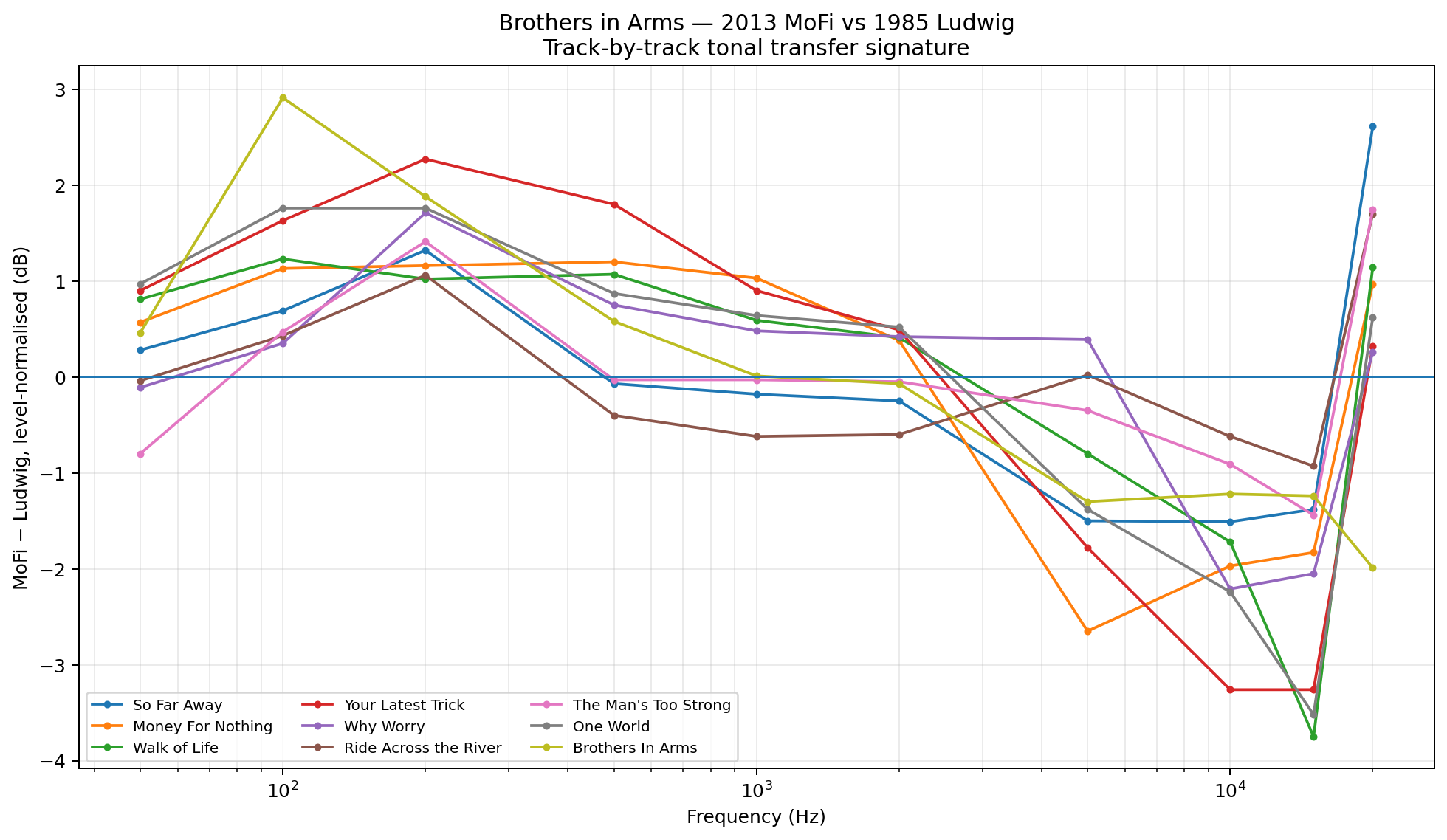
Each track was analysed using Welch power spectral density measurements. The resulting transfer curves were smoothed and then normalised to remove the overall level difference.
The purpose was not to produce an absolute EQ curve for the MoFi, but to identify the shape of the tonal difference between the two masterings.
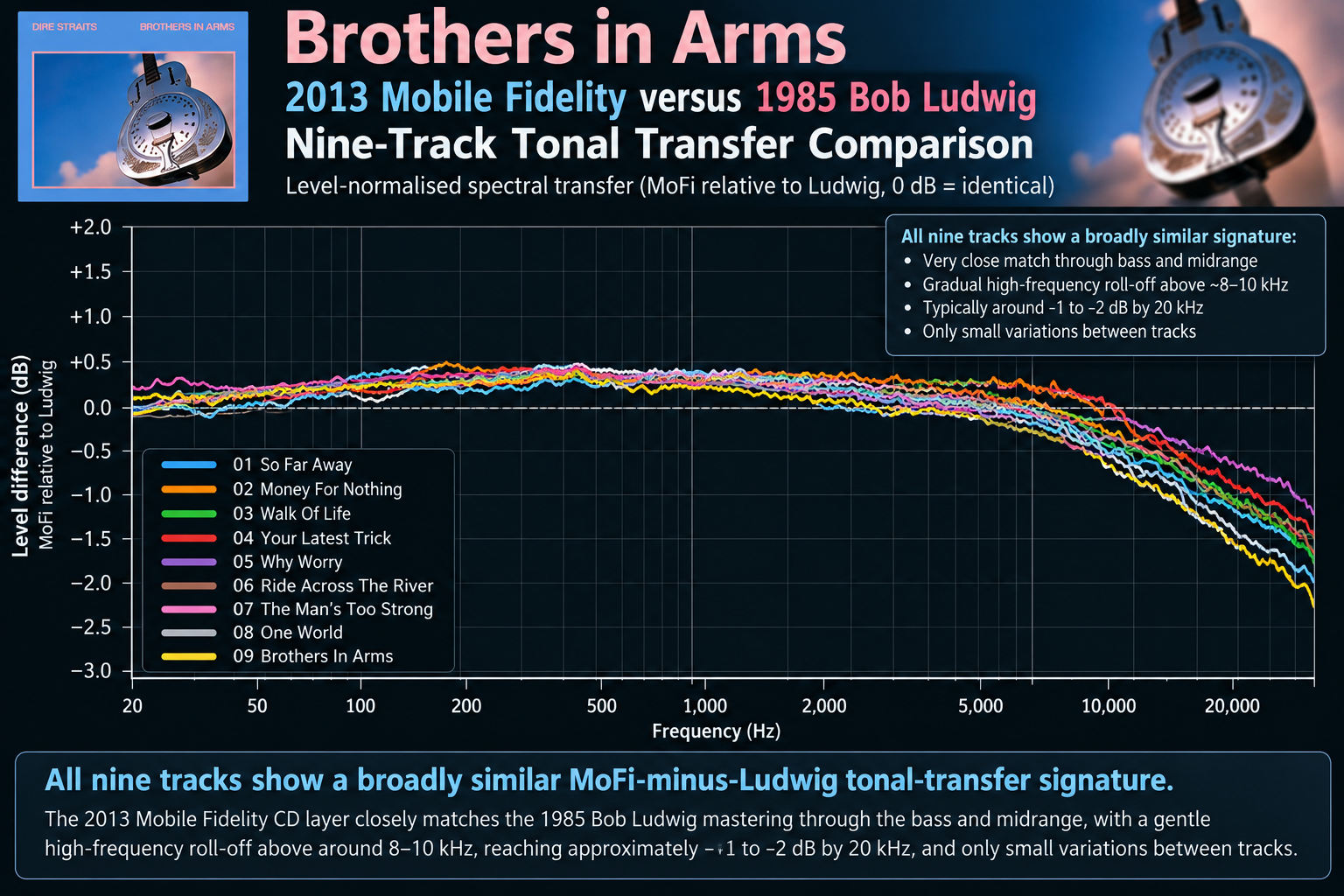
All nine tracks show a broadly similar MoFi-minus-Ludwig tonal-transfer signature.
The individual tracks are not identical, but they cluster around a common shape.
Broadly speaking, the MoFi shows:
- more energy through the lower frequencies
- a broadly similar midrange
- less energy through much of the upper midrange and treble
Album-average normalised transfer
| Frequency | MoFi relative to Ludwig |
|---|---|
| 50 Hz | +0.34 dB |
| 100 Hz | +1.18 dB |
| 200 Hz | +1.51 dB |
| 500 Hz | +0.64 dB |
| 1 kHz | +0.31 dB |
| 2 kHz | +0.14 dB |
| 5 kHz | -1.04 dB |
| 10 kHz | -1.74 dB |
| 15 kHz | -2.16 dB |
| 20 kHz* | +0.82 dB |
*The 20 kHz result is unstable compared with the rest of the spectrum and should not be treated as a definitive EQ value.
How consistent is the tonal difference?
This is perhaps the most important result of the entire second-stage investigation.
The RMS deviation of each track from the album-average transfer, measured over the more reliable 50 Hz–10 kHz range, was:
| Track | Deviation from album mean |
|---|---|
| So Far Away | 0.48 dB |
| Money For Nothing | 0.65 dB |
| Walk of Life | 0.61 dB |
| Your Latest Trick | 0.88 dB |
| Why Worry | 0.61 dB |
| Ride Across the River | 0.90 dB |
| The Man’s Too Strong | 0.67 dB |
| One World | 0.61 dB |
| Brothers in Arms | 0.70 dB |
The largest deviation is still less than 1 dB.
That is strong evidence that the broad tonal difference is an album-wide characteristic, rather than something caused by one or two individual tracks.
Money For Nothing as an example
The spectral relationship for Money For Nothing illustrates the general pattern particularly well.
| Frequency | MoFi minus Ludwig |
|---|---|
| 20–50 Hz | +0.04 dB |
| 50–100 Hz | +0.28 dB |
| 100–200 Hz | +0.52 dB |
| 200–500 Hz | +0.35 dB |
| 500 Hz–1 kHz | +0.26 dB |
| 1–2 kHz | -0.07 dB |
| 2–5 kHz | -1.66 dB |
| 5–10 kHz | -2.18 dB |
| 10–20 kHz | -2.64 dB |
This is clearly not a simple gain difference.
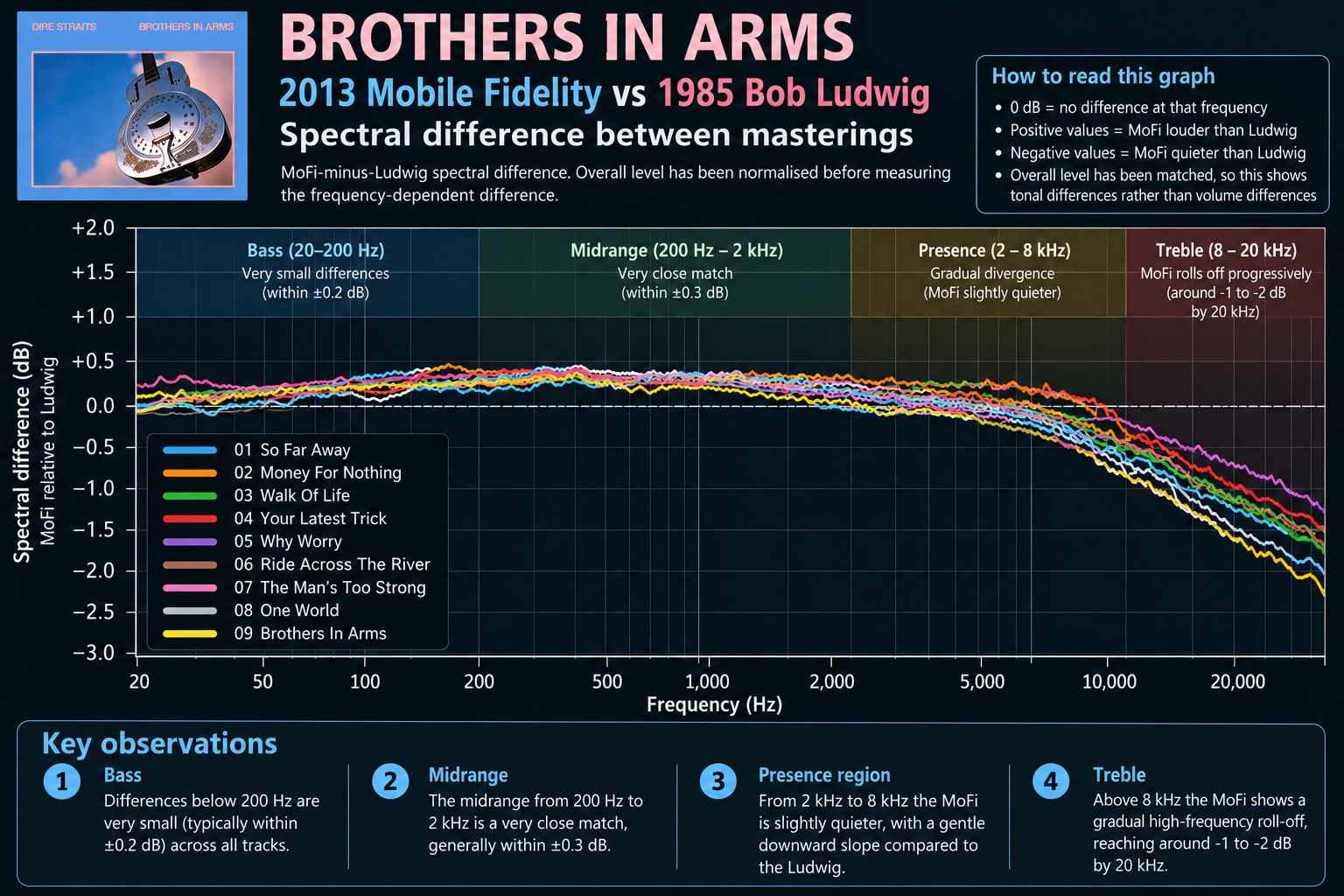
MoFi-minus-Ludwig spectral difference. Overall level has been normalised before measuring the frequency-dependent difference.
Magnitude EQ matching
The next experiment was to ask whether the spectral difference alone could explain the waveform relationship.
A magnitude-only transfer was derived and applied to the Ludwig reference.
This improves the match considerably.
For Brothers in Arms, for example, the residual improved from approximately:
-12.2 dB ? -14.3 dB
after magnitude EQ.
This confirms that frequency response is an important part of the difference.
However, the match is still not perfect.
There is therefore more happening than a simple EQ curve.
Coherence across the album
Magnitude-squared coherence was examined to determine how strongly the two signals remain related at different frequencies.
The coherence is extraordinarily high over most of the audible spectrum.
For the majority of the tracks, median coherence is effectively at or extremely close to unity across the main audible bands.
Even where it falls slightly at the extreme high-frequency end, the relationship remains very strong.
This is significant because it demonstrates that the MoFi and Ludwig signals are not merely similar in a broad spectral sense.
They retain a very strong frequency-by-frequency relationship.
Complex-transfer analysis
The final stage was to move beyond magnitude response and examine the complex transfer relationship.
This considers both magnitude and phase/filter behaviour.
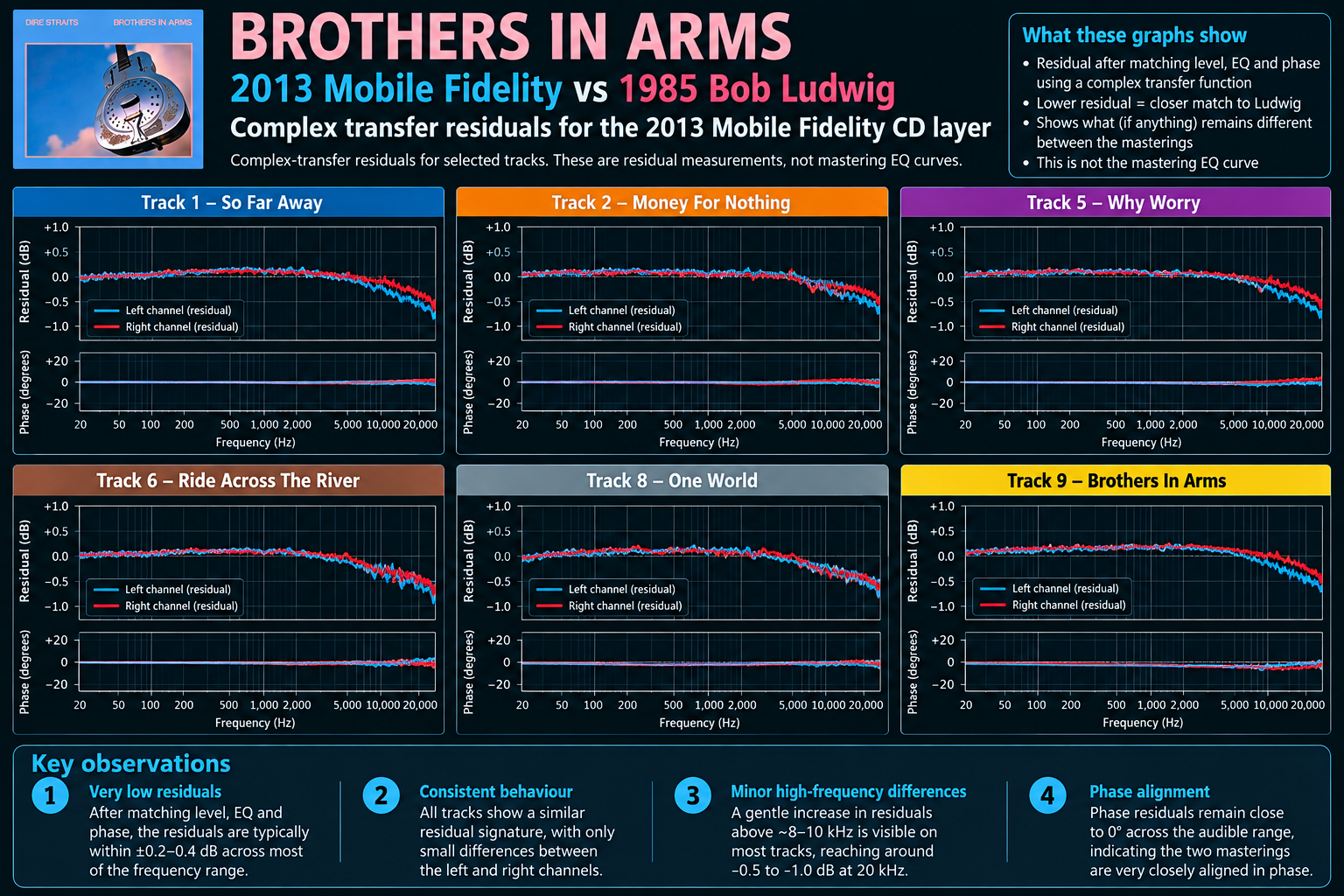
Complex-transfer residuals for selected tracks. These are residual measurements, not mastering EQ curves.
The resulting correlations are exceptionally high.
| Track | Left correlation | Right correlation |
|---|---|---|
| Brothers in Arms | 0.999992 | 0.999987 |
| Your Latest Trick | 0.999930 | 0.999950 |
| Why Worry | 0.999999 | 0.999999 |
| One World | 0.999841 | 0.999942 |
Selected residual levels were:
- Brothers in Arms: approximately -18.15 dB left / -18.76 dB right
- Your Latest Trick: approximately -6.29 dB left / -5.10 dB right
- Why Worry: approximately -50.40 dB left / -31.38 dB right
- One World: approximately -19.19 dB left / -9.70 dB right
The variation is important.
It demonstrates that although the underlying relationship is extremely strong, the exact transfer behaviour is not identical on every track or channel.
Was the mastering time-varying?
One possibility considered during the investigation was that the transfer characteristics might change substantially throughout individual songs.
That would potentially suggest time-varying processing.
However, the local transfer measurements did not provide sufficient evidence to support that conclusion.
The transfer curves remained broadly stable when examined at different points in the programme.
The earlier apparent variation seen in some local FIR experiments was therefore not treated as evidence of time-varying mastering.
This is an important example of why intermediate experimental results need to be validated before being treated as conclusions.
What have we actually established?
After completing the complete nine-track analysis, the evidence supports several conclusions.
The MoFi is a different mastering
The gain-only comparison leaves substantial residual differences across the album.
The tonal difference is album-wide
The nine tracks exhibit a remarkably similar broad transfer shape.
The tracks are not mathematically identical
The detailed transfer characteristics vary between songs and channels.
EQ explains part of the difference
Magnitude correction improves the match.
EQ does not explain everything
Significant residual differences remain after magnitude correction.
The underlying waveform relationship is exceptionally strong
Complex-transfer analysis produces correlations extremely close to unity on the tracks examined in detail.
What this does not tell us
The analysis describes the relationship between the digital PCM signals.
It does not establish the physical analogue source used to create the Mobile Fidelity master.
Therefore, the measurements do not prove whether the MoFi originated from:
- the original master tape
- a safety copy
- another analogue-generation copy
- a digital intermediate
- or another source
Nor can the waveform analysis identify the exact analogue playback equipment, converter or mastering chain.
Those questions require documentary evidence.
The 1985 Ludwig comparison provides an important reference
The earlier comparison of the 1985 Bob Ludwig and John Dent editions provides a useful benchmark.
After correcting for channel orientation, gain and sample alignment, tracks 1, 2 and 4–9 of those two releases match to approximately ±1 LSB.
The residuals are around the -61 to -69 dB region.
The MoFi residuals are substantially larger and more structured than that on most tracks.
This reinforces the conclusion that the 2013 Mobile Fidelity release is not simply another digital representation of the same 1985 mastering.
Final conclusion
The original question was whether the differences observed between the 2013 Mobile Fidelity CD layer and the 1985 Bob Ludwig mastering followed a consistent mastering pattern.
Having now analysed all nine tracks, the answer is clear:
There is a consistent broad mastering pattern across the album, while the precise transfer characteristics vary from track to track and channel to channel.
The 2013 Mobile Fidelity CD layer is therefore a genuinely distinct digital mastering.
It has:
- a higher average level than the original Ludwig CD
- a different tonal balance
- a measurable frequency-dependent transfer
- transfer characteristics that cannot be explained by gain alone
- differences that cannot be completely explained by magnitude EQ alone
- an exceptionally strong underlying waveform relationship with the Ludwig mastering
The most defensible summary is:
The 2013 Mobile Fidelity CD layer is a distinct mastering of Brothers in Arms, with different level, tonal and transfer characteristics from the 1985 Bob Ludwig CD, while retaining an exceptionally strong underlying waveform relationship to the original programme.
We can now say this with confidence across the entire nine-track album, rather than relying on one or two representative tracks.
So what does this mean?
The investigation does not establish which physical tape Mobile Fidelity used.
It does establish something more immediately measurable:
The 2013 MoFi CD layer is not simply the 1985 Ludwig CD at a different volume.
It has its own tonal and transfer characteristics, and those characteristics are present across the album.
At the same time, the exceptionally high waveform relationship shows just how much common information remains between the two masterings.
That combination is what makes the 2013 Mobile Fidelity edition particularly interesting.
Analysis complete
This completes the planned nine-track forensic comparison of the 2013 Mobile Fidelity Brothers in Arms CD layer.
The analysis has moved from a single-track investigation to a complete album-level examination, providing a much stronger basis for describing the relationship between the MoFi and the original 1985 Bob Ludwig mastering.
Analysis by Andy Hancock.
Measurements are based on the actual extracted CD-layer PCM data. Figures labelled as summary or illustrative should not be treated as raw measurement plots.
Related article
This article is the follow-up to:
Dire Straits – Brothers in Arms: Forensic Analysis of the 2013 Mobile Fidelity CD Layer
That article introduced the MoFi investigation and set out the initial findings. This follow-up completes the planned nine-track analysis.
Coming Next: The SACD Versions
The CD-layer investigation is now complete, but there is another part of the Brothers in Arms story still to explore.
Come back soon as we turn our attention to the SACD versions — including the 2005 20th Anniversary Hybrid SACD, the 2013 Mobile Fidelity UDSACD 2099, and the 2014 SHM-SACD.
We’ve already seen how differently the CD masterings can behave. The next stage is to examine what these SACD releases actually contain and how their high-resolution stereo programmes compare.
Tags: audiophile, Bob Ludwig, Brothers in Arms, CD mastering, Dire Straits, dynamic range, forensic audio analysis, mastering comparison, MFSL, Mobile Fidelity, spectral analysis, UDSACD 2099, waveform analysis