Posts Tagged ‘audio mastering’

Dire Straits – Brothers in Arms: Forensic Analysis of the 2013 Mobile Fidelity CD Layer

Friday, September 25th, 2026

Introduction

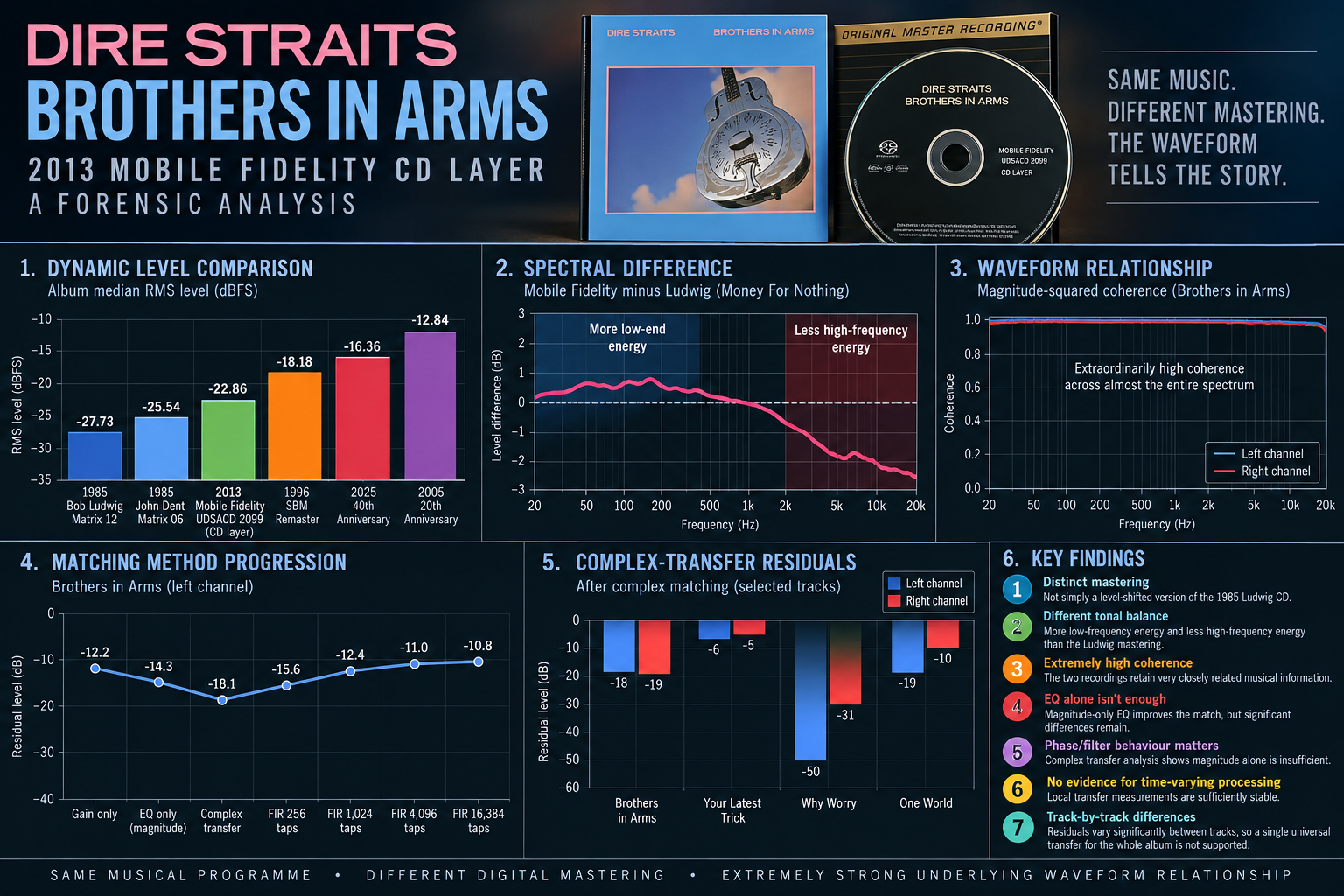
The 2013 Mobile Fidelity release of Brothers in Arms is often discussed alongside the original 1985 CD masterings, but listening alone cannot tell us exactly how the mastering relates to those earlier versions.

I therefore treated the CD layers as digital data and compared the actual PCM samples. The aim was not simply to measure loudness, but to determine how closely the Mobile Fidelity mastering is related to the 1985 programme and what processing separates the two.

The editions compared

  • 1985 John Dent — Matrix 06
  • 1985 Bob Ludwig — Matrix 12/17
  • 1996 SBM
  • 2005 20th Anniversary
  • 2013 Mobile Fidelity UDSACD 2099 — CD layer
  • 2025 40th Anniversary
Important: Matrix 12 and Matrix 17 of the 1985 Bob Ludwig mastering were found to be digitally identical after accounting for a 255-sample offset, so they represent one unique mastering for this analysis.

The Mobile Fidelity CD layer

The Mobile Fidelity UDSACD 2099 CD layer is a standard 44.1 kHz / 16-bit stereo programme. The nine tracks were extracted and verified with AccurateRip and CTDB. All nine tracks returned high-confidence AccurateRip results with no extraction errors.

The measured EAC peak levels range from 53.7% to 99.3%. More importantly, the average level is substantially higher than the 1985 masterings, while the crest factor remains much closer to the original CDs than to the later, more heavily levelled editions.

Dynamic level comparison
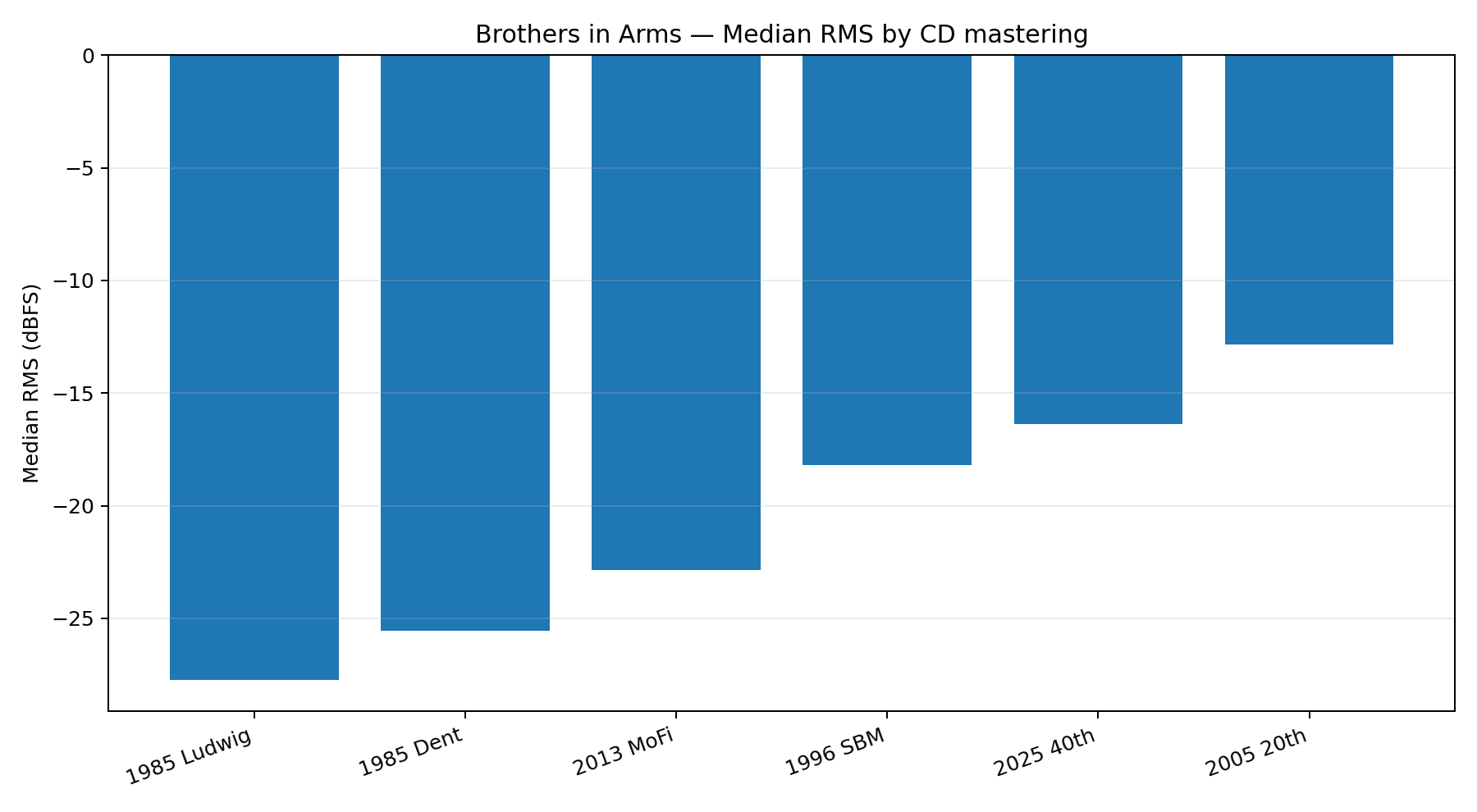
Median RMS level across the album. The 2013 Mobile Fidelity CD layer is considerably louder than the 1985 masterings, but remains substantially more dynamic than the 1996, 2005 and 2025 editions.

The album-wide median RMS figures are approximately:

Mastering Median RMS Median crest
1985 Bob Ludwig -27.73 dBFS 22.52 dB
1985 John Dent -25.54 dBFS 22.33 dB
2013 Mobile Fidelity -22.86 dBFS 21.51 dB
1996 SBM -18.18 dBFS 18.18 dB
2025 40th Anniversary -16.36 dBFS 15.36 dB
2005 20th Anniversary -12.84 dBFS 12.74 dB

Test 1 – Is the Mobile Fidelity version simply a level-shifted 1985 mastering?

No. A simple gain adjustment does not reproduce the Mobile Fidelity waveform.

For example, on Brothers in Arms, Your Latest Trick and Why Worry, aligning corresponding events and optimising the gain produces very high waveform correlations, but leaves substantial residual energy. The residuals are far above the level expected from simple 16-bit quantisation differences.

Test 2 – Spectral differences

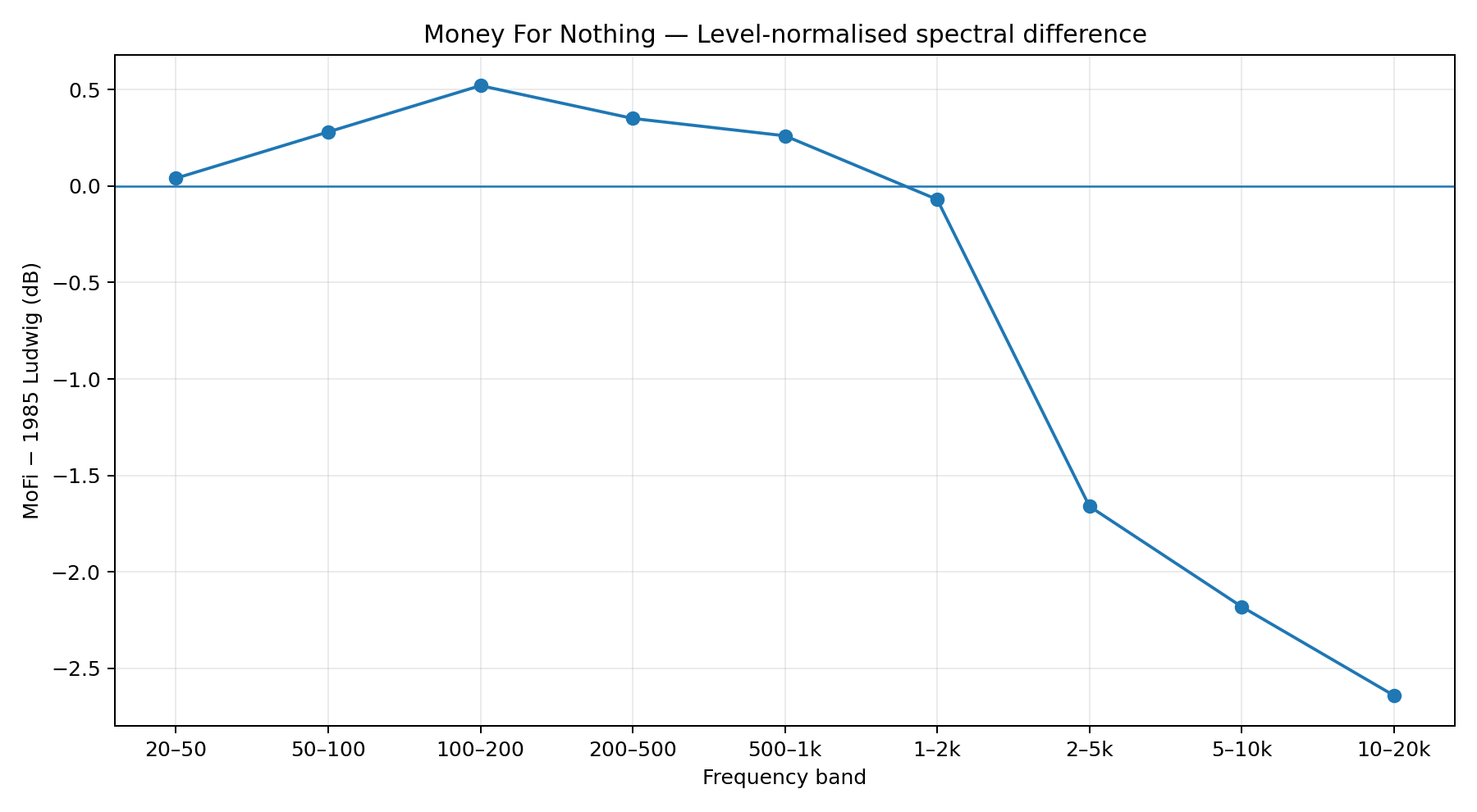
The tonal balance is also different. Money For Nothing provides a useful example. After normalising total 20 Hz–20 kHz power, the approximate Mobile Fidelity-minus-Ludwig spectral difference is:

Band Difference
20–50 Hz +0.04 dB
50–100 Hz +0.28 dB
100–200 Hz +0.52 dB
200–500 Hz +0.35 dB
500 Hz–1 kHz +0.26 dB
1–2 kHz -0.07 dB
2–5 kHz -1.66 dB
5–10 kHz -2.18 dB
10–20 kHz -2.64 dB

Approximate spectral difference after overall power normalisation: Mobile Fidelity minus 1985 Bob Ludwig, Money For Nothing.

This is not the signature of a simple digital gain change. The Mobile Fidelity version has a different frequency balance, with relatively more low-frequency energy and less upper-mid/high-frequency energy than the Ludwig reference.

Test 3 – Can magnitude-only EQ explain the difference?

Magnitude-only EQ improves the match significantly, but it does not completely explain the waveform relationship.

For example, on Brothers in Arms, the gain-only residuals were approximately -12 dB, while a magnitude-EQ correction reduced them to roughly -14 dB. The waveform correlation also increased.

That tells us that tonal balance is part of the difference, but not all of it.

Test 4 – Coherence

The most striking result is the magnitude-squared coherence between the two masterings.

  • Brothers in Arms: approximately 0.999–1.000 across essentially the entire audio band.
  • Your Latest Trick: approximately 1.000 through most of 100 Hz–20 kHz.
  • Why Worry: approximately 1.000 through most of 100 Hz–10 kHz.
  • One World: still extremely high, with the largest reduction occurring at the very top end.

This does not prove that the two CDs came from the same physical analogue tape or mastering chain. It does, however, demonstrate an exceptionally strong deterministic relationship between their waveforms.

Test 5 – Complex transfer behaviour

The next step was to allow both magnitude and phase/filter behaviour to vary rather than attempting to describe the difference with EQ alone.

After aligning the programmes, a complex transfer analysis produced very high correlations and substantially lower residuals on several tracks. The results vary by track and channel, which is important: there is no evidence here for one universal album-wide transfer function.
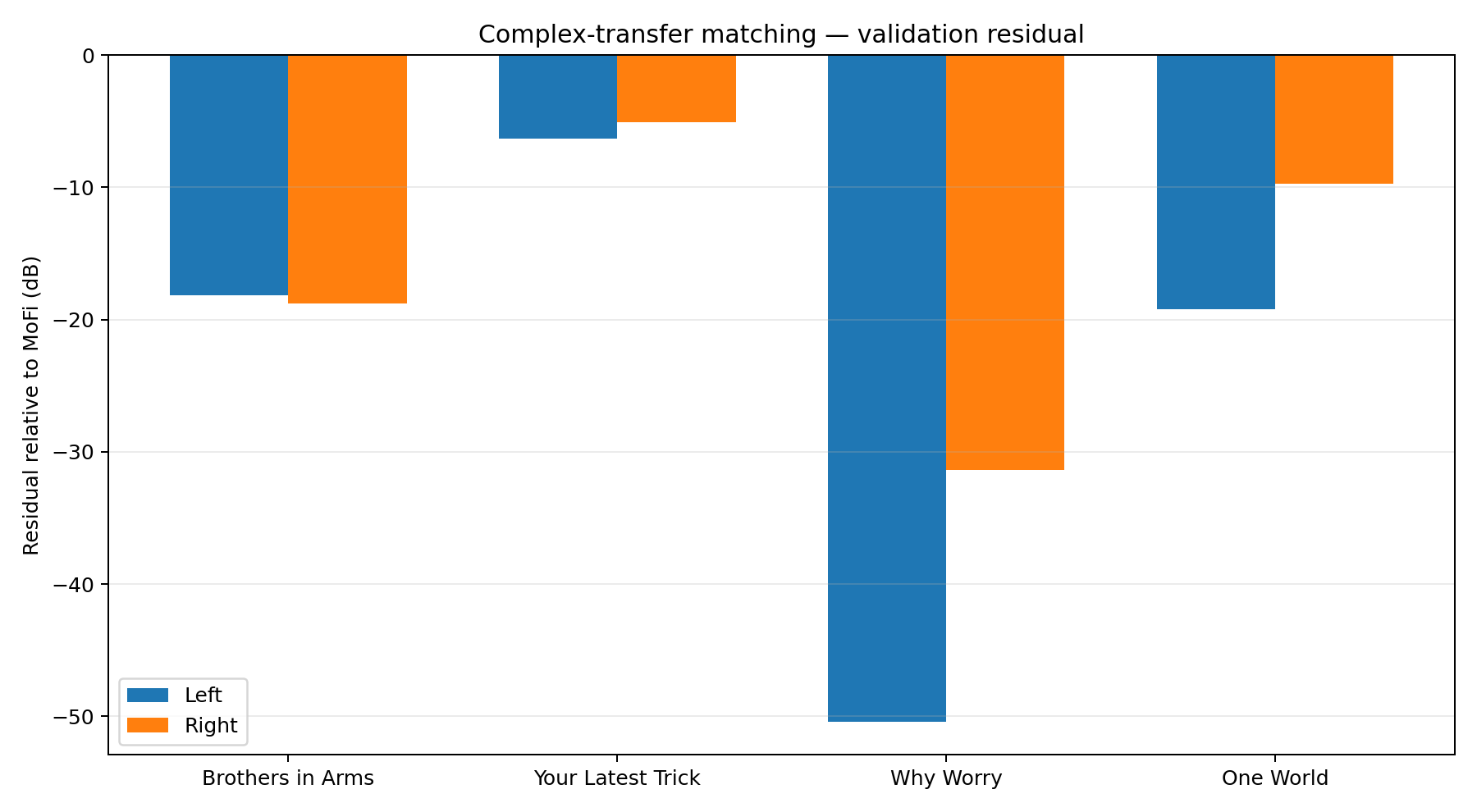
Residual levels after complex-transfer modelling for selected tracks and channels.

Test 6 – FIR filtering

Finite impulse response filtering was also tested. Increasing filter length improved the match in some cases, but the improvement eventually plateaued. This is consistent with a relationship that contains more than a simple static EQ curve, while not by itself proving a particular analogue or digital processing chain.
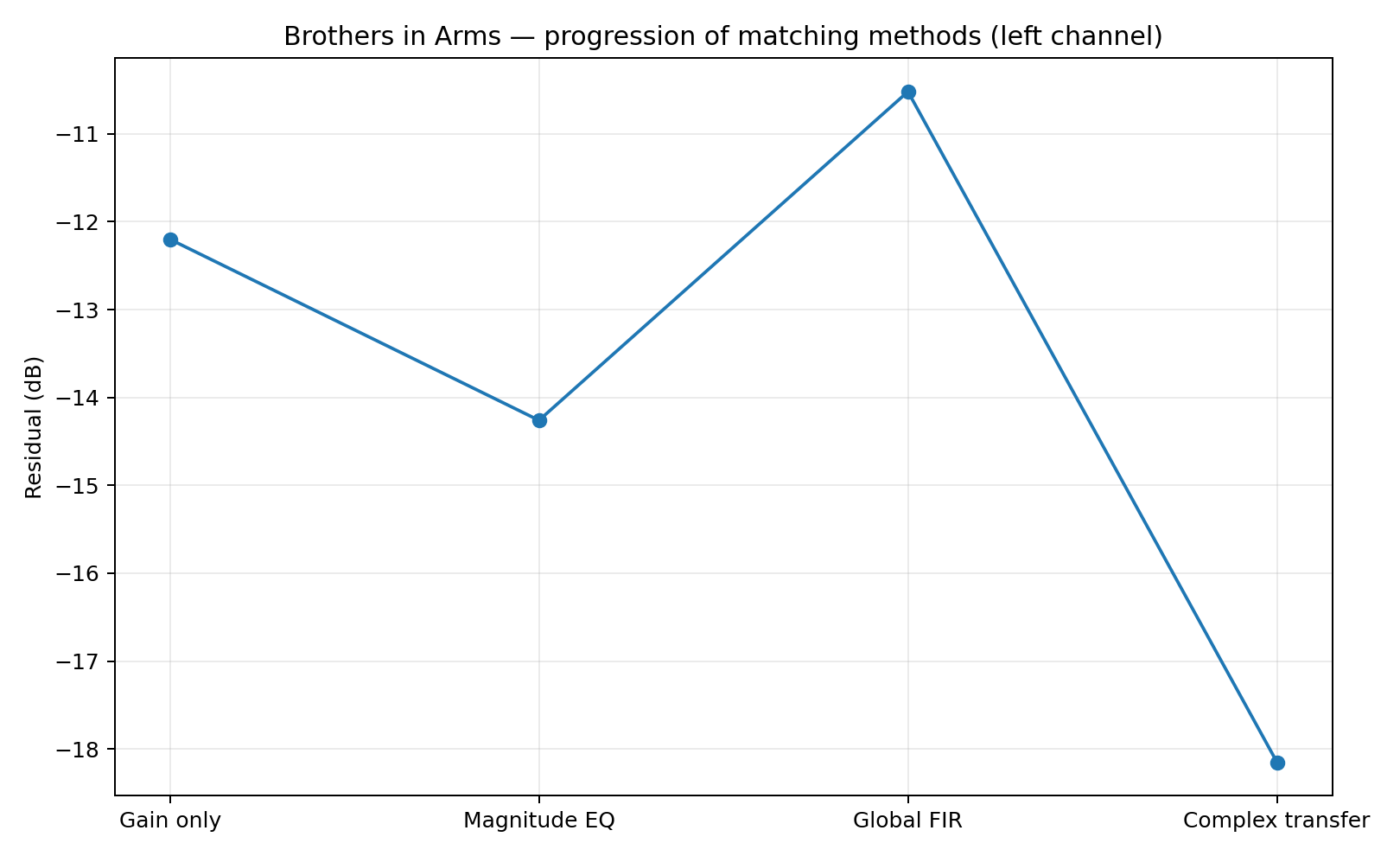
Illustrative progression of the matching methods used during the investigation. The chart is a summary of the analysis rather than a raw measurement plot.

Test 7 – Is the mastering changing over time?

An important possibility was that the Mobile Fidelity transfer might contain time-varying processing. Local transfer measurements were therefore compared at different points in the programme.

The transfer behaviour proved sufficiently stable that a claim of genuine time-varying mastering processing could not be justified from these tests. Some variation appeared in local FIR fits, but that variation was at least partly dependent on the musical content and limitations of the model.

Final complex-transfer results

The final reproducible complex-transfer validation gave the following approximate residuals:

Track Left Right
Brothers in Arms -18.15 dB -18.76 dB
Your Latest Trick -6.29 dB -5.10 dB
Why Worry -50.40 dB -31.38 dB
One World -19.19 dB -9.70 dB

The very low residual on the left channel of Why Worry is particularly interesting, with
the residual approaching the regime where quantisation and numerical effects become relevant.
However, the same cannot be said of every track, so the Mobile Fidelity mastering cannot simply
be described as a quantised copy of the Ludwig master.

Quantisation noise and the 1985 comparison

The relationship between the two 1985 masterings provides a useful control experiment. After channel reversal, gain correction and track-specific sample alignment, the John Dent and Bob Ludwig files match within approximately ±1 least-significant bit on most tracks. Their residuals are typically around -61 to -69 dB.

The Mobile Fidelity residuals are materially higher on several tracks. That is strong evidence against describing the 2013 CD layer as merely a digital level-shift or quantised copy of the 1985 Ludwig mastering.

What the analysis actually proves

  • The 2013 Mobile Fidelity CD layer is a distinct mastering.
  • It is not simply a global gain change of the 1985 Bob Ludwig mastering.
  • Its tonal balance is measurably different.
  • Magnitude-only EQ cannot fully explain the relationship.
  • The two programmes retain an exceptionally strong waveform relationship.
  • Complex transfer behaviour accounts for substantially more of the relationship than simple EQ.
  • A single universal album-wide transfer function has not been demonstrated.
  • Time-varying processing has not been demonstrated.
  • The waveform data alone cannot identify the physical analogue source tape.

What it does not prove

Digital waveform analysis cannot tell us with certainty which physical tape was used at the Mobile Fidelity mastering stage. A strong waveform relationship is evidence about the digital signals; it is not direct evidence about the provenance of the analogue source.

Likewise, these measurements do not establish the exact analogue mastering chain, converter, equaliser, compressor, limiter or other equipment that may have been used. Those conclusions would require documentation or additional independent evidence.

Conclusion

The 2013 Mobile Fidelity UDSACD 2099 CD layer is best described as a genuinely distinct digital mastering of Brothers in Arms. It is not simply the 1985 Bob Ludwig CD with its level changed.

At the same time, the forensic measurements show an unusually strong underlying relationship between the two programmes. The Mobile Fidelity version appears to preserve the same musical programme extremely closely while applying a different tonal and transfer characteristic.

That makes the 2013 CD layer particularly interesting: the differences are not adequately described by loudness alone, but neither does the evidence support treating it as an unrelated digital source.

Next stage

The next stage of the investigation is to run the same full analysis across all nine tracks and compare the transfer behaviour track by track. That should show whether the differences follow a consistent mastering pattern or whether individual tracks received materially different treatment.

Analysis by Andy Hancock. Measurements are based on the actual extracted CD-layer PCM data. Figures
labelled as summary or illustrative should not be treated as raw measurement plots.
Fleetwood Mac: What’s the Difference Between These Two Compact Discs?

Wednesday, August 26th, 2026
Lets start this by saying….As a “HiFi snob”! With lots of audio equipment!
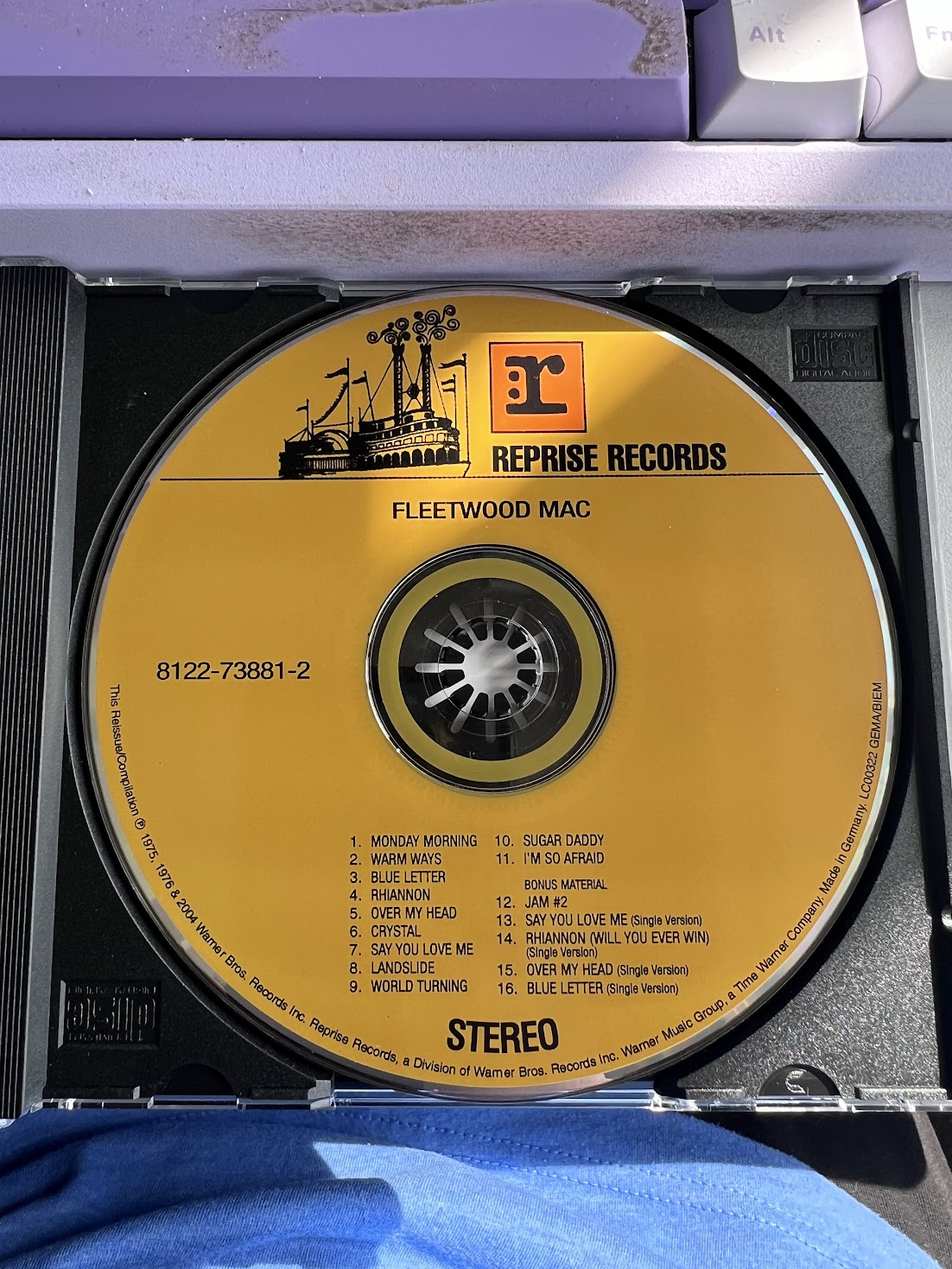
Apart from the obvious difference — one has a black spine and the other has a clear spine — what’s the difference between these two compact discs?That was the question that started this little investigation.At first glance, both CDs contain the same Fleetwood Mac album. One is an early West German Target CD and the other is the 2004 remastered and expanded edition.But are the original album tracks actually the same?Does the 2004 version simply contain the same digital master at a higher volume?Or did the mastering change?I decided to find out.

The Two CDs

The 1994 West German Target CD

The first CD is the West German Target pressing.

The most immediately noticeable feature is the black spine, along with the distinctive Target-style disc design associated with these early CD releases.

The disc contains the original 11-track album:

    1. Monday Morning
    2. Warm Ways
    3. Blue Letter
    4. Rhiannon
    5. Over My Head
  1. Crystal
  2. Say You Love Me
  3. Landslide
  4. World Turning
  5. Sugar Daddy
  6. I’m So Afraid

The disc was manufactured in West Germany and is one of the early Target-style compact discs associated with the original CD era.

There is something rather special about these early Target CDs. They belong to the first generation of commercially produced CDs and have become collectible in their own right.

But I wasn’t interested in the Target CD simply because it looks good.

I wanted to know how it sounds.

The 2004 Edition

The second disc is the 2004 remastered and expanded edition.

And immediately there is another obvious physical difference.

The spine is clear rather than black.

But the differences go much further than that.

The 2004 edition contains 16 tracks, rather than the original 11.

The five additional recordings are:

  1. Jam, No. 2
  2. Say You Love Me
  3. Rhiannon (Will You Ever Win)
  4. Over My Head
  5. Blue Letter

So before we even listen to the two CDs, we already know that the 2004 edition is more than a simple reissue.

It is an expanded and remastered edition.

But what happened to the original 11 tracks?

Let’s Rip the CDs

Rather than relying on my ears alone, I wanted to make this as objective as possible.

Both CDs were ripped using Exact Audio Copy (EAC), using secure extraction, and saved as lossless FLAC files.

The EAC results were then checked against AccurateRip and the CUETools Database.

The results were excellent.

1994 West German Target

All 11 tracks were reported as accurately ripped.

No errors occurred.

2004 Edition

All 16 tracks were also reported as accurately ripped.

No errors occurred.

The 2004 tracks had an AccurateRip confidence of 200, providing extremely strong confirmation of the extraction.

This means we weren’t comparing two recordings made from a CD player.

We were comparing the actual digital audio data extracted from the CDs.

The First Track: Monday Morning

I started with the opening track, Monday Morning.

And this is where things immediately became interesting.

The 1994 CD has a peak level of approximately:

-2.47 dBFS

The 2004 version reaches:

-0.10 dBFS

So the 2004 version is getting extremely close to digital full scale.

But peak level alone doesn’t tell the whole story.

The average level is even more revealing.

The 1994 version measures approximately –20.6 dBFS RMS.

The 2004 version measures approximately –13.2 dBFS RMS.

That’s roughly a 7.3 dB increase in average level.

In simple terms, the 2004 version is substantially louder.

But I wanted to know whether that was the whole story.

Is the 2004 Version Simply Louder?

This was the obvious question.

If the 2004 CD was simply the 1994 mastering with the volume turned up, reducing the 2004 version by the appropriate amount should make the two recordings essentially identical.

It doesn’t.

I level-matched the two versions, removing the large difference in overall volume, and then compared them again.

There were still measurable differences.

That means the 2004 version isn’t simply the 1994 master with the volume increased.

The mastering has changed.

The Dynamic Range Difference

One of the measurements we can use to examine this is crest factor — the difference between the average level of a recording and its peaks.

A higher crest factor generally means greater separation between the average level and the peaks.

For Monday Morning:

1994: approximately 17.6 dB

2004: approximately 13.1 dB

That’s a difference of approximately 4.5 dB.

And this wasn’t unique to Monday Morning.

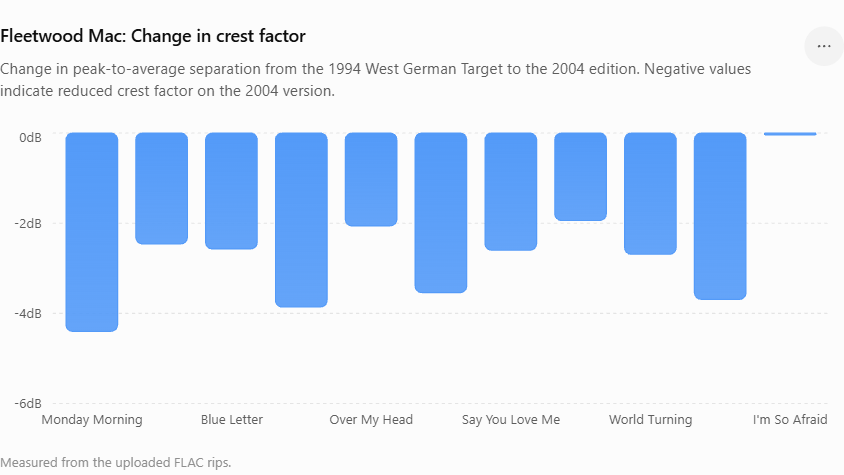
When all 11 tracks appearing on both CDs were analysed, 10 of the 11 tracks showed a reduction in crest factor on the 2004 version.

That is a significant pattern.

It tells us that the 2004 mastering has generally been made louder and denser.

It does not, by itself, mean that the CD is clipped. High peak levels and clipping are two different things.


Fleetwood Mac 1994 versus 2004 crest factor comparison
Change in crest factor between the 1994 West German Target and 2004 editions. Negative values indicate reduced peak-to-average separation on the 2004 version.

The Whole Album Tells the Story

This is where the comparison becomes much more convincing.

Rather than looking at one song, I analysed all 11 tracks that appear on both CDs.

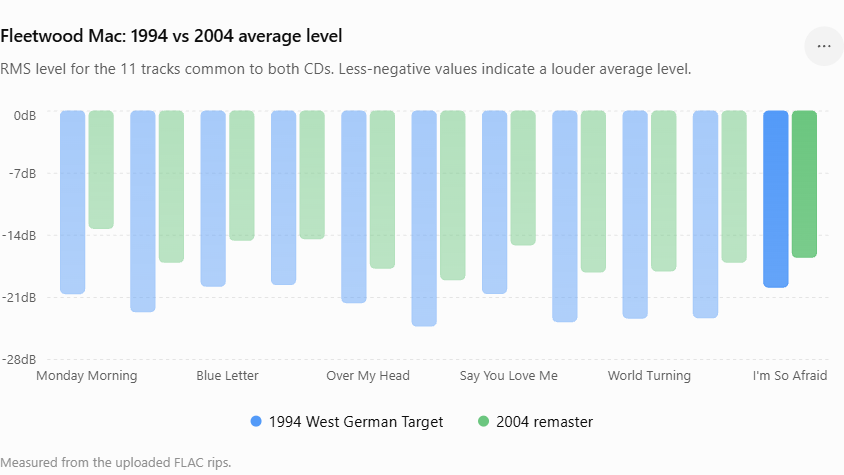
The average RMS difference across the album is approximately:

5.3 dB louder on the 2004 edition

Every single one of the 11 common tracks is louder on the 2004 CD.

The graph makes the pattern very easy to see.

The 2004 version is consistently louder across the original album.

But What About the EQ?

This was the next question.

Perhaps the 2004 mastering was simply compressed and made louder.

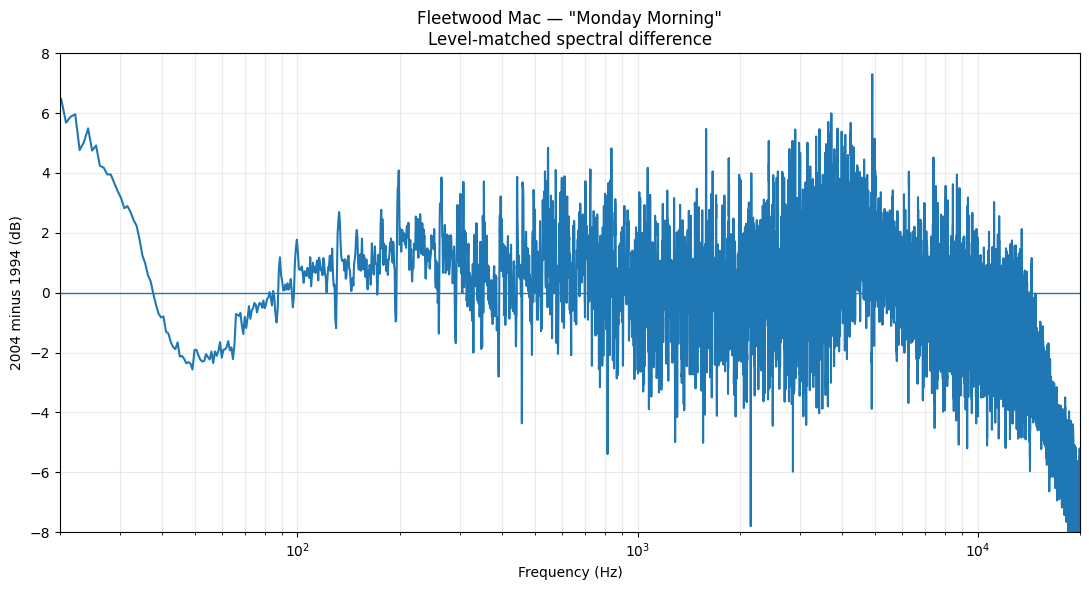
To test that, I removed the volume difference by level-matching the two versions.

Then I compared their frequency spectra.

And again, the results showed that the two CDs aren’t identical.

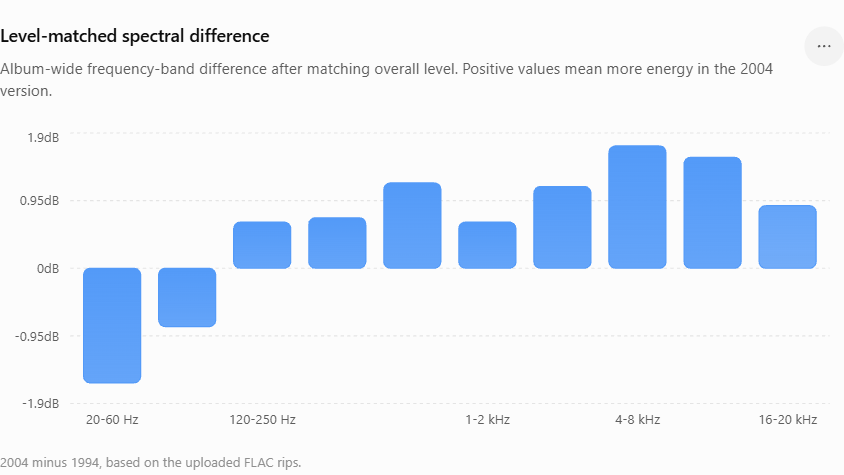
The broad album-wide differences were approximately:

Frequency range 2004 compared with 1994
20–60 Hz -1.6 dB
60–120 Hz -0.8 dB
120–250 Hz +0.7 dB
250–500 Hz +0.7 dB
500 Hz–1 kHz +1.2 dB
1–2 kHz +0.7 dB
2–4 kHz +1.2 dB
4–8 kHz +1.7 dB
8–16 kHz +1.6 dB
16–20 kHz +0.9 dB

The important point isn’t each individual number.

It’s the overall shape.

After the overall volume difference was removed, the 2004 mastering still showed less energy in the very lowest frequencies and more energy through much of the midrange and upper frequencies.

So the tonal balance has changed too.

A Picture Tells a Thousand Words

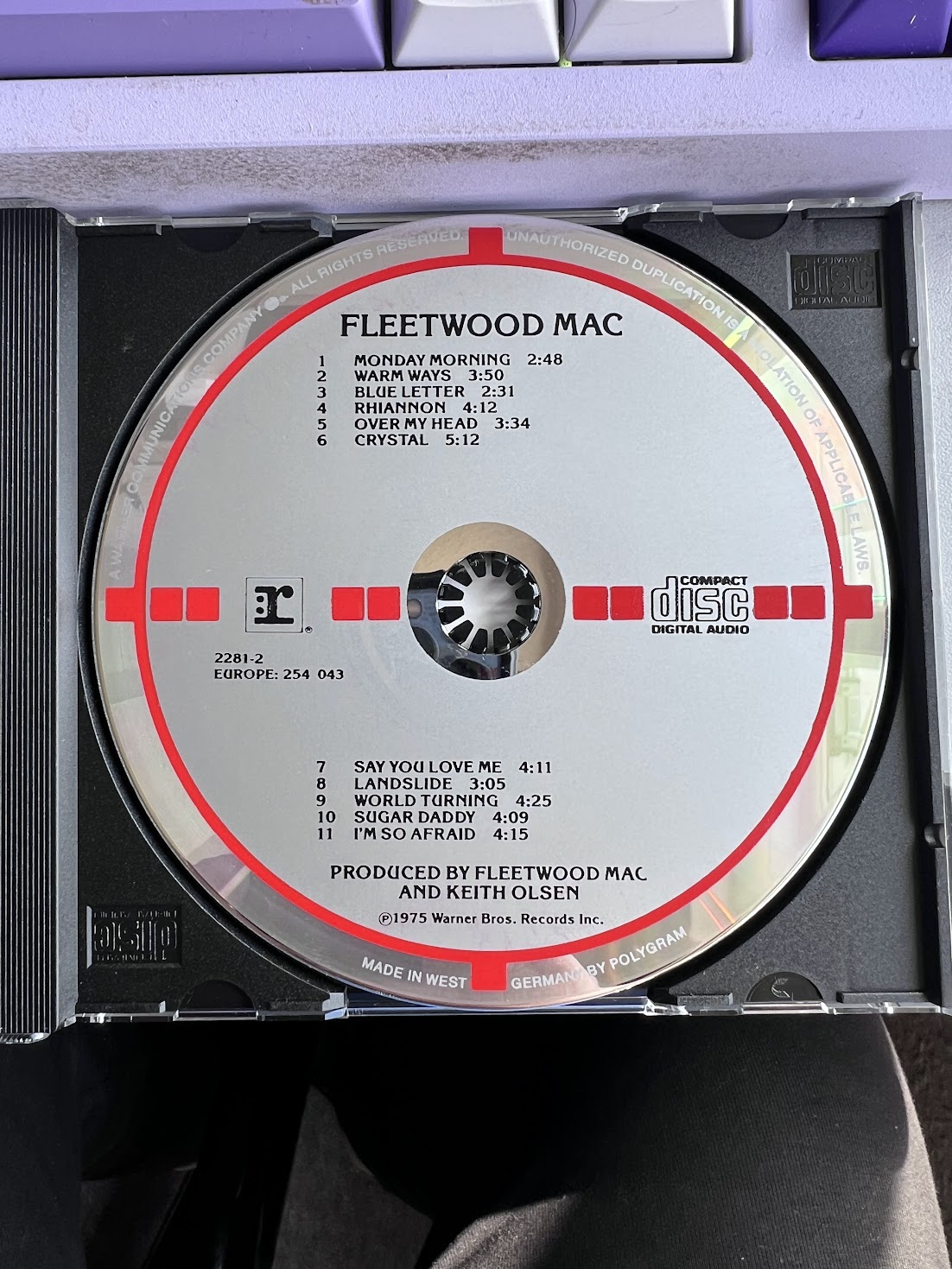
Put the two discs next to each other and the physical differences are immediately obvious.

The black spine and clear spine are only the beginning.

The artwork, disc design, catalogue information, packaging and track content all provide clues that these aren’t simply two identical CDs from different production runs.

But the really interesting difference is something you can’t see by looking at the discs.

It’s in the audio data.

Eleven Tracks, Same Conclusion

The strongest evidence comes from looking at all 11 tracks common to both editions.

Every track is louder on the 2004 CD.

Ten out of eleven have a lower crest factor.

The frequency analysis also shows a different tonal balance after level matching.

This means we can confidently say that the 2004 edition is not simply the 1994 mastering with the volume turned up.

There has been a change in the mastering.

And Then There Are the Five Bonus Tracks

The 2004 edition adds five additional recordings.

These aren’t relevant when comparing the mastering of the original 11 tracks, because there is no corresponding recording on the 1994 disc.

But they are still an important part of the comparison.

The 2004 CD therefore offers something the 1994 Target doesn’t:

additional material.

So Which One Is Better?

Now we get to the difficult question.

Which CD sounds better?

The measurements can tell us what changed.

They can’t tell us what you will personally prefer.

The 1994 West German Target

  • Lower overall mastering levels
  • Greater peak-to-average separation
  • More headroom
  • A different tonal balance
  • The original 11-track album

The 2004 Edition

  • A substantially higher average level
  • Peaks much closer to digital full scale
  • Reduced peak-to-average dynamics on most tracks
  • A different tonal balance
  • Five additional recordings

If you prefer a mastering with greater dynamic headroom and less aggressive level management, the 1994 Target is likely to be the more interesting choice.

If you prefer a louder, more forward presentation and want the bonus material, the 2004 edition has obvious advantages.

The Conclusion

So, what’s the difference between these two compact discs?

Quite a lot.

It started with something as simple as noticing that one had a black spine and the other had a clear spine.

But once the discs were ripped and analysed, the differences became much more substantial.

The 2004 edition isn’t simply the 1994 CD with the volume turned up.

Across all 11 tracks common to both editions, the 2004 version is approximately 5.3 dB louder on average.

Ten of the 11 tracks show reduced crest factor.

And after level-matching the recordings, there are still measurable differences in frequency balance.

In other words, these are different masterings.

The 1994 West German Target represents a much more conservatively mastered presentation, with greater peak-to-average separation.

The 2004 edition offers a louder, more forward mastering, a different tonal balance and five additional recordings.

So the answer to the question I started with is:

The difference isn’t just the spine.

The two CDs may contain the same Fleetwood Mac album, but they don’t contain exactly the same sound.

And now that we’ve got the measurements, the question becomes a much more interesting one:

Which one do you prefer?