Introduction
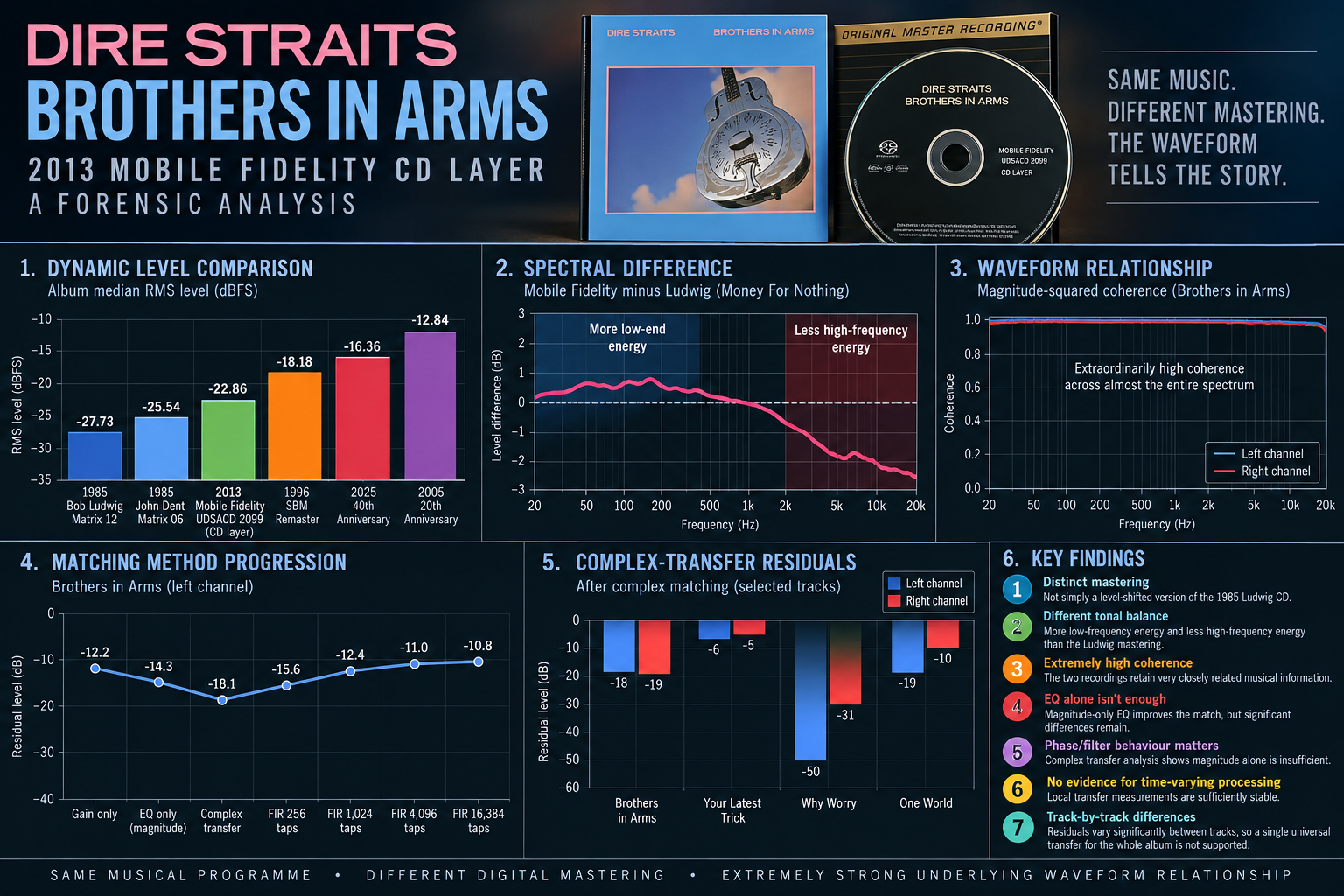
The 2013 Mobile Fidelity release of Brothers in Arms is often discussed alongside the original 1985 CD masterings, but listening alone cannot tell us exactly how the mastering relates to those earlier versions.
I therefore treated the CD layers as digital data and compared the actual PCM samples. The aim was not simply to measure loudness, but to determine how closely the Mobile Fidelity mastering is related to the 1985 programme and what processing separates the two.
The editions compared
- 1985 John Dent — Matrix 06
- 1985 Bob Ludwig — Matrix 12/17
- 1996 SBM
- 2005 20th Anniversary
- 2013 Mobile Fidelity UDSACD 2099 — CD layer
- 2025 40th Anniversary
The Mobile Fidelity CD layer
The Mobile Fidelity UDSACD 2099 CD layer is a standard 44.1 kHz / 16-bit stereo programme. The nine tracks were extracted and verified with AccurateRip and CTDB. All nine tracks returned high-confidence AccurateRip results with no extraction errors.
The measured EAC peak levels range from 53.7% to 99.3%. More importantly, the average level is substantially higher than the 1985 masterings, while the crest factor remains much closer to the original CDs than to the later, more heavily levelled editions.
Dynamic level comparison
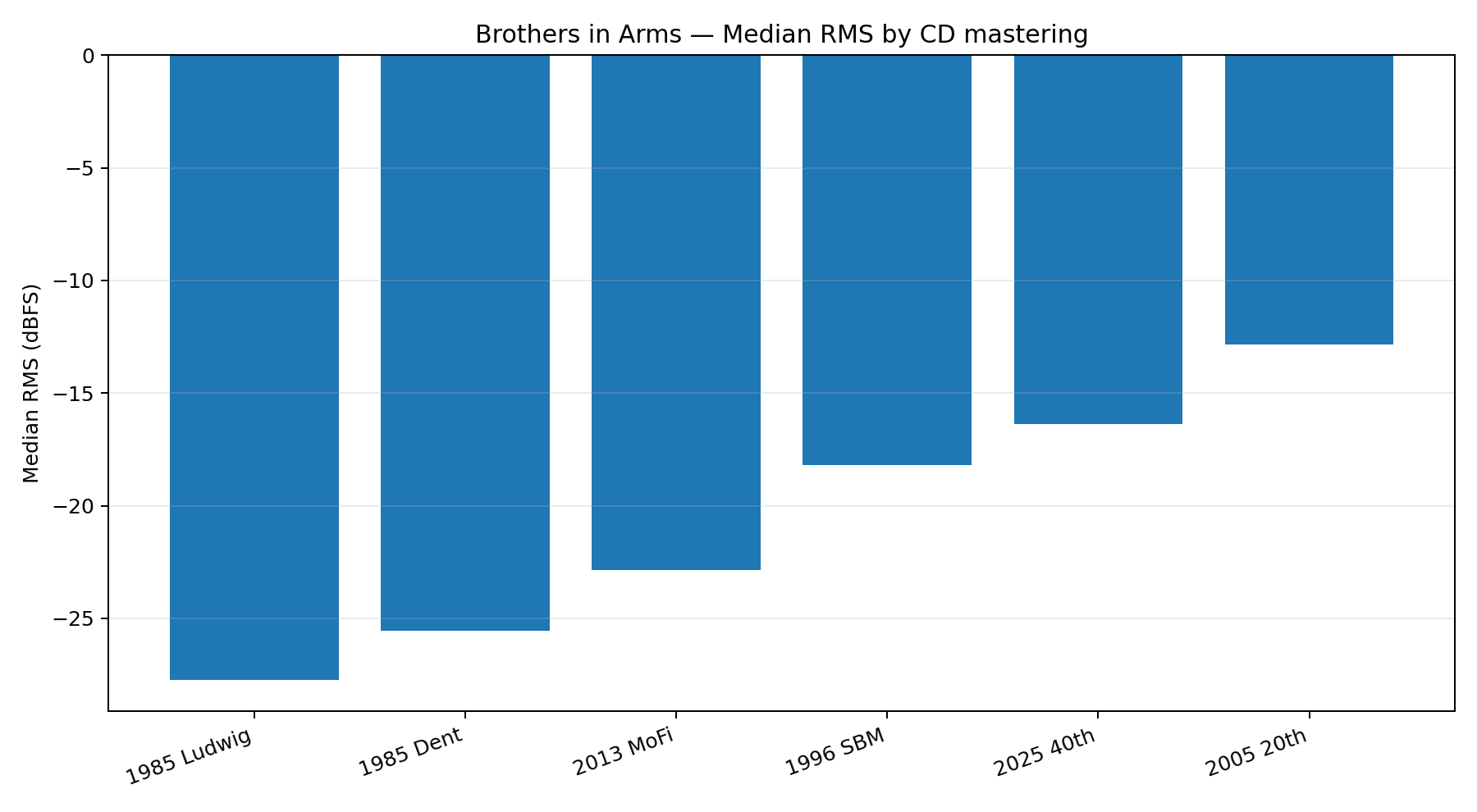
Median RMS level across the album. The 2013 Mobile Fidelity CD layer is considerably louder than the 1985 masterings, but remains substantially more dynamic than the 1996, 2005 and 2025 editions.
The album-wide median RMS figures are approximately:
| Mastering | Median RMS | Median crest |
|---|---|---|
| 1985 Bob Ludwig | -27.73 dBFS | 22.52 dB |
| 1985 John Dent | -25.54 dBFS | 22.33 dB |
| 2013 Mobile Fidelity | -22.86 dBFS | 21.51 dB |
| 1996 SBM | -18.18 dBFS | 18.18 dB |
| 2025 40th Anniversary | -16.36 dBFS | 15.36 dB |
| 2005 20th Anniversary | -12.84 dBFS | 12.74 dB |
Test 1 – Is the Mobile Fidelity version simply a level-shifted 1985 mastering?
No. A simple gain adjustment does not reproduce the Mobile Fidelity waveform.
For example, on Brothers in Arms, Your Latest Trick and Why Worry, aligning corresponding events and optimising the gain produces very high waveform correlations, but leaves substantial residual energy. The residuals are far above the level expected from simple 16-bit quantisation differences.
Test 2 – Spectral differences
The tonal balance is also different. Money For Nothing provides a useful example. After normalising total 20 Hz–20 kHz power, the approximate Mobile Fidelity-minus-Ludwig spectral difference is:
| Band | Difference |
|---|---|
| 20–50 Hz | +0.04 dB |
| 50–100 Hz | +0.28 dB |
| 100–200 Hz | +0.52 dB |
| 200–500 Hz | +0.35 dB |
| 500 Hz–1 kHz | +0.26 dB |
| 1–2 kHz | -0.07 dB |
| 2–5 kHz | -1.66 dB |
| 5–10 kHz | -2.18 dB |
| 10–20 kHz | -2.64 dB |
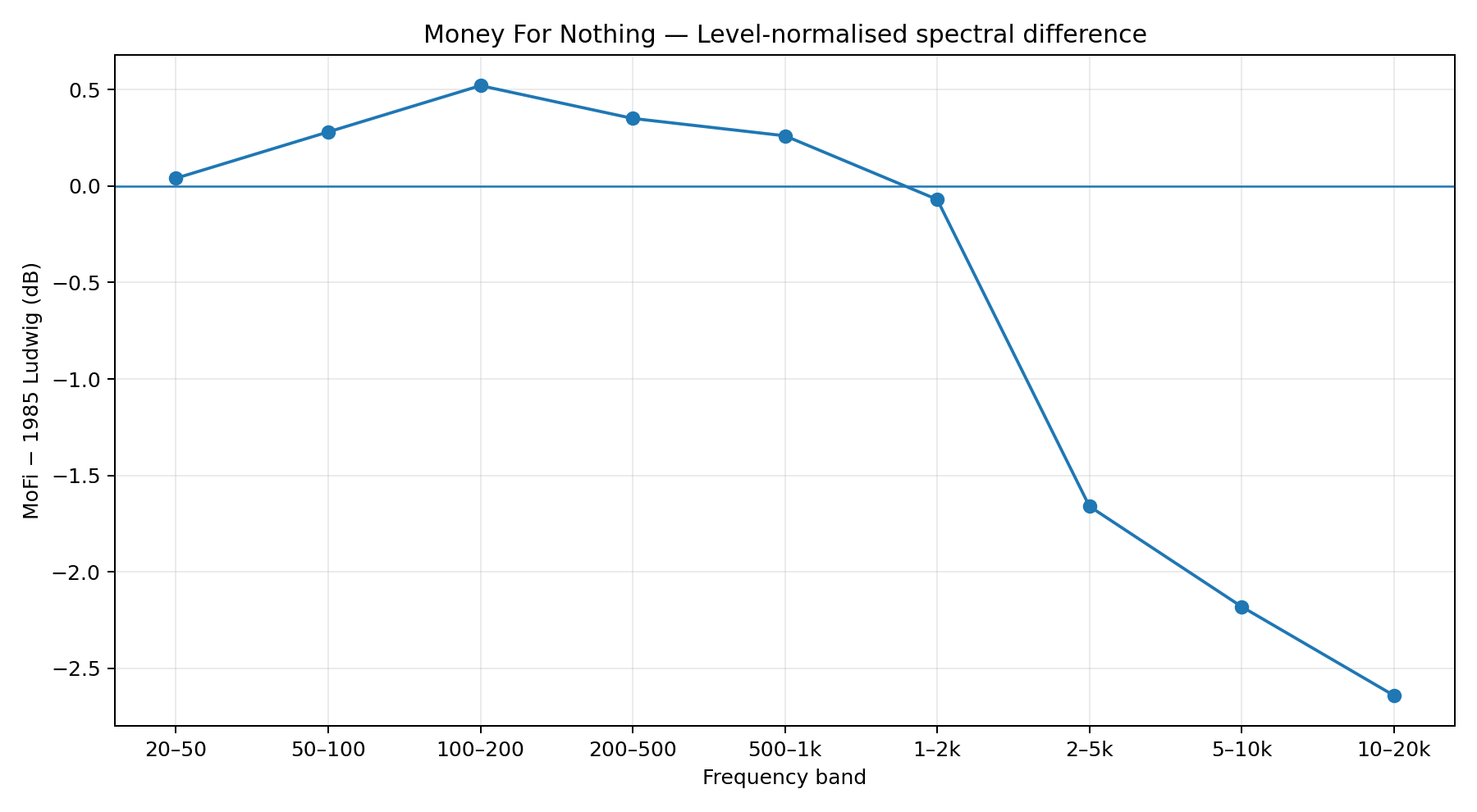
Approximate spectral difference after overall power normalisation: Mobile Fidelity minus 1985 Bob Ludwig, Money For Nothing.
Test 3 – Can magnitude-only EQ explain the difference?
Magnitude-only EQ improves the match significantly, but it does not completely explain the waveform relationship.
For example, on Brothers in Arms, the gain-only residuals were approximately -12 dB, while a magnitude-EQ correction reduced them to roughly -14 dB. The waveform correlation also increased.
That tells us that tonal balance is part of the difference, but not all of it.
Test 4 – Coherence
The most striking result is the magnitude-squared coherence between the two masterings.
- Brothers in Arms: approximately 0.999–1.000 across essentially the entire audio band.
- Your Latest Trick: approximately 1.000 through most of 100 Hz–20 kHz.
- Why Worry: approximately 1.000 through most of 100 Hz–10 kHz.
- One World: still extremely high, with the largest reduction occurring at the very top end.
This does not prove that the two CDs came from the same physical analogue tape or mastering chain. It does, however, demonstrate an exceptionally strong deterministic relationship between their waveforms.
Test 5 – Complex transfer behaviour
The next step was to allow both magnitude and phase/filter behaviour to vary rather than attempting to describe the difference with EQ alone.
After aligning the programmes, a complex transfer analysis produced very high correlations and substantially lower residuals on several tracks. The results vary by track and channel, which is important: there is no evidence here for one universal album-wide transfer function.
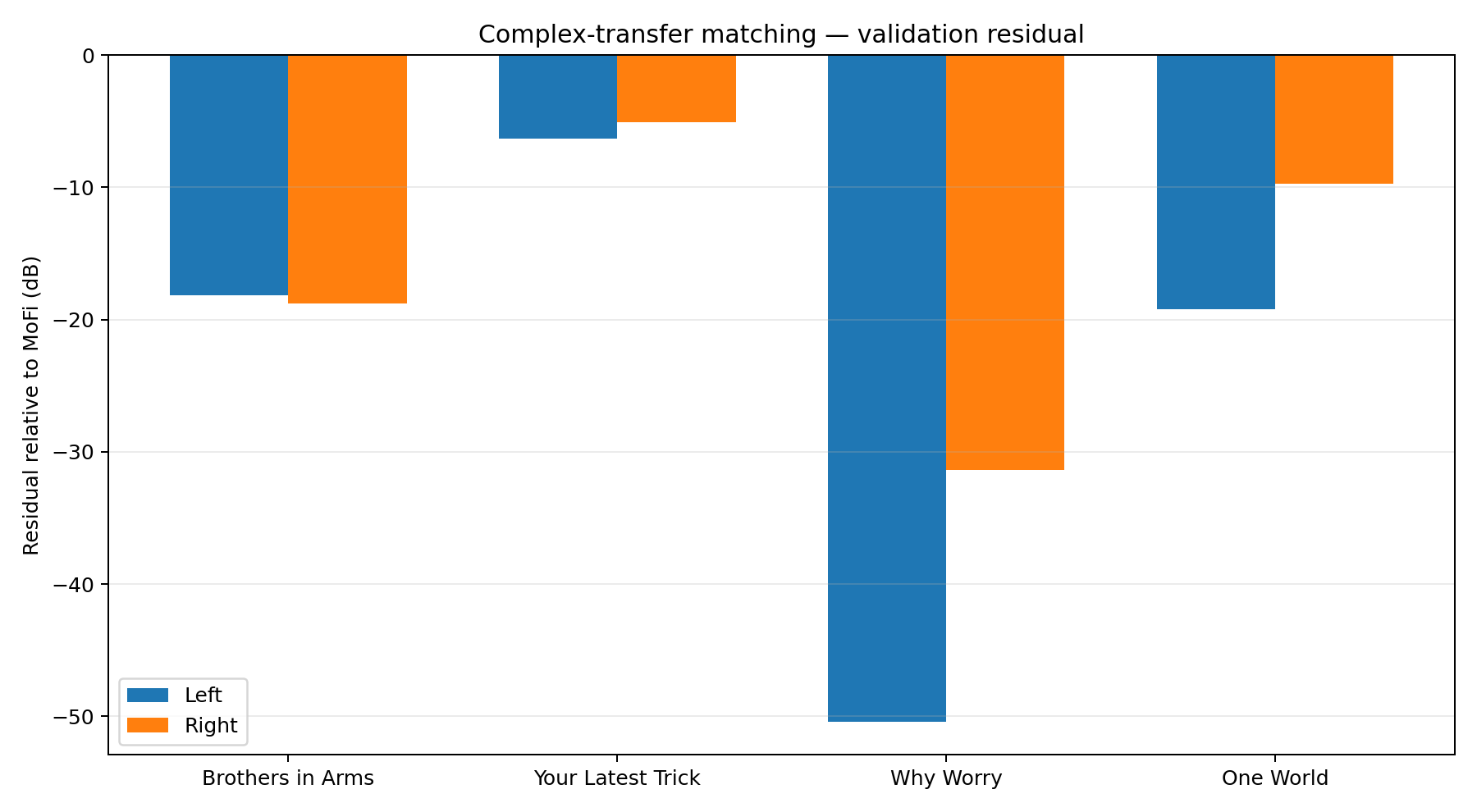
Residual levels after complex-transfer modelling for selected tracks and channels.
Test 6 – FIR filtering
Finite impulse response filtering was also tested. Increasing filter length improved the match in some cases, but the improvement eventually plateaued. This is consistent with a relationship that contains more than a simple static EQ curve, while not by itself proving a particular analogue or digital processing chain.
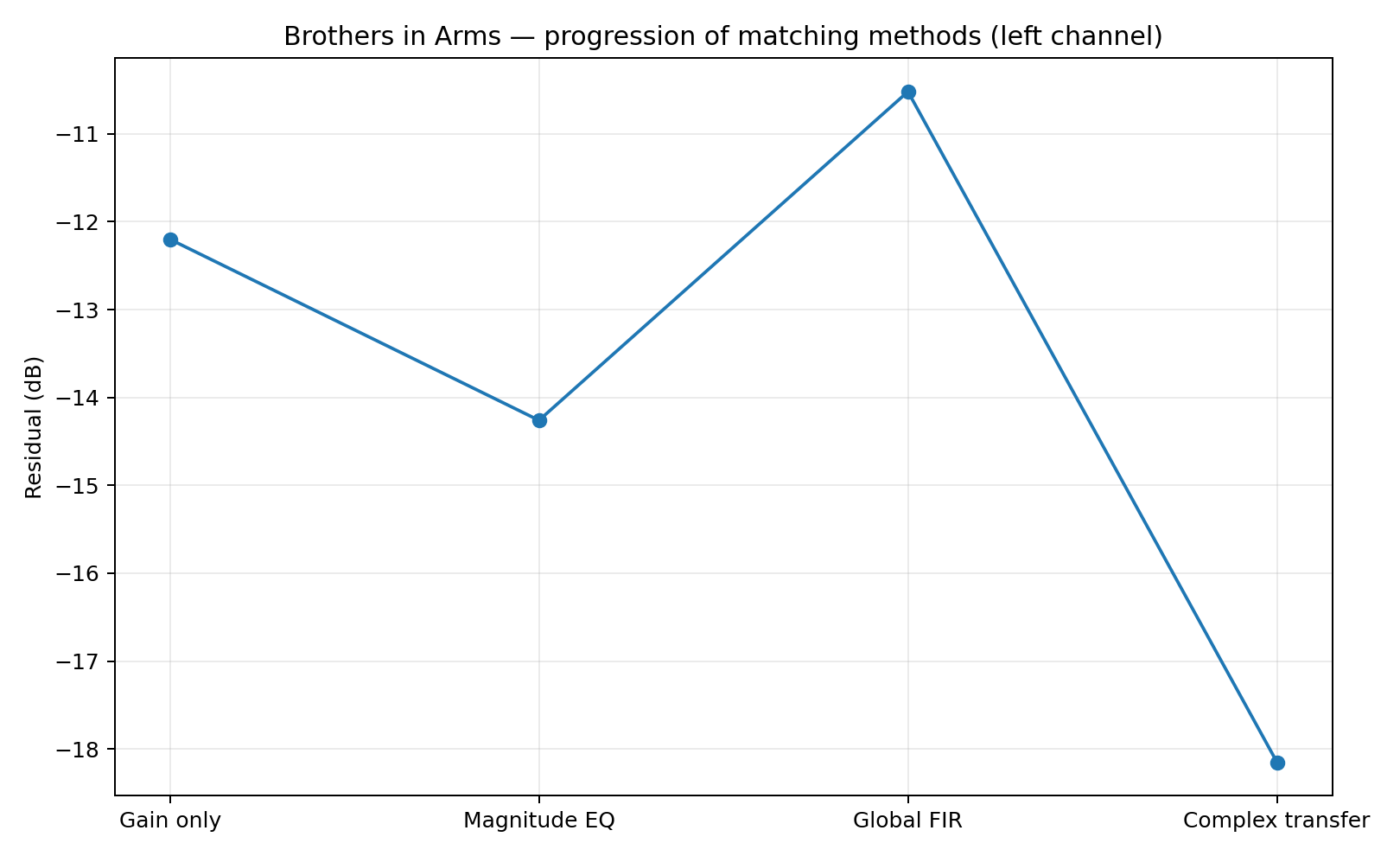
Illustrative progression of the matching methods used during the investigation. The chart is a summary of the analysis rather than a raw measurement plot.
Test 7 – Is the mastering changing over time?
An important possibility was that the Mobile Fidelity transfer might contain time-varying processing. Local transfer measurements were therefore compared at different points in the programme.
The transfer behaviour proved sufficiently stable that a claim of genuine time-varying mastering processing could not be justified from these tests. Some variation appeared in local FIR fits, but that variation was at least partly dependent on the musical content and limitations of the model.
Final complex-transfer results
The final reproducible complex-transfer validation gave the following approximate residuals:
| Track | Left | Right |
|---|---|---|
| Brothers in Arms | -18.15 dB | -18.76 dB |
| Your Latest Trick | -6.29 dB | -5.10 dB |
| Why Worry | -50.40 dB | -31.38 dB |
| One World | -19.19 dB | -9.70 dB |
The very low residual on the left channel of Why Worry is particularly interesting, with
the residual approaching the regime where quantisation and numerical effects become relevant.
However, the same cannot be said of every track, so the Mobile Fidelity mastering cannot simply
be described as a quantised copy of the Ludwig master.
Quantisation noise and the 1985 comparison
The relationship between the two 1985 masterings provides a useful control experiment. After channel reversal, gain correction and track-specific sample alignment, the John Dent and Bob Ludwig files match within approximately ±1 least-significant bit on most tracks. Their residuals are typically around -61 to -69 dB.
The Mobile Fidelity residuals are materially higher on several tracks. That is strong evidence against describing the 2013 CD layer as merely a digital level-shift or quantised copy of the 1985 Ludwig mastering.
What the analysis actually proves
- The 2013 Mobile Fidelity CD layer is a distinct mastering.
- It is not simply a global gain change of the 1985 Bob Ludwig mastering.
- Its tonal balance is measurably different.
- Magnitude-only EQ cannot fully explain the relationship.
- The two programmes retain an exceptionally strong waveform relationship.
- Complex transfer behaviour accounts for substantially more of the relationship than simple EQ.
- A single universal album-wide transfer function has not been demonstrated.
- Time-varying processing has not been demonstrated.
- The waveform data alone cannot identify the physical analogue source tape.
What it does not prove
Digital waveform analysis cannot tell us with certainty which physical tape was used at the Mobile Fidelity mastering stage. A strong waveform relationship is evidence about the digital signals; it is not direct evidence about the provenance of the analogue source.
Likewise, these measurements do not establish the exact analogue mastering chain, converter, equaliser, compressor, limiter or other equipment that may have been used. Those conclusions would require documentation or additional independent evidence.
Conclusion
The 2013 Mobile Fidelity UDSACD 2099 CD layer is best described as a genuinely distinct digital mastering of Brothers in Arms. It is not simply the 1985 Bob Ludwig CD with its level changed.
At the same time, the forensic measurements show an unusually strong underlying relationship between the two programmes. The Mobile Fidelity version appears to preserve the same musical programme extremely closely while applying a different tonal and transfer characteristic.
That makes the 2013 CD layer particularly interesting: the differences are not adequately described by loudness alone, but neither does the evidence support treating it as an unrelated digital source.
Next stage
The next stage of the investigation is to run the same full analysis across all nine tracks and compare the transfer behaviour track by track. That should show whether the differences follow a consistent mastering pattern or whether individual tracks received materially different treatment.
Analysis by Andy Hancock. Measurements are based on the actual extracted CD-layer PCM data. Figures
labelled as summary or illustrative should not be treated as raw measurement plots.




![[Valid RSS]](http://andysworld.org.uk/images/valid-rss.png "Validate my RSS feed")