Posts Tagged ‘fish house’

A BIG THANK YOU!

Sunday, August 27th, 2006

I would just like to thank the following individuals, who have contributed in the last five months

  • Lindsey’s and my parents for support and encouragement.
  • My Brother Christopher at Groundscaper for help in moving the fish house.
  • Barbara at Langleys for help with Convenyancy and the house purchase.
  • JulieW for the signatures!
  • Paul at JLB Electronics, for help with electrics and building works and survey.
  • Tim at Bargain Cottages, for help with moving the monster tank in the fish house, “don’t I owe you a curry!”
  • Eileen and Janet at Chris Clubley Estate Agents
  • Mick at Hambleton Preservations Services for arranging and managing the required dampwork.
  • IanD, for help with “the survey”
  • KateM’s assistance with the house purchase and boxes!
  • SueG for recommending the plasterer.
  • Lez the plasterer for a fantastic job.
  • Scott at The York Flooring Centre.
  • NickD at A&M Removals.
  • Ian, David, Mike, Simon of “The Last Line of Defence” at City of York Council in providing cover for me, when I’ve not been in the office – Thanks Guys – oh and putting up with a moody sod!
  • and a special thank you to Lindsey!

I’m sure they are others that I’ve not listed above and forgotten, Thank You. (let me know and I’ll include you!)

Fish House Re-located

Monday, July 24th, 2006
  • 250 fish
  • 5 x 12 hour days
  • 15 Fish Tanks
  • 2000l of water
  • 180 miles

and it’s done. The fish house is now up and running in its new location.

Old Fish House
Old Fish House after relocation.

Fish House move…

Wednesday, July 19th, 2006

The fish house move has been booked for Thursday 20 – 24 July 2006. I hired some muscle, I’m flying my younger brother from the West Country to help me with the glass and water, and a local friend with large trailer to move the 6ftx2ftx2ft tank on Monday 24 July 2006. It’s all got to be done by Tuesday 25 July 2006, because that’s when I take my brother back to the airport. I’ve booked time off work to complete this task.

Rainmate aka Flatpack Water Butt

Monday, July 17th, 2006

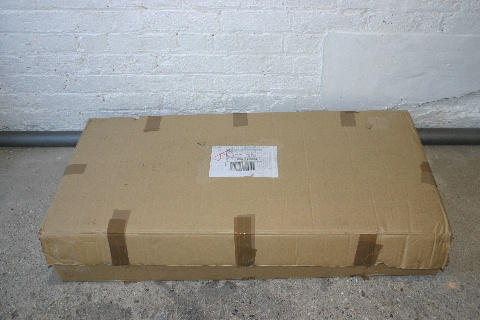
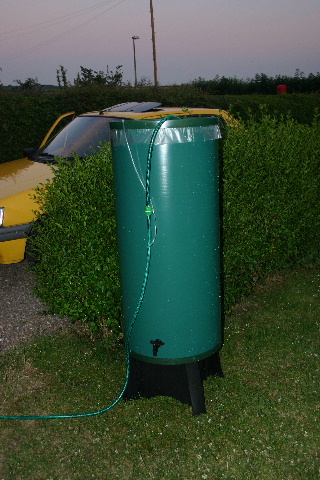
I purchased a flatpack water butt today called a Rainmate(R) to help me store 200 litres of water ready for the fish house move. The first flatpack water, self-assembly water butt, delivered to my door!

The water was filtered via my HMA filter and heated to the correct temperature used by the aquariums in the fish house.

Rainmate No.1
Before Assembley Flatpack in box.

Rainmate No.2
After 2 hours, I could probably have done with some help, two people would have made it easier to assemble!

Reason for lack of posts..

Wednesday, July 12th, 2006

The reason for the lack of posts in the last few months, is on the 11 July 2006, we completed on a new house. Since April 2006, I’ve been very busy with the purchase of a new house.

Yes, and that means the fish house will be moving, not the website, that can stay here, but the fish house will be moving here:- (Our House Blog!).

Andy’s New Fish House

Painted the first room in the house!

Wednesday, July 12th, 2006

Whilst the builders were knocking “hells bells” our of the lounge and dining room, we started to paint the first room in the house.

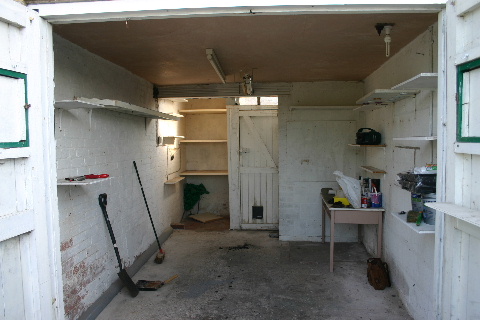
Garage Before
Before

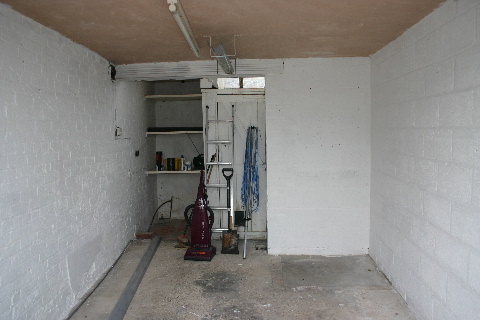
Garage After
After, 5 hours, one tub of white masonary paint, and one swollen ankle! Thanks to my partner for doing most of the expert painting.

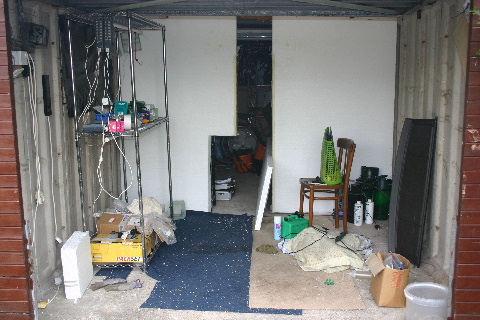
Okay, so it’s not a room, but this is where the new fish house will co-locate to over the next few weeks.

Poor Pleco, well actually it’s a Gibbiceps

Friday, June 30th, 2006

About 2 years ago I acquired a Glyptoperichthys gibbiceps or “Sailfin Pleco” from a local tropical fish shop in York which needed some tender loving care, it was really poorly; sunken eyes, and a grey/white covering over its fins. This didn’t appear to be fungus, but the fish was clearly not deporting well, with clamped and torn fins. This was the picture of the fish.

Glyptoperichthys Gibbiceps

I’ve been waiting 2 years for it’s sailfin to grow back, and it had almost grown back, I was going to take some pictures and produce a “before” and “after” shot for the blog, when the same fish was struck down by a sudden bacterial infection “fin rot”, which started to eat away at all it’s fins, it only affected this catfish in my display tank, so it was immediately moved to a quarantine tank in the fish house, and dosed with Melafix, and large quantities of cucumber for 7 days, and I happy to report, it’s fins are recovering well.

Andy’s Water Treatment Works

Friday, May 26th, 2006

All the waters used in the fish house aquariums are passed through an “Heavy Metal-Axe” (HMA) filter, stored in 100 litres containers, heated to 28 degrees C, aerated beforeadding to any aquarium as part of the partial water change or top up procedure. The main difference between an HMA and RO filter is that the HMA filter will not alter the pH or Total Dissolved Hardness of the input water. It will how ever remove Chlorine, Chloramines, Lead, Copper etc.

I use a three stage HMA filter

  • the first stage uses a 5 micron poly-spun polypropylene sediment filter for the removal of dirt and dust – this is used to protect the second stage filter.
  • the second stage uses a coconut carbon (CCB) filter, this is made from coconut shell, not coal. It is rated at 3,500 UK gallons or 6 months use. This removes chlorine and organics, ensuring that the water is chemical free.
  • the second stage used a CBR2-10 filter. The CBR2-10 filter performs many functions, CBR2-10 filter cartridges are manufactured using a patented process and combine powdered activated carbon with a specially designed media for lead reduction. In addition to lead reduction, the unique formation of the carbon block enables it to reduce Cryptosporidium and Giardia cysts and fine sediment particles down to 0.5 microns. The CBR2-10 also reduces levels of chlorine, and certain VOC’s than granular activated carbon cartridges.

Today, I received my replacement filter cartridges from RO-MAN They suggested changing the CBR2-10 filter cartridge for a Chlorplus-10, which is more effective at removing Chroline and Chloromines from the water than the CBR2-10 filter cartridge previously used. (It’s the green filter on the far right in the picture)

HMA Filter 1
Sediment, Carbon, CBR2-10 used filter cartridges.

Chlorine and Chloramines are used for treating drinking water. Unfortunately, Chloramines are more harmful to freshwater and saltwater fish than Chlorine. And unlike Chlorine, Chloramines will NOT evaporate if you let the water stand.

HMA Filler 2
The new Chlorplus-10 filter cartridge, is the blue filter on the far right in the picture, third stage).

The HMA filter saves me having to treat the water with third party chemicals, which are costly. I also have an Reverse Osmosis filter, but this rarely gets used, because of the high levels of waste water produced. (I’m on a water meter!).

I never like changing the 10″ filter cartridges in this HMA filter, because it takes me a while afterwards to stop the leaks, I have to keep tighting up the 10″ filter cases with the spanner, I think I need new O ring seals!

A friend once said, I needed a new grommit fitting, becuse it was a bit slack!
A Fish House Could Seriously Damage your Health!

Monday, May 22nd, 2006

A few weeks ago whilst carrying out regular daily maintenance in the fish house, I heard a “crackling sound”, at first this sounded like running water, I then smelt burning and noticed thick smoke from the terminal (chocolate) block in the following photograph. I quickly shutdown all electricity in the fish house. To investigate the problem further.

Melted Terminal Block

This 15Amp terminal block was used to connect a 500Watt (approx 2-3Amp) heater to an external thermostat. As you can see from the photograph, it’s been completely destroyed, melted and fused.

On further investigation I found that the solder used to “tin” the wires had degraded, causing a gap between the electrical contacts in the terminal block and wire. This gap caused an electrical arc, hence the crackling sound, the heat caused by this electrical arc was responsible for melting the terminal block. This heater is thermotstatically controlled, so the heater is only on for very short periods.

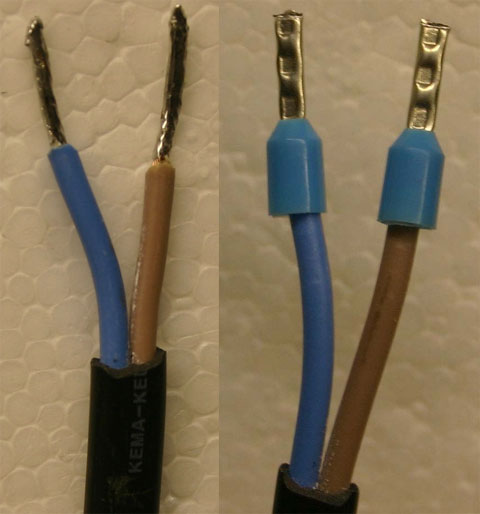
I understand that the practice of “tinning wires” in electrical appliances is no longer performed for this very reason, solder breaks down with age, exposure to air (oxidation) and can cause fires. Wires in electrical appliances are now terminated using bootlace ferules.

Tinned and Boot Ferrules
Tinned copper wires and wires terminated with insulated bootlace ferrules.

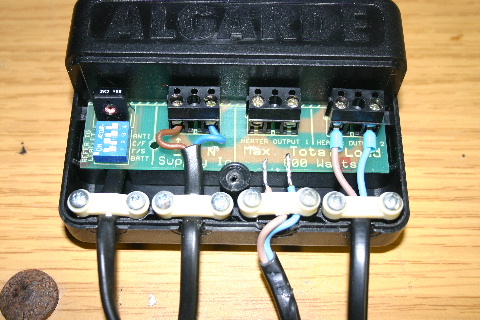
I’ve now started to remove all tinned wires using solder and replace with insulated bootlace ferrules. in the fish house.

Algarde Digiterm with Bootlace ferrules
insulated bootlace ferrules. in use, when connecting heaters to an Algarde DigiTherm external thermostat.

WANTED: Zebra Danios!

Thursday, May 11th, 2006

I’ve only got a few Zebra Danios left, I don’t know where they’ve also disappeared, 12 months ago, I had 30+, in tanks throught the fish house.

Time to purchase more Zebra Danios, as they are handy fish to have around to mature tanks and filters.