I’ve just received an email from DragonFli, my Bumblebees will be delivered next week, I hope the rain stops…

I’ve just received an email from DragonFli, my Bumblebees will be delivered next week, I hope the rain stops…

Bumble Bee Hive - Beepol Villa
This is my Bumblebee Hive – Beepol Villa, Lindsey purchased this for my birthday last year. It’s low maintenance and requires less management (or no management) compared to Honey Bees, it does not provide any honey, but the Bumble bees are excellent pollinators.
The hive is currently empty, and I’m waiting for the delivery of the bumble bees in May! The bumble bees are – Bombus terrestris audax, or the Buff-Tailed Bumblebee.

This could be my closet to keeping bees this year until my health improves. At present I find it difficult carrying bee hives around, so my strength needs to improve. (that’s unless a swarm of honey bees arrive, and then they need managing!)
and it’s not honey….it takes 7kg of honey to produce 1kg of bees wax! Bees wax burns clean with no soot, so that’s why it was favored in Churches and Monasteries, because it does not stain the ceilings! and many say that’s why Monks kept bees! Wax candles are usually made from paraffin!
You can see Sheldon’s support of beeswax candles here:-
As the season, winds down, I’ve started to tidy up and render this years bees wax down for wax exchange. This is from bees wax, I’ve been collecting all year, after inspections, e.g. removed from hives, queen excluders, and other bits of brace comb. Later in the year, I’ll take this wax and exchange it for foundation at Thorne. Foundation is the starter strips we use for bees to use as a template to draw out their comb. Thorne just add this and blend this with their other sources to create the foundation, so no waste, and completely recycled!
Here are some fantastic pictures of the process at Thorne, when I was lucky enough to visit, and have a tour around the factory by Gill Smith (Director and Owner of Thorne), in their Centenary year (2013).


Don’t forget Thorne Rand Open and Sale Day – Saturday 17th October, 10am.
Last Saturday, I did my first honey stall, at a Local Produce Market at the local village hall, to support the local community. Lets just say it was a great success, and I will be ordering my new honey extractor in due course, with the proceeds! I also sold eggs, and plants from the Allotments.

Honey Stall at Yapham Village Hall

Honey Stall at Yapham Village Hall
Despite the slow start to spring, and the cold high winds we have experienced this spring, and lack of bees flying, I was surprised by the number of honey boxes or ‘honey supers’, I collected at the weekend for extraction. I’ve still go to go back to remove 4 honey supers, that the bees are not wanting to give up easily!!!
here’s a 1 minute video, of the extracted filtered honey, flowing into rectangular honey buckets to settle, before processing (creaming!) or jarring. None of the pollen is removed from my honey, only the wax bits, and bee parts. The water content of the honey in the comb and extracted was 16.5%, tested with my calibrated refractometer.
Selling Honey in the UK, is subject to the The Honey (England) Regulations 2003, an easier version is here The British Beekeepers Association Selling Honey Complying with the Law. Yes there is a Honey Law, and monitored by the Honey Police!
and it states “The water content of the honey must be not more than 20%.The higher the water content the more likely the honey is to ferment.”
So that’s what work goes into a jar of local honey from a British Beekeeper, spare a thought for that the next time, you pick-up a jar of “honey-syrup” from a supermarket! If you have never tasted honey from a local British Beekeeper, I’m afraid you have never tasted real honey.
The analogy I like to use is the difference, between a 21 years old single Scottish malt whiskey and a blended whiskey! The malt whiskey is the local honey, and the blended whiskey is the honey syrup from the supermarket, in this comparison.
So support British Beekeepers, and purchase a jar from your local Beek today!

6 'honey-supers' on my bee barrow!

Andy's Hives

Andy's Hives
Now that I have my new Catering Certificate, see this blog post, I’m scaling up the Honey Selling activities…first I purchased a ‘A Pavement board”, to replace my smaller Local Honey sign, and Lindsey kindly did the artwork. The artwork is Copyright (c) Andysworld! (well Lindseyworld!) 2015. So be warned anyone that downloads it, and uses it!

Meltonby Honey Sold Here

Meltonby Honey Sold Here

Meltonby Honey Sold Here

Meltonby Honey Sold Here
Online Ordering coming soon….to a website near you!
I spent three hours this weekend, obtaining a new Certificate.
I now have a Level 2 Award in Food Safety in Catering – Safe Food Handling.
This is my certificate

Level 2 Award in Food Safety in Catering - Safe Food Handling
This maybe a requirement in the future, for the preparation and selling jars of honey, but also now beneficial to have if you deal with food preparation and supply, as a food handler for human consumption.

Snow in the "Shire"!
Second time this year, that it’s snowed. so went down to the apiary, to check on the bees, and took some photos in the glorious sunshine.

Andy's Apiary
The colonies were treated by vaporising with oxalic acid crystals, one week ago, to reduce the levels of phoretic varroa destructor mites, which at this time of year are actually living on the honey bees (Apis mellifera), because my colonies are broodless at present.
The varroa destructor mite was introduced into the UK, in 1992, honey bees (Apis mellifera) have no natural defence to it, and we need to check regularly, as part of our integrated pest management, to ensure the levels are kept low, it cannot be completely eradicated (yet!), over populations of varroa destructor, can lead to colony collapse, it’s also a vector for disease and viruses in honey bees (Apis mellifera). Varroa destructor reproduce by female mite enters the brood cell, with bee larva, just before the cell is capped, and lays her eggs on the bee larva, when the cell is uncapped, out come the young mites. So, no brood, no larva, all the mites on on the bees, so an easy target to treat, hence why we treat in broodless periods, between November – February.
How do we know, they have mites, we use a sticky inspection board, inserted into the bottom of the hive, the mites drop off the bees, and stick on the board, and then we count them! (yes they can easily be seen with the naked eye!).

sticky inspection board to count varroa destructor mites, brownish spot = mite !

a close up of some varroa destructor mites
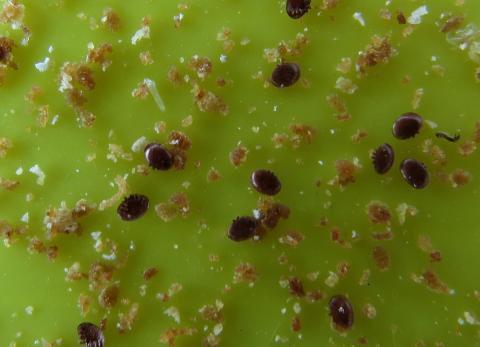
close up varroa destructor mites, you can see their legs or mouth parts
and I added 2.5kg of ambrosia fondant to each hive. (An insurance policy, to prevent them starving – to help feed them during the winter period), and they are securely lashed down, using hive straps.
.


I’ve been away from the bees, they’ve now all been fed, and now wrapped up for the winter. We will see what happens this winter. A few chores left to do, before the frosts, mouse guards to go on hives, external insulation on some of the hives, and finally this year treatment, nearer Christmas Day, a trickle of oxalic acid, to knock down the remainder of varroa mites.
The final honey from this Spring harvest has now been creamed and jarred, to create a creamed or soft set honey.

New jars and corkscrew bit for creaming honey

Jarring the Honey
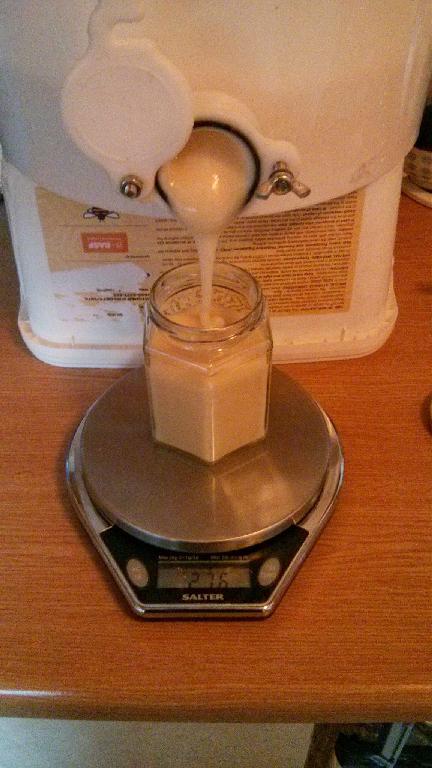
Jarring the honey, each jar is at least 340 grams

final jars waiting to set (yes, that's a hive outside the window!)

All complete and jarred!
So, if you are in the “honey club”, there could be a jar, in the mail to you shortly!
hey, another Bee related post, board with Bees yet! A very busy weekend, with the bees….and I’m very tired!

"wild" comb made from pure beeswax
A week has past since, I’ve moved all the hives to their new secret apiary location, from my two apiaries, they have been now united down from ten to six colonies (hives). All the honey has now been removed and extracted, and the wet supers have been give back to the bees, to help them top their winter stores. (the super/shallow is the smaller box on the bottom of the brood box on top!).

Andysworld! Secret Apiary
The third hive from the right, was a small cast swarm from the University of Hull, which I transferred from a nucleus (6 frame box) to a national hive yesterday (11 frames), and I’ve started to feed for winter.
Today, I treated with MAQS, to minimize the Varroa destructor mite, and ensure the colony is at it’s strongest going into the winter, as part of my integrated pest management (IPM). The Varroa destructor mite, arrived in the UK in 1992, so since then we’ve had to treat against Varroa destructor mite.
So, I’ve got a week off, before I go back to the bees, and start feeding, so time to clean up, inventory the equipment, and start putting back in the “bee shed”.
(although need to check on small colony this week, to check they are taking feed down!)
if you look carefully, you may notice, honey leaking all over the floor, so I had to stop filming….to mop up!



![[Valid RSS]](http://andysworld.org.uk/images/valid-rss.png "Validate my RSS feed")