Posts Tagged ‘aquablog’

The King of All Catfish

Sunday, May 6th, 2007

The Royal Tiger Shovelnose catfish Merodontotus tigrinus or Brachyplatystoma tigrinum has got to be the king of all Tropical catfish.

This fine specimen is owned by a fellow fishkeeper, unfortunately not by me. I’ve always wanted one!

Merodontotus tigrinus1
12 inch young baby! The Royal Shovel Nose catfish Merodontotus tigrinus or Brachyplatystoma tigrinum

Merodontotus tigrinus2
I’m told he eats anything, but he’s feed on white bait,larger prawns,sliced trout,bloodworm and river shrimp

Merodontotus tigrinus3

UPDATE Sold to another fishkeeper for 350 GBP UK pounds.

Ammonia Alert by Seachem

Saturday, April 28th, 2007

This is an interesting “Ammonia Testing Kit”, it’s called the Ammonia Alert by Seachem. Designed to stay permanently in the water, and the centre indicator changes colour when ammonia levels rise. This is a similiar concept to the Carbon Monoxide detectors which change colour. Changes from yellow (safe) to blue (toxic). It’s designed to last at least 12 months. I purchased this device just under 10 GBP UK Pounds, which is about double what an ammonia testing kit will cost you. Expensive to add one of these to all my tanks! But handy in critical tanks, holding expensive breeding pairs!

Ammonia Alert
I purchase this fish gadget on my travels, I have seen these advertised, as I was contacted by someone trying to sell me this device and I also believe there is a similiar device called the ph Alert.

Nannacara adoketa pictures

Thursday, April 12th, 2007

The Nannacara adoketa are settling in very well, feeding on Tetra Prima, Bloodworm and Diskusin, I’ve not moved them yet from their quarantine tanks. I’ll do this over the next couple of weeks, and will remove the possible pair to a setup, with sandy bottom and old leaves.

Nannacara adoketa3
Possibly Female?

Nannacara adoketa4
Not happy!

Nannacara adoketa5
Younger Nannacara adoketa at the bottom.

Nannacara adoketa6
Possibly Male?

Male Ancistrus

Thursday, April 12th, 2007

If you’ve come via a bookmark or RSS Newsreader “thru’ the backdoor”, you will not have noticed that I’ve changed the image on the Home Page.

It’s given me an opportunity to try out a new digital camera, the “boss” doesn’t read the blog, so she’ll never know, unless you tell her, and I’ll know!

I’ve still got a Digital SLR, which gives great results, but a decent Canon macro lens and flash is very expensive for such a camera, and you can get good macro fucntions in smaller compact Digital Cameras, you can also get closer to the glass with a compact Digital Cameras – this one was a bargain!

So here’s the first picture I took with the new camera, which is also featured on the home page, if you missed it, here it is again.

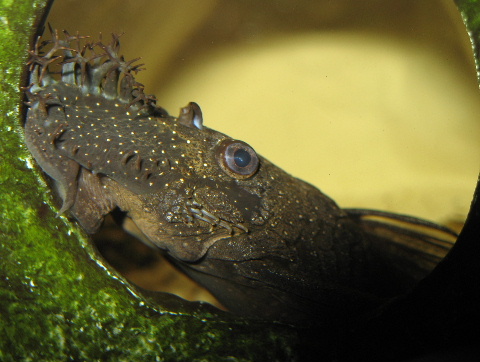
Male Ancistrus
Male Ancistrus sp. Bristlenose catfish to most of us fishkeepers, this one is rather special because it doesn’t have the usual colouration as most common, it is almost black with white spots, and it will not breed with any of the common females!

A very special fish – Nannacara adoketa

Friday, March 30th, 2007

I saw these fanastic, stunning, excellent South American Dwarf Cichlids two weeks ago in a local tropical fish shop in York. Unfortunately, I didn’t have the quarantine space to purchase these fish at the time, and was tempted to purchase them, and ask the shop to keep them a few weeks for me. (All fish into the fish house is quarantined, before moving to different holding/breeding/display tanks)

I didn’t purchase them two weeks ago, and I didn’t post a blog entry either, just in case any other readers snapped them up! (crafty eh!). I’ve only ever seen Nannacara anomala, which I had a pair of many years ago, and successfully bred – another lovely South American Dwarf Cichlid, until 12 months ago, when a local fishkeeper, which specialises in Rare South American Cichlids, show me he/she had managed to breed successfully Nannacara adoketa – but he/she wasn’t selling any young, despite how much money I offered! It is possible that these are the young fish sold to a local shop, because I know he/she visits the same shop.

But I did purchase them today. Five Nannacara adoketa in total, three large fish, and two smaller fish. (Well it was payday!)

Nannacara adoketa1
Four Nannacara adoketa photographed from above, in Fintro.

Nannacara adoketa2
Single Nannacara adoketa, poor picture, try and get some better pictures.

I’ll quarantine the fish, feed them up for a few months, and later get a breeding tank ready.

Corydoras julii or Corydoras sterbai?

Friday, March 23rd, 2007

I visited a local Pet Shop in York on Tuesday, that sells a few “bread and butter” tropical fish, looking for Algarde right-angled airline elbows to finish off my centralised air reservoir. Tuesday was the day, that they had just received their new stock of tropical fish for the week, the fish were not currently for sale, because they wait for 24 hours before selling any fish (good to see!). After looking around the tanks, I noticed two large Corys in one tank and I was 99 percent sure, I knew what they were, so I asked the Pet Shop Owner, how much they were, without trying to readily indentify them, (so he could look them up on his invoice!). He told me they were labelled and pointed to a label stating “Corydoras julii 4.25 GBP”. I immediately paid the man, and said I would collect in Wednesday, unfortunately, I was unable to collect until this evening, and I did think, that they might had sold them to someone else, or identified them correctly.

On returning this evening they were still there, quickly netted and handed over to me, but he did say I don’t think there julii’s, and then told me it would be the suppliers loss, because if the supplier doesn’t have the number of Julii’s he asks for, they just drop any other Cory in at the same price! I feel better now! Pet Shop doesn’t lose any money, just the distributor!

Anyway it was a chance to try out the Fintro…

Here’s the pictures..What do you think Corydoras julii or Corydoras sterbai?

Fintro in Use
Introduced using the Fintro

Corydoras sterbai1
Corydoras julii or Corydoras sterbai?

Corydoras sterbai2
Corydoras julii or Corydoras sterbai?

The Fintro by Maidenhead Aquatics

Friday, March 23rd, 2007

The Fintro – Fish Acclimatisation Unit or Fish Introduction Unit call it what you like, I’ve been trying to make one of these for years, using plastic yoghurt cartons, plastic fruit boxes, the best method I found was to use Ferrero Rocher plastic boxes, with holes drilled in the bottom, the only problem, I could never get the water fill/flow rate correct, or the stability of the plastic box in the water.

Now these problems, have been solved with the The Fintro by Maidenhead Aquatics. I know this device has just been reviewed in the March 2007 Issue of PracticalFishkeeping Magazine, but I was keen to purchase a two units, and test it for myself. I purchase many fish for the fish house (too many sometimes!), and the older method of just floating the tropical fish in the bag from the tropical fish shop fvor 30 minutes has long been proved in-correct. I usually introduce fish into my quarantine tanks, by floating the bag to equalize temperatures, but I also remove water from the bag, and throw away, and slowly over a period of 30-45 minutes, replace the water in the bag with tank water. This lessens the stress on the fish, by gradually introducing the fish to your aquariums water chemistry, rather than causing toxic shock due to vast pH changes.

  • Float the Fintro in your aquarium.
  • Transfer the fish from bag to Fintro, making sure the fish are in the bottom chamber, and there is at least 1cm of water in the upper chamber. (make sure this is over the tank, because although there is a one-way valve,if you fill the Fintro, not over a tank, water will go on the floor!)
  • The Fintro has a valve which permits a very slow trickle of water to gradually fill it, giving time for your new fish to adjust to the aquarium water conditions.
  • After approximately 45 minutes the Fintro will be completely full and sink to the bottom of the tank, releasing the fish.

Fintro
The Fintro by Maidenhead Aquatics

Python Syphon Drain Adaptor

Thursday, March 22nd, 2007

My fish house already has a 40mm/1.5 inch ABS waste pipe to drain so I can syphon water direct from tanks to a drain outside the fish house, without using buckets or a house pipe. After I purchased the Python Syphon which connects to a standard tap, there needs to be a drain immediately underneath the tap to catch the waste water, most people probably connect to a tap above a sink, or an outside tap. I could have connected it to an outside tap, but neither of my outside taps, have a drain underneath, and I would have to go in and out fo the fish house, to control draining and filling the tanks.

Here’s a simple solution. 5 inches of 30mm ABS waste pipe, 30mm-40mm reducer, 30-50mm reducer, 3 inches of 50mm ABS waste pipe, cut to shape.

Python Drain
Python Syphon drain adaptor

The Python Syphon

Sunday, March 18th, 2007

Let me introduce you to the The Python Syphon. It’s a clever device that connects to your household or outside tap, a 25 foot length of clear UV stabilized, non-porous tubing connects to a fast disconnection snap device, which connects to a conventional 10 inch gravel tubes. Extended length gravel tubes are available for deeper tanks. (I’ve also got a 30 inches one as well!), but the largest is a massive 72 inches, handy for those acryllic hexagonal tanks. There is also an on/off tap which allows you to stop syhphoning or filling up with water.

Python Syphon
This is the brains of the Python Syphon. This is connected to the tap, the tap is turned-on fully, and the Faucet Pump as it is called, has a oulet on the end which is pulled down into the “Drain” position, this has the effect of water passing through the device causing a venturi action.

Venturi ActionThe vacuum created by manipulating the speed of a stream of water. The incoming water stream is restricted by a nozzle, while the speed of the outgoing water is decreased by the inverted funnel shape at the bottom of the venturi. The result is a vacuum in the middle, where the waste-water from the tank is sucked into the water stream.

This venturi action is a well known principle used in filters, to bleed air into tanks e.g. Eheim Diffusors use the same principle to suck air into tanks to aertate the returned water.

To fill a tank, the outlet nozzle is pushed up into the Fill postion, water is then diverted up the syphon tube into the tank.

The only issues, I’ve had is in my fish house, I have a internal water supply, but the drain I use for syphoning water away, uses conventional 40mm waste pipe, near each tank for ease. I didn’t want to connect to an external tape outside the fish house, because when working in the fish house, I don’t want to be opening and closing the door, and going in and out, to turn on and off the tape etc

I have finally “designed” and “implemented” “an adaptor” to allow me to use my Python Syphon with ease in the fish house.

If you are still filling and emptying tanks with buckets and a conventional syphon tubes, STOP and purchase The Python Syphon today. One of the Best Inventions Ever for the Aquatic Market.

The correct name is “Clean and Fill No Spill Aquarium Maintenance System” The original and patented

If you’ve got a few minutes, click the above links to view and read the Patents on the No Spill system and if you dig deep enough into the Patent Archives, you’ll quickly see, that Python, didn’t originally design this! A Patent was filed at the US Patents office in 1931 for a similiar device called the Filling and Draining device. Later syphons, were associated with aquariums in the 1950s.

Interesting stuff …

Mission to Leeds

Friday, March 9th, 2007

I was hoping to go to Leeds this evening to collect a pair of Yellow Longfin Quad CrownTail Betta Splendens but I’ve just had a text message from the breeder that has informed me that the male has died! So it doesn’t look as if I’m going now!

The breeder came home to find his landlord had moved tables and shelves whilst fixing the central heating system. Having done this, it knocked all the cards away from inbetween the containers and left all the males able to see each other!

Male Yellow Crowntail
Male Yellow Longfin Quad CrownTail Betta Splendens, I was hoping to collect!