Posts Tagged ‘honey bees’

Bee Hives in the Snow Feb 2015

Tuesday, February 3rd, 2015
Snow in the "Shire"!

Snow in the "Shire"!

Second time this year, that it’s snowed. so went down to the apiary, to check on the bees, and took some photos in the glorious sunshine.

beehives-in-feb-2015-1

Andy's Apiary

The colonies were treated by vaporising with oxalic acid crystals, one week ago, to reduce the levels of phoretic varroa destructor mites, which at this time of year are actually living on the honey bees (Apis mellifera), because my colonies are broodless at present.

The varroa destructor mite was introduced into the UK, in 1992, honey bees (Apis mellifera) have no natural defence to it, and we need to check regularly, as part of our integrated pest management, to ensure the levels are kept low, it cannot be completely eradicated (yet!), over populations of varroa destructor, can lead to colony collapse, it’s also a vector for disease and viruses in  honey bees (Apis mellifera). Varroa destructor reproduce by female mite enters the brood cell, with bee larva, just before the cell is capped, and lays her eggs on the bee larva, when the cell is uncapped, out come the young mites. So, no brood, no larva, all the mites on on the bees, so an easy target to treat, hence why we treat in broodless periods, between November – February.

How do we know, they have mites, we use a sticky inspection board, inserted into the bottom of the hive, the mites drop off the bees, and stick on the board, and then we count them! (yes they can easily be seen with the naked eye!).

sticky inspection board to count varroa destructor mites

sticky inspection board to count varroa destructor mites, brownish spot = mite !

a close up of some varroa destructor mites
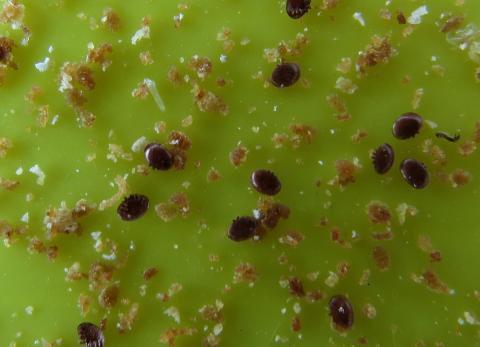
a close up of some varroa destructor mites

close up varroa destructor mites, you can see their legs or mouth parts

close up varroa destructor mites, you can see their legs or mouth parts

and I added 2.5kg of ambrosia fondant to each hive. (An insurance policy, to prevent them starving – to help feed them during the winter period), and they are securely lashed down, using hive straps.

.

Andysworld! Secret Apiary

Sunday, August 31st, 2014

hey, another Bee related post, board with Bees yet! A very busy weekend, with the bees….and I’m very tired!

"wild" comb made from pure beeswax

"wild" comb made from pure beeswax

A week has past since, I’ve moved all the hives to their new secret apiary location, from my two apiaries, they have been now united down from ten to six colonies (hives). All the honey has now been removed and extracted, and the wet supers have been give back to the bees, to help them top their winter stores. (the super/shallow is the smaller box on the bottom of the brood box on top!).

Andysworld! Secret Apiary

Andysworld! Secret Apiary

The third hive from the right, was a small cast swarm from the University of Hull, which I transferred from a nucleus (6 frame box) to a national hive yesterday (11 frames), and I’ve started to feed for winter.

Today, I treated with MAQS, to minimize the Varroa destructor mite, and ensure the colony is at it’s strongest going into the winter, as part of my integrated pest management (IPM). The Varroa destructor mite, arrived in the UK in 1992, so since then we’ve had to treat against Varroa destructor mite.

So, I’ve got a week off, before I go back to the bees, and start feeding, so time to clean up, inventory the equipment, and start putting back in the “bee shed”.

(although need to check on small colony this week, to check they are taking feed down!)

if you look carefully, you may notice, honey leaking all over the floor, so I had to stop filming….to mop up!

Last of the Honey Supers for extraction

Monday, August 25th, 2014

These are the last of the honey supers (shallows or honey boxes), for me to extract that have come off the hives at the allotment. I’ve removed the last two supers, and I have one finally to remove from a hive.

Here are some pictures of capped honey comb, full of honey, before de-capping and extracting.

Each frame holds approx 2kg of honey. Approx 3-5 jars per frame.

honey-super1

Super of capped honey 10 frames on castellations per super

honey-super2

2 full supers ready to un-cap and extract

honey-super3

frame of capped honey, ready for de-capping and extraction, the two dark uncapped cells contain pollen!

honey-super4

close-up of super and capped honey frame

Bees On The Move

Friday, August 22nd, 2014

The winter approaches fast, I’m now taking the honey off the hives, uniting the colonies to make them stronger over the winter, treating them for varroa (mite!), and moving them to their new home…

Hive on the move, on my hive barrow (I built!)

Hive on the move, on my hive barrow (I built!), on the far right of the picture you can just make out, a nucleus box (half a hive), left to catch any stragglers left!

This is the first hive on it’s travels, this hive has given me 75kg of honey this year.

Let the Honey Flow … “GOLD!”

Monday, August 18th, 2014

A busy time of year extracting the honey from the hives, which makes all the effort worth it! But now the hard work comes, starting to prepare the colonies for the winter ahead!

here is a little video, which is best called a “montage”….

I also had a little stealth mission to Leyburn to pick up a honey warming cabinet….

The Black Swan Hotel in Leyburn

The Black Swan Hotel in Leyburn

this honey warming box, is to allow me, to gently warm oil seed rape granulated honey, from the spring, and seed with additional runny honey, so I can cream it, creating a soft set honey.

Honey Warming Cabinet

Honey Warming Cabinet

Extracting the first honey of 2014

Tuesday, May 27th, 2014

Finished with the swarming for the moment, and now onto extracting the first of the honey crop for this year 2014.

Pure Gold – All jarred up!

Monday, September 2nd, 2013

Honey is now all jarred up into 12oz hexagonal jars, waiting for the labels to be printed, and then ready for sale!

honey3

So if you want to purchase any rural rustic cottage wild flower honey from the Yorkshire Wolds, let me know…

Pure Gold

Wednesday, August 28th, 2013

Pure Gold – and I’m not referring to the song Gold by Spandau Ballet. I’m referring to my honey.

honey1

honey2

from a swarm of bees which arrived in June, into one of my hives, I’ve successfully taken off 15kg of honey, which is now filtered, waiting for jarring and labeling.

Here is a quick video of the extracted honey leaving the extractor and being filtered, via coarse and fine mesh filters.

Just some thanks, to Vickie and Andrew (or Andrew and Vickie) for the loan of the extractor, and advice!

Why not visit Vickie’s Website – Wordweaver Stories, and not forgetting Paul @ JLB Electronics.

What’s killing our bees?

Tuesday, August 6th, 2013

Too Hot for My Bee Suit!

Sunday, July 7th, 2013

by joe, it’s hot today, I’m now hiding from the sun today, yesterday, I weeded the allotment for a few hours in the midday sun, and got sunburnt arms!

and today, at 1pm was in a full bee suit, inspecting the bees…must have sunstroke! I ate some honey comb straight out of the hive the other day, it was delicious!

queencell1

not sure but these could be - Supersedure cells?

day35-afterinspection

Supersedure cells – bees have decided to make themselves a new queen, either the queen is damaged, not laying, disappeared, or old.

Update – these could be drone cells, and not Supersedure cells because they are too small and not vertical.